Organism Field Study
star
star
star
star
star
Last updated over 6 years ago
17 Nsɛmmisa
Hyɛ no nsow a efi ɔkyerɛwfo no hɔ:
Students observe an organism and its interactions in their local ecosystem.

1
1
1
1
2
Students observe an organism and its interactions in their local ecosystem.
1: What kinds of organisms do you expect to see in your field study?
2: Where do you expect to find those organisms?
3: What do you think these organisms might be doing?
A. Take a walk outside near your home to observe living things.
B. Choose one organism to study carefully.
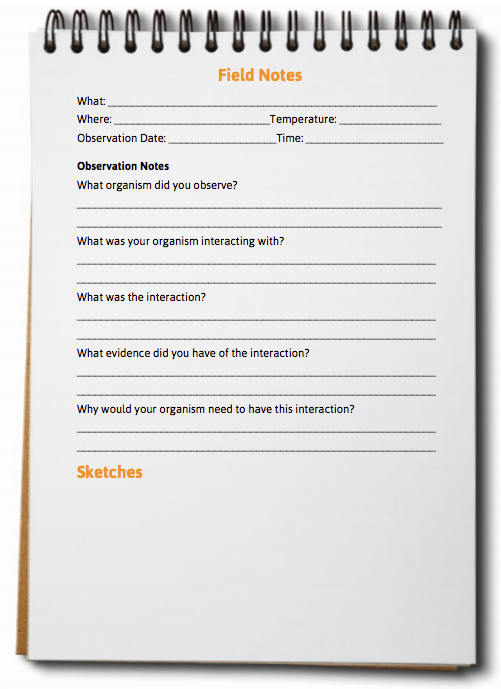
C. Complete the observation information (What, Where, Temperature, Date, and Time) in the “Field Notes” section below.
D. Observe the organism carefully for several minutes. Be careful not to disrupt or damage the habitat.
E. Record your observations in the "Observation Notes" section below.
F. Draw your observations in the "Sketches” section below.
G. Answer the questions in the “Making Sense” section at the bottom.
1. Do you think the interactions you observed the organism engaging in today is something the organism is involved in often? (Yes / No)
2. Explain why you answered Yes or No to question 1.
What organism are you observing?
Where is your organism?
What is the current temperature outside? (If you aren't sure, you can describe the temperature- warm, cold, etc.)
What is today's date?
What is the current time?
What organism did you observe? (If you don't know the name, describe the organism.)
What other organisms or parts of the environment was your organism interacting with?
Describe the interactions your organism was having with other organisms or its surroundings.
What signs did your organism leave behind as evidence of these interactions? (ie. tracks, broken branches, feather, etc.)
What was the purpose of these interactions? (Why do you think your organism had these interactions?)
Draw a sketch of your organism.
Draw a sketch of your organism's interactions.