Chapter Lesson 2 New Ideas

Last updated over 5 years ago
11 questions
Note from the author:
New Ideas from the Renaissance
LESSON 2
New Ideas and Art Renaissance Humanism Guiding Question
How did Renaissance writers rely on the past to develop new ideas?
In the 1300s and 1400s,
European scholars developed a new way of understanding the world. It was called humanism. Humanism was based on ancient Greek and Roman ideas. Humanist scholars thought the individual and human society were important. They wanted to gain knowledge through reason, not just through religious faith. Humanism encouraged people to be active in their cities. It also encouraged them to develop their talents. The humanists made important advances. For example, there were new forms and styles of literature and art because of humanism. Technological inventions in cartography, engineering, and printing also came about. So did new theories in science, mathematics, human anatomy, and astronomy. These advances changed the world.
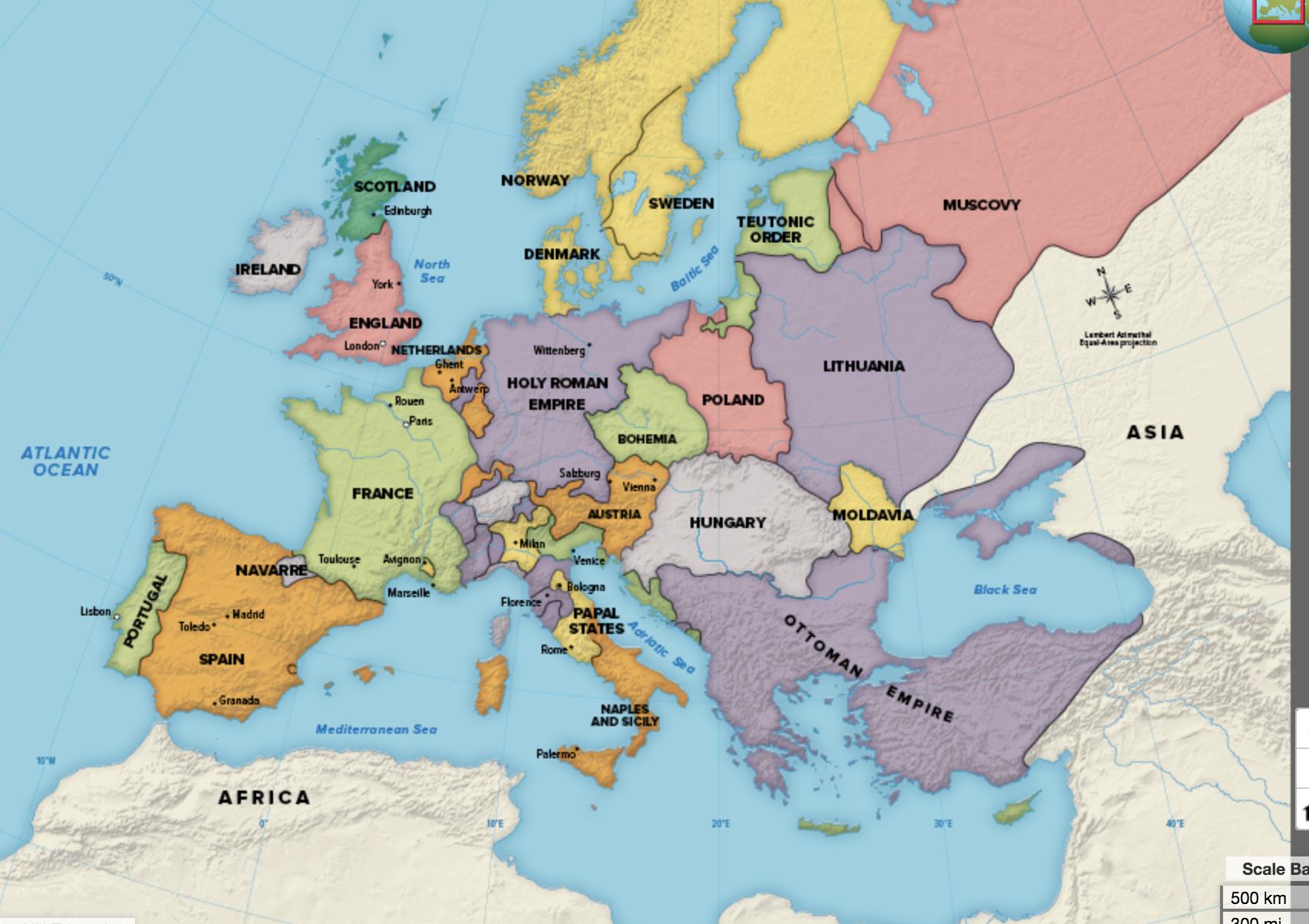
Scientific Revolution scholars and Enlightenment thinkers built on these advances with their own achievements in the centuries that followed. Discovering Ancient Works Italian scholars began to study ancient Roman and Greek works in the 1300s. Western Europeans knew little about these works for most of the Middle Ages. During the Crusades, though, they came into contact with the Middle East. Arab Muslim scholars there and in Spain knew the classic Greek and Roman writings. They passed on what they knew to the Western Europeans.
Byzantine scholars also brought classical works to Italy.
Francesco Petrarch (PEE • trahrk) was a famous humanist scholar. He lived in Italy during the 1300s. Petrarch studied such Roman writers as Cicero (SIH • suh • roh). He also wrote biographies of famous Romans. Petrarch traveled to different monasteries to find old Latin manuscripts. Scholars all over Europe followed his example. In time, new libraries were built to hold the newly found manuscripts. The largest library was at the Vatican. The Vatican was the pope’s home in Rome. Italians also began to value the ancient buildings and statues all around them. Workers removed dirt and rubble from damaged columns and statues across Rome. Artists then eagerly studied the proportion of ancient works. For example, artists compared the length of a statue's arms to its height. They believed this could tell them why the statue looked perfect.

A New Literature
In addition to studying the classics, humanists in Italy and other parts of Europe made important achievements of their own.
One of their contributions was new forms of literature.
During the Renaissance, educated Europeans wrote in the classical Latin used in ancient Rome. However, they also began writing in the vernacular. This is the everyday language people spoke in a region. Vernacular languages included Italian, French, and German. For example, Petrarch used Italian to write sonnets, or short poems. His sonnets expressed his love for a woman who died from the Black Death.
Many more people could read works written in the vernacular than in Latin. When the Christian Bible was published in vernacular languages, people could read it themselves. They no longer had to depend on church officials to read it for them.
This was an important basis for the Reformation. Dante Alighieri (DAHN • tay ah • lee • GYEHR • ee) was a poet from Florence. In the early 1300s, he wrote a work in the vernacular called The Divine Comedy. It tells of a person's journey from hell to heaven. The poem describes the horrible punishments for different sins. It is considered one of the world's greatest poems.
An English writer named Geoffrey Chaucer (CHAW • suhr) also wrote popular vernacular literature. He wrote his famous work The Canterbury (KAN • tuhr • behr • ree) Tales in English. The Canterbury Tales is a collection of stories told by pilgrims on a religious journey to the English town of Canterbury. The entire range of English society is portrayed, or shown. They stories include nobles at the top of society to the poor at the bottom and others in between. The English spoken today comes from the form of English that Chaucer used in his writing.
Gutenberg's Printing Press The printing press helped spread humanist ideas throughout Europe. In the early 1450s, a German printer named Johannes Gutenberg (yoh • HAHN • uhs GOO • tuhn • buhrg) developed a printing press that used movable metal type. The press held individual carved letters. The letters could be arranged to form words. These carved letters could be used again. Until this time, books were written slowly by hand. With the printing press, they could be printed quickly by machine. The Chinese had already invented movable type. However, the Chinese written language had many characters. As a result, the movable type system did not work well for them.
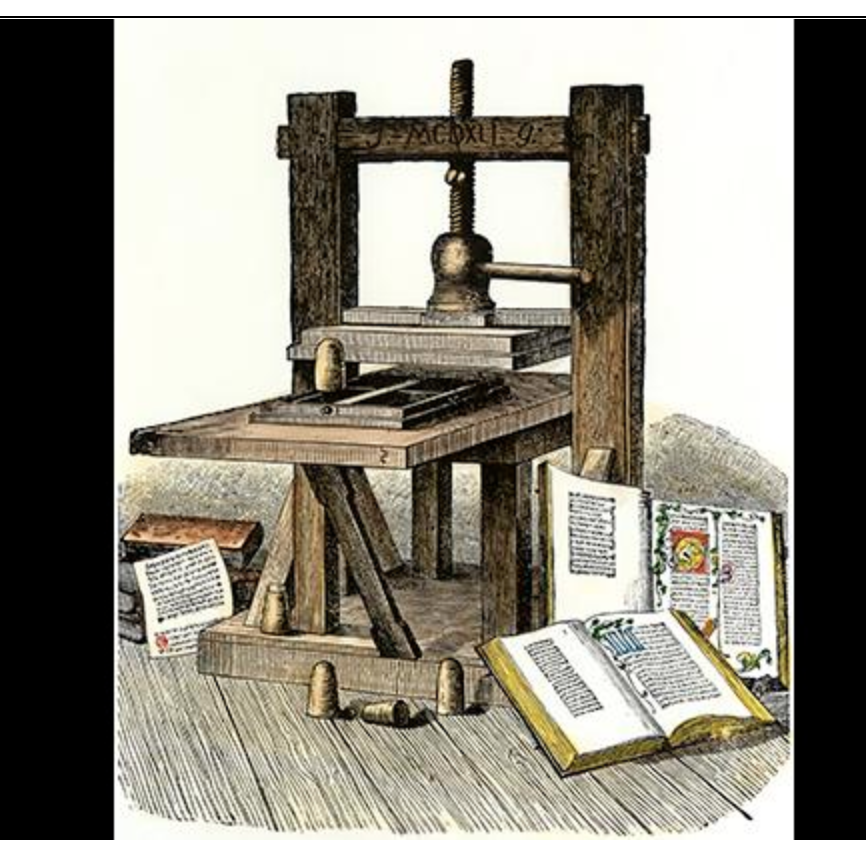

For Europeans, the printing press was a great advance. It was easy to use with linen paper. The paper was another invention from China. Gutenberg's printing press made many more books available to people. It was invented at a time when many townspeople were learning to read and think for themselves. Now scholars could read each other's works and exchange ideas, often in letters. The printing press helped ideas to develop and spread more quickly than ever before in Europe. In 1455, Gutenberg produced the first European printed book on the new press. The book was the Christian Bible. Soon, many books became available in Europe. More books were printed in the first 50 years of printing than were written by hand in the entire history of the world up until 1450. Forty thousand books were published by the year 1500. Half were religious works such as the Christian Bible or prayer books.


What Effect Did Humanism Have on Society?
Humanist scholars were curious about subjects such as biology, medicine, and astronomy. Scholars' study of mathematics helped them in many areas. Leonardo da Vinci (lee • uh • NAHR • doh duh VIHN • chee) was a leading Renaissance scientist. He also was a great artist, inventor, and engineer. Da Vinci cut open dead bodies to learn more about the human body. He studied fossils to understand Earth's early history. Most of what is known about da Vinci comes from his notebooks. He filled their pages with notes and sketches of his scientific and artistic projects. The drawings often pictured parachutes, flying machines, and other mechanical inventions that were far ahead of da Vinci’s time.
Italy's Renaissance Artists
Guiding Question How did Renaissance artists learn to make their art look natural and real?
Renaissance Italy’s wealthy families and church leaders appreciated beautiful buildings and works of art. They hired talented people to construct beautiful buildings. They also hired talented people to fill the buildings with works of art. The pope paid for works of art to decorate the Vatican, his headquarters in Rome. Builders and artists carefully studied ancient Greek and Roman art. They also studied ancient Greek and Roman science and mathematics. These builders and artists also expressed the new humanist ideas. As one artist stated, human beings were "the center and measure of all things.
1

What is humanism? What is it based on?

1

Learning about Humanism- fill in the chart

1

What is the benefit of writing in the vernacular?

1

Name three important Renaissances artists and one of their works and the two techniques

1

How was the Renaissance art different from art of the Middle Ages

1

Connections How did Renaissance use humanist ideas?

What New Styles Did Artists Develop? Renaissance art was very different from medieval art.

Artistic works of the Renaissance tried to show what people really looked like. They also tried to reveal people's feelings. In the early 1300s, an artist from Florence named Giotto (JAH • toh) was the first to show this change. His series of wall paintings showed the life of Francis of Assisi. The paintings used gestures and facial expressions to show people’s emotions. Renaissance painters found new methods to bring life, color, and action to their works. The most important method they used was perspective (puhr • SPEHK • tihv).
Perspective is a way of showing people and things as they appear at different distances. Artists had tried to use perspective in the past. However, Renaissance artists like Leonardo da Vinci perfected it. They gave paintings a realistic, three dimensional look. Renaissance artists studied the human body to learn how to draw it accurately, or correctly. Artists began to experiment with light, color, and shade. They used a technique called chiaroscuro (kee • ahr • uh • SKYUR • oh) to make their paintings more realistic. This technique used light and shadows instead of stiff outlines to separate objects. In Italian, chiaro means "clear or light," and oscuro means "dark." Chiaroscuro created drama and emotion in paintings.
Many Renaissance artists painted on fresh, wet plaster with watercolor paint. They produced a kind of painting called a fresco (FREHS • koh), which means "fresh" in Italian. Frescoes were painted in churches all over Italy. Who Were Leading Renaissance Artists? The period between 1490 and 1520 was the golden age of Italian Renaissance painting.
Three of the most famous artists were Leonardo da Vinci, Michelangelo Buonarroti (MY • kuh • LAN • juh • loh bwah • nah • RAH • tee), and Raphael Sanzio (rah • feye • EHL SAHN • zee • oh). Leonardo da Vinci was born in Florence. He is known for a painting called the Mona Lisa. It is a portrait of a young noblewoman whose smile makes people looking at the painting wonder what she is thinking.
Da Vinci also painted a wall painting of Jesus and his disciples called The Last Supper. He showed emotion through the way the apostles hold their heads and the way they sit in relation to Jesus. “Lionardo [Leonardo] undertook to paint for Francesco del Giocondo a portrait of Mona Lisa his wife, but having spent four years upon it, left it unfinished. This work now belongs to King Francis of France, and whoever wishes to see how art can imitate nature may learn from this head. Mona Lisa being most beautiful, he used, while he was painting her, to have men to sing and play to her and buffoons [clowns] to amuse her, to take away that look of melancholy [sadness] which is so often seen in portraits; and in this of Lionardo's there is a peaceful smile more divine than human.” —from Stories of the Italian Artists by Giorgio Vasari Michelangelo, another great Renaissance artist, began his career as a sculptor in Florence. In 1508, Pope Julius II hired him to work at the Vatican.
There, Michelangelo painted scenes from the Christian Bible on the ceiling of the Sistine Chapel. The paintings remain famous today. A noted Renaissance biographer praised Michelangelo: "The work [Sistine Chapel ceiling] has been, indeed, a light of our art, illuminating the world which had been so many centuries in darkness. Oh, truly happy age, and oh, blessed artists, who at such a fountain can purge [remove] away the dark films from your eyes. Give thanks to Heaven, and imitate Michael Angelo [Michelangelo] in all things." —from Stories of the Italian Artists by Giorgio Vasari Raphael too worked at the Vatican, as did Michelangelo.
Raphael painted many frescoes for the palace of the pope. Perhaps his best-known fresco is the School of Athens. It shows Greek philosophers. People also admired his paintings of Mary, the mother of Jesus. These works were done in bright colors. They showed the Renaissance ideals of grace and beauty. Renaissance women had few roles independent of men. Some women, though, did contribute to the arts. Those who did were either daughters of artists or children of nobles. Artemisia Gentileschi (ahr • teh • MIHZ • ee • uh jehn • tih • LEHS • kee) was the most celebrated female artist. She was one of the first women to paint major historical and religious scenes.

The Northern Renaissance
Guiding Question
How did the Renaissance change as it moved from Italy into northern Europe?
During the late 1400s, the Renaissance spread from Italy to northern Europe. War and trade helped spread humanist ideas. Travel and the printing press also helped spread these ideas. The people of northern Europe eagerly accepted Italian Renaissance style. Then they changed it to suit their own tastes and needs. Northern European Painters The term "Northern Renaissance" refers to the cultural changes in what is today Belgium, the Netherlands, Luxembourg, and Germany.
Northern artists wanted more realism in their works as did the Italian artists. However, they used different methods to achieve it. Northern artists began painting in oils rather than using water-based paints. Oils provided richer colors. They also allowed changes to be made on the painted canvas. Artists often used oils to show small surface details, such as gold trim on a robe. The Flemish painter Jan van Eyck (YAHN van EYEK) was skilled in using oils. One of his best-known paintings is The Arnolfini (ahr • nuhl • FEE • nee) Portrait. It shows a newly married couple standing together in a formal room. Van Eyck showed every fold in their richly colored clothes. He also showed every detail of the ceiling lamp above them.
Germany’s Albrecht Dürer (AHL • brehkt DYUR • uhr) was another important Northern Renaissance artist. His work blended Italian Renaissance methods and medieval German traditions. Dürer was skilled in showing perspective and fine detail. He is best known for his engravings. An engraving is produced from an image carved on metal, wood, or stone. Next, ink is placed on the surface. Then, the image is printed on paper. Dürer's Four Horsemen of the Apocalypse (uh • PAH • kuh • lihpz) is an excellent example of a woodcut. A woodcut is a print made from carved wood.
The Four Horsemen shows four fierce riders who announce the end of the world. England's Theaters The Renaissance reached its height in England in the late 1500s. At the time, England was ruled by Elizabeth I. Renaissance English people enjoyed plays. The first theaters in England were built in about 1580. Their stages stood in the open air. Some wealthy people sat under a roof or covering. Admission was only one or two cents, so even the poor could attend. The poor stood in a large open area. English playwrights, or authors of plays, wrote about people's strengths, weaknesses, and emotions.
William Shakespeare (SHAYK • spihr) was the greatest English playwright of the time. He wrote histories, comedies, and tragedies. Shakespeare drew ideas for his plays from the histories of England and ancient Rome. His plays often included Italian scenes, characters, and plots. Many of his plays were about loyalty, family, friendship, or justice. Hamlet, Macbeth, Romeo and Juliet, and Henry V are just a few of Shakespeare’s famous works.
1

The Renaissance spread from Italy to northern Europe.

1

Artists in northern Europe used water based paints rather than oils paints.

1

Only wealthy people in England could afford to attend plays.

1

William Shakespeare's plays were mostly comedies

1

Identify some of the achievements of the Renaissance artists;
Jan vanEyck
Albrecht Durer
William Shakespeare