Evidence for Climate Change- NASA
star
star
star
star
star
Last updated over 6 years ago
7 Nsɛmmisa
Hyɛ no nsow a efi ɔkyerɛwfo no hɔ:
Students learn to take in data about climate change and assess whether is is from a reliable source
1
1
1
1
1
1
1
Students learn to take in data about climate change and assess whether is is from a reliable source
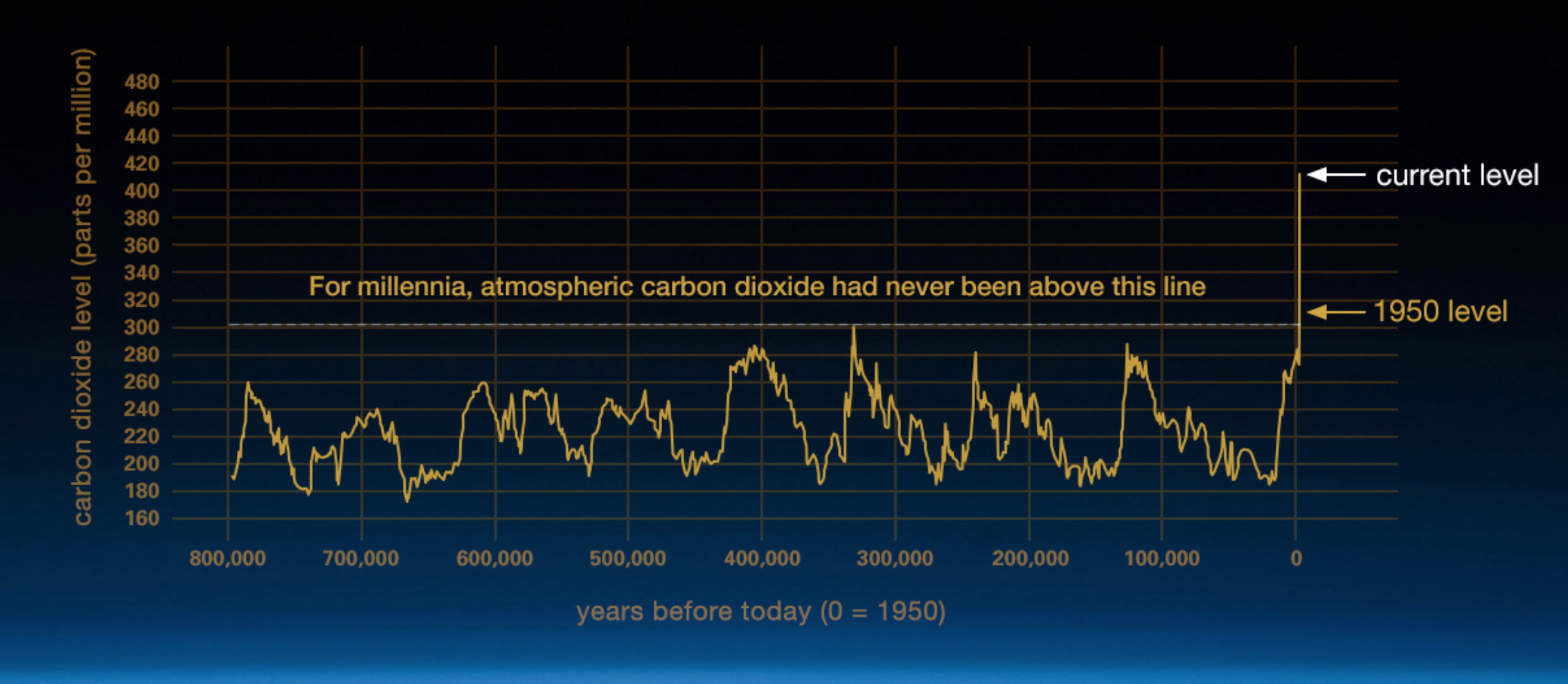
Evidence for Climate Change- "Ice cores drawn from Greenland, Antarctica, and tropical mountain glaciers show that the Earth’s climate responds to changes in greenhouse gas levels. Ancient evidence can also be found in tree rings, ocean sediments, coral reefs, and layers of sedimentary rocks. This ancient, or paleoclimate, evidence reveals that current warming is occurring roughly ten times faster than the average rate of ice-age-recovery warming," (NASA, 2020).
Using context clues from the paragraph above, what does "paleo" in paleoclimate mean?
What trend does the NASA graph above show?
Global Temperature Change- "The planet's average surface temperature has risen about 1.62 degrees Fahrenheit (0.9 degrees Celsius) since the late 19th century, a change driven largely by increased carbon dioxide and other human-made emissions into the atmosphere. Most of the warming occurred in the past 35 years, with the five warmest years on record taking place since 2010. Not only was 2016 the warmest year on record, but eight of the 12 months that make up the year — from January through September, with the exception of June — were the warmest on record for those respective months," (NASA, 2020).
What could be potential consequences of increased global temperature?
Ice Sheets Melting- "The Greenland and Antarctic ice sheets have decreased in mass. Data from NASA's Gravity Recovery and Climate Experiment show Greenland lost an average of 286 billion tons of ice per year between 1993 and 2016, while Antarctica lost about 127 billion tons of ice per year during the same time period. The rate of Antarctica ice mass loss has tripled in the last decade," (NASA, 2020).
Sea Level Rising- "Global sea level rose about 8 inches in the last century. The rate in the last two decades, however, is nearly double that of the last century and is accelerating slightly every year," (NASA, 2020).
Based on the data above about ice melting and sea level increasing, it's fair to infer that melting ice sheets may be a cause of sea level rising.
"Since the beginning of the Industrial Revolution, the acidity of surface ocean waters has increased by about 30 percent.This increase is the result of humans emitting more carbon dioxide into the atmosphere and hence more being absorbed into the oceans. The amount of carbon dioxide absorbed by the upper layer of the oceans is increasing by about 2 billion tons per year," (NASA, 2020).
Based on information above, the surface ocean waters are changing by...
Select all the sea creatures discussed in the video above that are being impacted by increasing ocean acidity
Is the data true?- As described in each prior text/ graph, all the data pulled for this assignment is from NASA. Is NASA a reliable source to collect informaiton about climate change from? Should we believe what NASA says about climate change? Here are some of the sources used by NASA to complile the information used in this assignment:
IPCC Fifth Assessment Report, Summary for PolicymakersB.D. Santer et.al., “A search for human influences on the thermal structure of the atmosphere,” Nature vol 382, 4 July 1996, 39-46Gabriele C. Hegerl, “Detecting Greenhouse-Gas-Induced Climate Change with an Optimal Fingerprint Method,” Journal of Climate, v. 9, October 1996, 2281-2306V. Ramaswamy et.al., “Anthropogenic and Natural Influences in the Evolution of Lower Stratospheric Cooling,” Science 311 (24 February 2006), 1138-1141B.D. Santer et.al., “Contributions of Anthropogenic and Natural Forcing to Recent Tropopause Height Changes,” Science vol. 301 (25 July 2003), 479-483.
https://www.ncdc.noaa.gov/monitoring-references/faq/indicators.phphttp://www.cru.uea.ac.uk/cru/data/temperaturehttp://data.giss.nasa.gov/gistemp
National Snow and Ice Data CenterWorld Glacier Monitoring Service
(NASA, 2020)
Based on the sources used on the NASA website to compile data about climate change...
1. Is NASA a reliable source?
2. Should we believe what NASA says about climate change?
3. Explain why or why not?
(Respond to the prompt in 3 sentences answering each of the 3 questions).