Use the picture below to choose which set of quadrilaterals have both 2 sets of parallel lines AND 2 acute angles
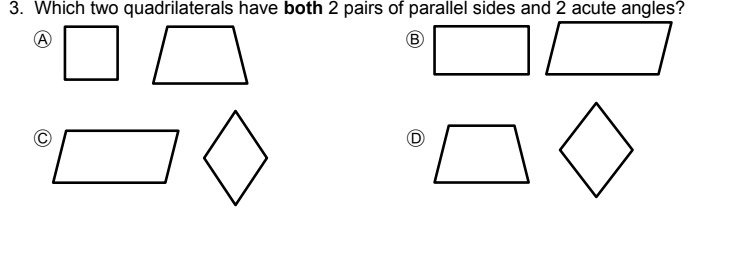
Use the picture below to choose which set of quadrilaterals have both 2 sets of parallel lines AND 2 acute angles
Emma tiled a rectangle and then sketched her work. Fill in the missing information, and multiply to find the area.
Kurt drew a rectangular maze with a length of 3/4 foot and a width of 5/12 foot. What is the area, in square feet, of Kurt’s maze?
Find the area of a rectangle with a length of 1 & 3/4 foot and a width of 1 & 1/2 foot. Solve using the area model.
A rectangular garden is 6 & 1/2 yards long and 5 & 1/4 yards wide. What is the area of the garden?
A rectangular table is 5 & 1/4 feet by 3 & 3/4 feet. What is the area of the table? Show all of your work &/or explain your thinking. (Students who show work & explain have the potential to earn a 4).
Which explanation about geometric figures is correct?
Use the picture below to choose which set of quadrilaterals have both 2 sets of parallel lines AND 2 acute angles
Select all that are true:
Use the picture below:
Remember all parallelograms have 2 pairs of opposite sides that are parallel. Based on that description, which figures are parallelograms? Hint: There are 2
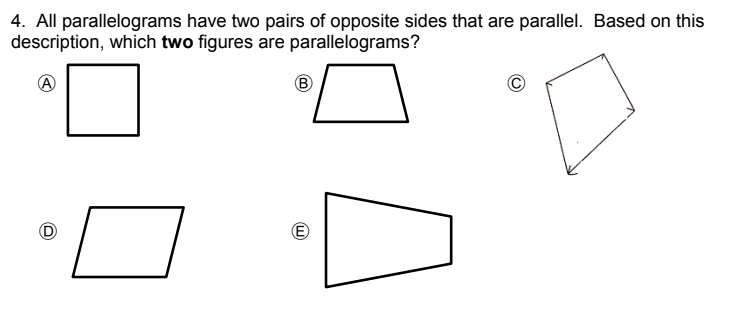
Select all that are true:
Which statement best describes the relationship between squares and rhombuses? Read each statement carefully.
Complete the sentence using the shapes from the word bank. YOU WILL USE EACH SHAPE MORE THAN ONCE.
Which figure is ALWAYS a rectangle
Draw each of the following figures. You must draw >> to show parallel lines and // to show sides that are equal. If there are any right angles, mark the angle with a small square.
If rectangles must have right angles, explain how a rhombus could also be called a rectangle?