Log in
Sign up for FREE
arrow_back
Library
The South Test
By Treva Rogers
star
star
star
star
star
Share
share
Last updated almost 6 years ago
14 questions
Add this activity
1
1
1
1
1
1
1
1
1
1
1
1
1
1
Question 1
1.
What was the largest social group living in the South?
free African-Americans
white yeoman farmers/workers
plantation owners
slaves
Question 2
2.
How did the cotton gin make processing cotton easier?
It made planting cotton easier and more efficient/
Picking cotton became easier and more efficient.
The selling and distribution of cotton became easier.
Seeds were easier to remove.
Question 3
3.
What areas made up the cotton belt?
The states and territories west of the Mississippi.
The southwest territories gained from Mexico.
The south from the atlantic to Texas
The north from New York to Iowa
Question 4
4.
Which of the following was a segment of Southern Society?
slaves
free African-Americans
plantation owners
yeomen
Question 5
5.
How did the Indian Removal Act affect the expansion of slavery?
Removal of Native Americans allowed for cultivation of cotton by settlers.
Northerners wanted an area to keep slavery contained.
Slaves were able to excape to the west with Native Americans.
Native Americans were against slavery.
Question 6
6.
What effects did states' strict codes have on enslaved African Americans' lives?
kept slaves isolated
dehumanized
encouraged family, community and religion
illiterate
Question 7
7.
Slave uprisings led to
increased literacy among free African Americans
strength in slave communities.
stricter slave codes.
increased freedom in slave states.
Question 8
8.
What span of time saw the largest increase in cotton production?
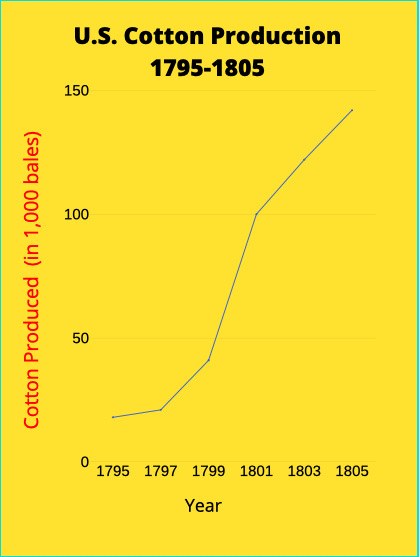
1800-1820
1820-1840
1840-1860
after 1860
Question 9
9.
The main reason for the changes showing in the graph was
a decline in the number of slaves.
the end of the international slave trade.
a swich from food crops to cash crops.
the invention and use of the cotton gin.
Question 10
10.
Which statement accurately describes southern society in the mid-1800's
Very few white southerners owned slaves.
Many African Americans in the South owned land.
Few white southerners owned the land they farmed.
Most white souteherners were small farmers.
Question 11
11.
Free African Americans in the South in the early and mid-1800s
had the same rights and freedoms as white southerners.
had few rights and freedoms.
usually had escaped from slavery.
could travel freely in their home states.
Question 12
12.
The most famous leader of the Underground Railroad was
Frederick Douglass
Harriet Tubman
William Lloyd Garrison
Harriet Beecher Stowe
Question 13
13.
Which of these statements about the education of African Americans in the mid-1800s is not true?
Opportunities for college were rare until black college were rare until black colleges were founded in the 1840s.
African American students often went to separate schools from white students
Educational opportunities generally were greater in the North than in the South.
Southern African Americans benefited from the educational reforms of Horace Mann.
Question 14
14.
The temperance movement, efforts at prison reform and the abolition movement were all elements of
social reforms of the mid-1800s.
the Second Great Awakening
transcendentalism
the women's rights movement