State which of the options below would have more energy.

State which of the options below would have more energy.
State which of the options below would have more energy.
Sodium metal is dropped into water, and creates an explosive reaction. The reaction creates a lot of heat and flame.
Identify if this reaction is an endothermic or exothermic process.
When bread is baked, heat is required for the dough to rise and cook.
Identify whether baking bread is an endothermic or exothermic process.
Gaseous water becomes liquid in the air and forms a cloud.
Identify whether the system of the air is endothermic or exothermic?
Define an exothermic reaction
A cold pack contains a reaction that takes in energy, and Nina puts it on her sore muscles to relieve the injury by absorbing the heat it releases.
Is the system of the muscles exothermic or endothermic?
THIS QUESTION IS ASKING IF THE MUSCLES ARE EXOTHERMIC OR ENDOTHERMIC. IT IS NOT ASKING ABOUT THE COLDPACK
Potassium chloride is dissolved in water in a conical flask. The reaction makes the glass feel cold.
Identify if this reaction is an endothermic or exothermic process.
Water is warmed up to its boiling point, where it starts to create gaseous water vapour.
Identify whether this state change is an endothermic or exothermic process.
The Sun burns far away in space, and plants here on earth use the energy it provides to photosynthesise and fuel themselves.
Identify whether the system of the plants photosynthesizing are endothermic or exothermic?
Questions 10 - 13 are based on diagram 1below:
Diagram 1
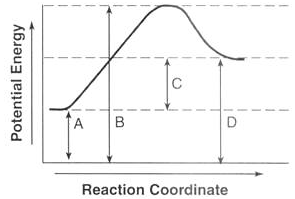
Name part A
Name part B
Name part C
Name part D
The questions below are based diagram2:
Diagram 2
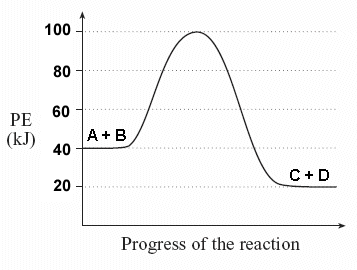
Is the reaction in diagram 2 endothermic or exothermic?
Name the reactants in diagram 2
What is the potential energy of the products in diagram 2? Your answer must have the correct unit.
Calculate the activation energy for diagram 2. Give your answer in the correct unit and show your work.
Calculate the heat of the reaction for diagram 2. Give your answer in the correct unit, with the correct sign and show your work.
Determine the amount of energy stored in the system at the activated complex of diagram 2. Answer in correct unit.
Diagram 3
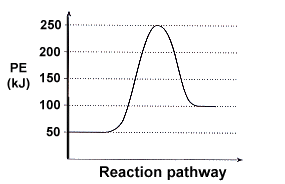
The questions that follow are all based on this diagram
Is the reaction portrayed in diagram 3 endothermic or exothermic?
Give a reason for your answer in 20
Calculate the activation energy for the reaction in diagram 3. Show your work, give your answer in the correct unit.
Calculate the heat of the reaction for diagram 3. Show your work, give the answer with the correct unit and sign
Is the reverse reaction for diagram 3 endothermic or exothermic?
Calculate the activation energy for the reverse reaction. Show your work, give your answer in the correct unit
Determine the energy of the activated complex