How are you hearing me?
star
star
star
star
star
Last updated about 6 years ago
4 Nsɛmmisa
1
C.HS.PHY.ALT.05
1
C.HS.PHY.ALT.05
1
C.HS.PHY.ALT.05
1
C.HS.PHY.ALT.05
Speaking is transferring motion energy in your vocal cords to motion energy of the air. Your vocal cords move quickly back and forth. When they move forward they push the air in your throat forward making a high-pressure front of air. This is quickly followed by your vocal cords moving back creating a space with much less air (or low-pressure front). These tiny, rapid changes of high-low-high-low-high-low pressure fronts traveling out of your mouth toward the phone is called a sound wave. The microphone and processor in your cell phone convert the information in this sound wave into digital information. This digital information is really as simple as a long string of 1’s and 0’s, for example, 110110101001010001101001101001.
The converted sound wave, now an electric signal inside the cell phone is then encoded into a type of light wave invisible to our eyes called radio waves. Radio waves also oscillate between high-low-high-low like sound waves, but also have many important differences from sound waves. One of the most notable differences is that sound needs air or another medium to travel through, but light, being made up of electric and magnetic fields can travel through empty space. (Note also, since light is made up of oscillating electric and magnetic fields it is often referred to as an electromagnetic wave.)
Another important difference is that while sound travels superfast, over 300 m/s in air, light travels super duper fast, near 300,000,000 m/s in air. So it is easy to see why your voice once encoded and broadcasted by your cell phone’s antenna as radio waves can quickly travel to the nearest cell tower, then be rebroadcasted to the closest cell tower to who you are calling, and then be re-rebroadcasted by that cell tower to their cell phone, all in less than a second.
Once this digital signal (encoded in the radio waves) reaches your friend’s cell phone antenna, the digital signal then is converted back into an electrical signal. This electric signal is then processed and sent to the cell phone’s speaker which converts that signal back into a sound wave similar to your voice. This process of hearing someone’s voice from far away is why telephones are called telephones -- that is, tele = “far away”, phone = “sound”, so telephone = hearing someone’s sound (voice) from far away.
When your friend hears these sound waves, it is their ears responding to the tiny, rapid changes in the pressure of the air. Speech is a complex mixture of waves with different frequencies and amplitudes. Each frequency oscillates a different part of their inner ear. The bigger the amplitude of that frequency, the bigger the oscillation of that part of their ear. The bigger oscillation of that part of your inner ear, the bigger nerve signal that part of your ear sends to your brain. The typical high school student’s ear can perceive sound ranging in frequency from 20 to 20,000 Hz.
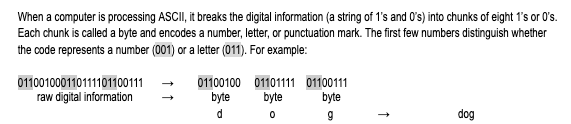
At first, using numbers may sound harsh or ill-equipped to capture the beauty of the human voice or the dazzling motion of a dancer, however, once you find an acceptable means of representing the underlying conditions (information) with numbers we can send, cheaply store and distribute, and later retrieve the information incredibly fast and reliably. The meaning in a text message may need a human brain to appreciate it, but the underlying information of the letters and punctuation marks are represented quite easily with numbers (think A = 1, B = 2, and so on). For historic reasons and issues related to the cost and constraints of technology, we use more complex schemes to digitally encode information. Let us focus on one of the simpler and common methods referred to as ASCII, which stands for the American Standard Code for Information Interchange. ASCII converts each piece of information (think each letter and punctuation mark) into a unique combination of eight 1’s and 0’s. Here is a selection of the ASCII encoding table:
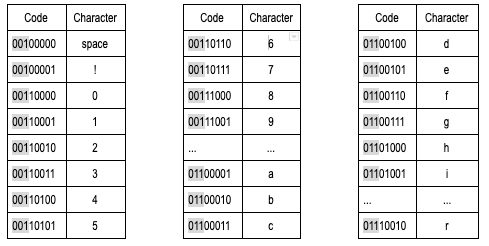
See if you can decode this signal (write your answer in the box).

See if you can decode this signal (write your answer in the box).

Use the image below to show how a senders voice gets to the sender.
How does hardware and software work together to make a computer function?