EBV grade 12 SL Chemistry exam Paper 2

Last updated over 5 years ago
13 questions
EBV CHEM FINAL EXAM MAY 2020 P2 SL [27 marks]
TIME: 1 HR 15 MINUTES
Instructions:
1. You may use your data booklet
2. If a question says "show your working" you will only get the mark for the answer if you show your working.
3. I can see if you copy and paste answers and will give zero for anything copied and pasted
2

3.26 g of iron powder are added to 80.0 cm3 of 0.200 mol dm−3 copper(II) sulfate solution. The following reaction occurs:
Fe (s) + CuSO4 (aq) → FeSO4(aq) + Cu (s)
Determine the limiting reactant showing your working.

2

The reaction in question 1 was carried out in a calorimeter. The maximum temperature rise of the solution was 7.5 °C.
Calculate the enthalpy change, ΔH, of the reaction, in kJ, assuming that all the heat released was absorbed by the solution. Use sections 1 and 2 of the data booklet.

1

State another assumption you made in question 2.

3

Enthalpy changes depend on the number and type of bonds broken and formed.
Hydrogen gas can be formed industrially by the reaction of natural gas with steam.
CH4(g) + H2O(g) → 3H2(g) + CO(g)
Determine the enthalpy change, ΔH, for the reaction, in kJ, using section 11 of the data booklet.
Bond enthalpy for C≡O: 1077 kJ mol−1

1

A student titrated an ethanoic acid solution, CH3COOH (aq), against 50.0 cm3 of 0.995 mol dm–3 sodium hydroxide, NaOH (aq), to determine its concentration.
The temperature of the reaction mixture was measured after each acid addition and plotted against the volume of acid.
Using the graph, estimate the initial temperature of the solution.

2

Use the diagram in question 5 to calculate the concentration of ethanoic acid, CH3COOH, in mol dm–3.

2

Determine the heat change, q, in kJ, for the neutralization reaction between ethanoic acid and sodium hydroxide, shown in the diagram of question 5.
Assume the specific heat capacities of the solutions and their densities are those of water.

4

To determine the enthalpy change of combustion of methanol, CH3OH, 0.230 g of the methanol was combusted (burned up) in a spirit burner. The heat released increased the temperature 50.0 cm3 of water from 24.5 °C to 45.8 °C.
Calculate the enthalpy change of combustion of methanol

3

Methanol can be produced according to the following equation:

This is your target equation.

Calculate the standard enthalpy change of this reaction using the following data:


2


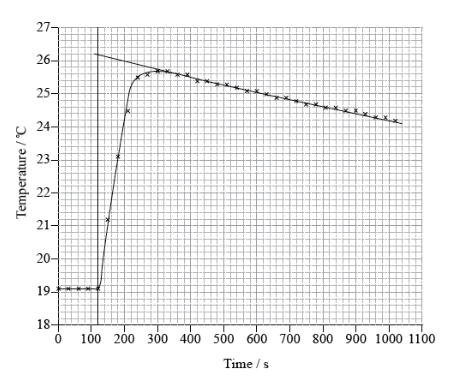
To determine ΔH, a student placed 50.0 g of water in a cup made of expanded polystyrene and used a data logger to measure the temperature. After two minutes she dissolved 3.99 g of anhydrous copper(II) sulfate in the water and continued to record the temperature while continuously stirring. She obtained the following results.

DIAGRAM 1
Calculate the amount, in mol, of anhydrous copper(II) sulfate dissolved in the 50.0 g of water.

1

Use diagram 1 in question 10 to determine what the temperature rise would have been, in °C, if no heat had been lost to the surroundings.

2

Calculate the heat change, in kJ, when the 3.99 g of anhydrous copper(II) sulfate in question 10 is dissolved in the water

2

Determine the value of ΔH for the reaction in question 10 in kJ.mol-1