Log in
Sign up for FREE
arrow_back
Library

Algebra 1 5-7 Complete Lesson: Scatter Plots and Trend Lines

star
star
star
star
star
Last updated over 5 years ago
27 questions
10
N.Q.1
10
S.ID.7
10
S.ID.7
10
N.Q.1
S.ID.6.a
S.ID.6.c
10
F.LE.5
S.ID.6.a
10
S.ID.7
S.ID.9
10
S.ID.7
S.ID.9

20
N.Q.1
S.ID.6.a
S.ID.6.c
10
S.ID.6.a
S.ID.7
10
F.LE.5
S.ID.6.a
10
10
10
10
5
5
5
5
10
10
100
10
S.ID.6.c
10
Question 1
1.

Solve It! The table shows the number of digital albums downloaded per year and the number of CDs sold by manufacturers per year. What relationship exists between the two sets of data?

F.LE.5
10
F.LE.5
S.ID.7
Question 3
3.

Problem 1 Got It? Make a scatter plot of the data in the table.
Be sure to include relevant graph detail: label axes, indicate units and scale on both axes, and use arrows to represent end behavior, as appropriate.

Question 4
4.

Question 6
6.

Problem 2 Got It? Make a scatter plot of the data in the table. Draw a trend line and write its equation.

Be sure to include relevant graph detail: label axes, indicate units and scale on both axes, and use arrows to represent end behavior, as appropriate.

Question 7
7.

10
Question 8
8.

Problem 3 Got It? Use the equation of the line of best fit from Problem 3 to predict the cost of attending in the 2016-2017 academic year. You may use the embedded Desmos 4-function calculator above.

Include a dollar sign and round your answer to the nearest whole dollar.

S.ID.6.a
10
F.LE.5
S.ID.6.a
S.ID.7
Question 10
10.

Problem 4 Got It? In the following situation, is there likely to be a correlation? If so, does the correlation reflect a causal relationship? Explain.

the cost of a family's vacation and the size of their house

Question 11
11.

Problem 4 Got It? In the following situation, is there likely to be a correlation? If so, does the correlation reflect a causal relationship? Explain.

the time spent exercising and the number of Calories burned

Question 12
12.

Make a scatter plot of the data, draw an appropriate trend line, and write the equation of the trend line.
Be sure to include relevant graph detail: label axes, indicate units and scale on both axes, and use arrows to represent end behavior, as appropriate.

Question 13
13.

Question 14
14.

Question 15
15.

Vocabulary: Given a set of data pairs, how would you decide whether to use interpolation or extrapolation to find a certain value?

Question 16
16.

Compare and Contrast How are a trend line and the line of best fit for a set of data pairs similar? How are they different?

10
Question 18
18.

Question 19
19.

Question 20
20.

Review Lesson 1-5: Find the absolute value.
Enter only a number.

Question 21
21.

Review Lesson 1-5: Find the absolute value.
Enter only a number.

Question 22
22.

Review Lesson 1-5: Find the absolute value.
Enter only a number.

Question 23
23.

Review Lesson 1-5: Find the absolute value.
Enter only a number.

Question 24
24.

Vocabulary Review: A scatter plot is a graph that relates two sets of data. Plot each ordered pair on the graph on the canvas to make a scatter plot.

Question 25
25.

Question 26
26.

Notes: Take a clear picture or screenshot of your Cornell notes for this lesson. Upload it to the canvas. Zoom and pan as needed.

For a refresher on the Cornell note-taking system, click here.

Question 27
27.

Reflection: Math Success

Question 2
2.

Solve It! Predict the number of CDs sold and the number of albums downloaded in 2010. Explain your reasoning.

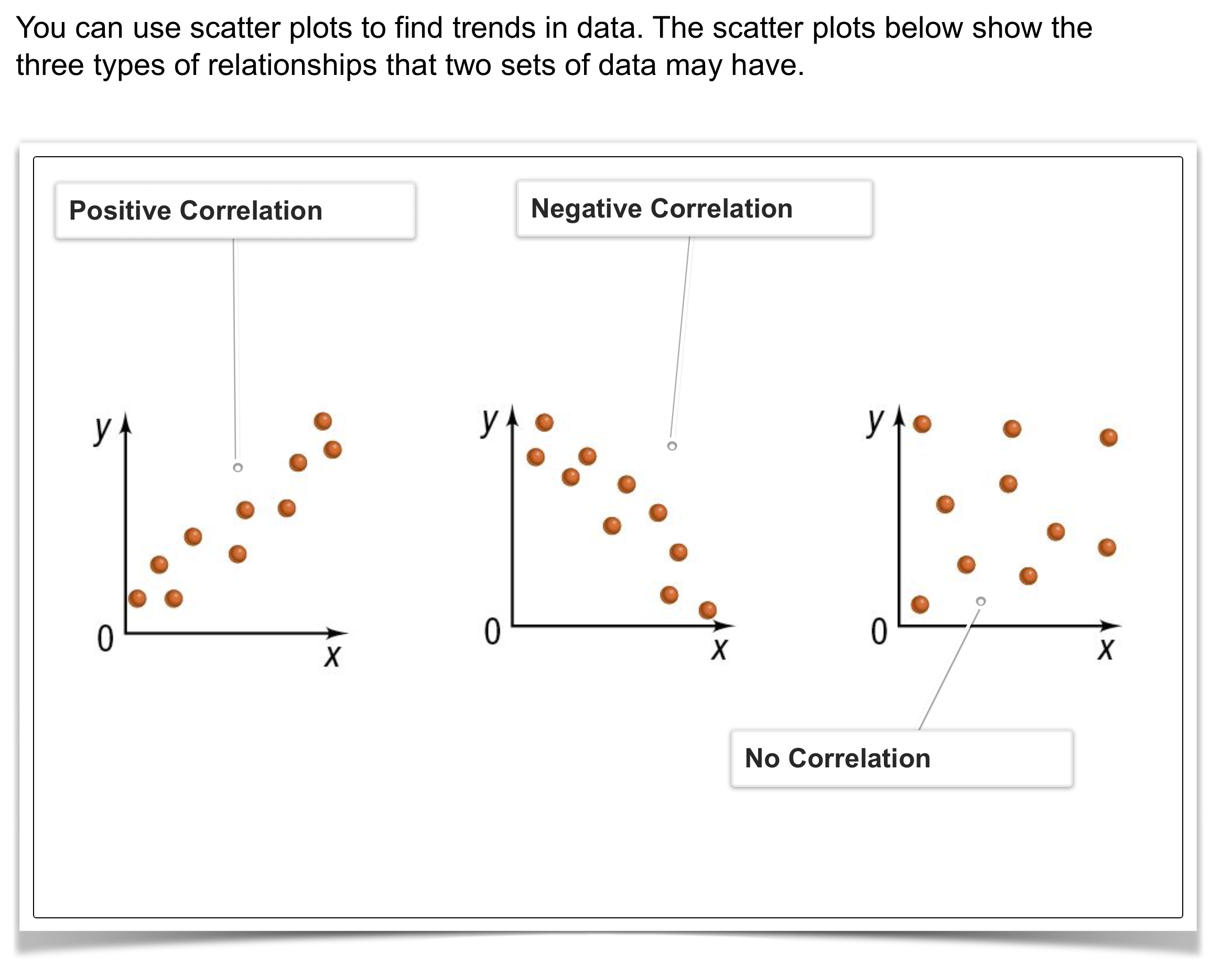
Problem 1 Got It? What type of relationship does the scatter plot you created in the previous item show?
positive correlation
negative correlation
no correlation
Problem 2 Got It? Use the trend line you drew in the previous item to predict the approximate body length of a 7-month-old panda.
About 29.1 in.
About 21.8 in.
About 24.4 in.
About 34.2 in.
Question 9
9.

Problem 3 Got It? Reasoning: What does the slope of the line of best fit in Problem 3 tell you about the rate of change in the cost?

Consider your scatter plot and the data in the previous item. What type of relationship is shown?
Strong positive correlation
Positive correlation
Little to no correlation
Negative correlation
Strong negative correlation
Consider your scatter plot and the data once more. Predict the average maximum daily temperature in January at a latitude of 50° N.
Choose the most reasonable prediction.
About 10°F
About 20°F
About 30°F
About 40°F
Review Lesson 5-6: Write an equation of the line in slope-intercept form that passes through the given point and is parallel to the graph of the given equation.
y + 3 = 5(x - 2)
y = -2x + 3
y = 5x - 13
Review Lesson 5-6: Write an equation of the line in slope-intercept form that passes through the given point and is parallel to the graph of the given equation.
y = x + 9
y = -x + 5
y = 5x
Use Your Vocabulary: Identify the correlation shown in each scatter plot above.
positive correlation
negative correlation
no correlation
Scatter Plot A
Scatter Plot B
Scatter Plot C