9.5a Classwork (1)
star
star
star
star
star
Last updated about 6 years ago
10 Nsɛmmisa
1
1
1
1
1
1
1
1
1
1
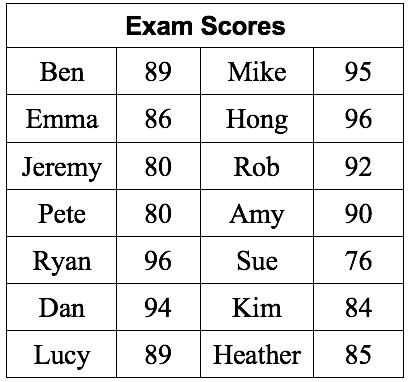
a. What is the mean exam score?
b. Make a dot plot of the data. Place an “X” on the number line to represent the mean.
c. Is the number of exam scores that are greater than the mean equal to the number of exam scores that are less than the mean?
d. Which exam score deviates the most (is furthest away) from the mean? Which exam score deviates (is closest to) the least from the mean? Explain how you found your answers.
e. Overall, do you think the exam scores are close to the mean or far away from the mean? Explain your reasoning.
a. Complete the table below. Add rows if needed. Be sure to find the sum of the values in the last column of the table.
b. Complete the table for students with scores greater than the mean.
c. LOGIC What do you notice about the sums you found in your tables? Why do you think this happens?
a. LOGIC Add the sums you found in your tables in Activity 2. Divide that amount by the total number of students. Round your result to the nearest tenth.
In your own words, what do you think this value represents?
b. Reasoning In a data set, what do you think it means when the value you found in part (a) is close to 0? Explain.