a. number of quarters brought to a batting cage
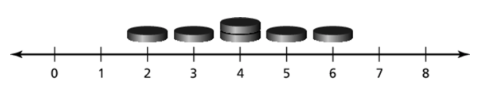
a. number of quarters brought to a batting cage
a. number of quarters brought to a batting cage
b. annual income of recent graduates (in thousands of dollars)
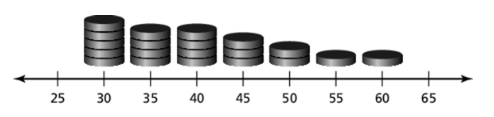
c. hybrid fuel economy (miles per gallon)
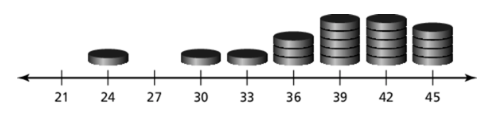
It costs $0.25 to hit 12 baseballs in a batting cage. The table shows the numbers of quarters six friends bring to the batting cage. They want to group the quarters so that everyone has the same amount.
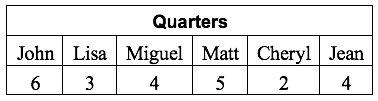
Use counters to represent each number in the table. How can you use the counters to determine how many times each friend can use the batting cage? Explain how this procedure results in a “fair share.”
a. What is the total number of quarters the group of friends brought to the batting cage?
b. Reasoning How can you use math to find the average number of quarters that each friend brought to the batting cage? Find the average number of quarters. Why do you think this average represents a fair share?
The table shows the numbers of quarters several people bring to a batting cage. You want to answer the question:
“How many quarters do people bring to the batting cage?”
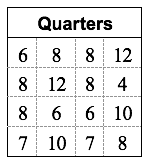
a. Explain why this question is a statistical question.
b. MODELING Make a dot plot of the data. Use the distribution of the data to answer the question:
“How many quarters do people bring to the batting cage?”.
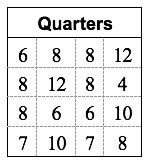
b. REASONING Use an average (add all of the number of quarters then dvided by the number of people) to answer the question:
"How many quarters do people bring to the batting cage?”.
5. in your own words How can you find an average value of a data set?
6. Give two real-life examples of averages.
7. Explain what it means to say the average of a data set is the point on a number line where the data set is balanced.
8. There are 5 students in the cartoon. Four of the students are 5 feet tall. One is 10 feet tall.

a. How do you think the students decided their average height is 6 feet?
b. Does a height of 6 feet seem like a good representation of the average height of the 5 students? Explain why or why not.