Tendency of a group to express more extreme views than members would as individuals.
Question 2
2.
Tendency for people to perform better when others are watching
Question 3
3.
Tendency for people to follow the behavior of the group
Question 4
4.
Diffusion of responsibility when a large group of people is present
Question 5
5.
A change in behaviour that is deemed necessary in order to fit in a particular group
Question 6
6.
Diffusion of responsibility phenomenon seems to reduce the sense of personal responsibility that any one person in the feels to help another in need and increases in proportion to the size of the group present.
Question 7
7.
Situational attribution refers to the way people gather, use, and interpret information about the social aspects of the world around them.
Question 8
8.
When we are in a group of like-minded people, group polarization might occur.
Question 9
9.
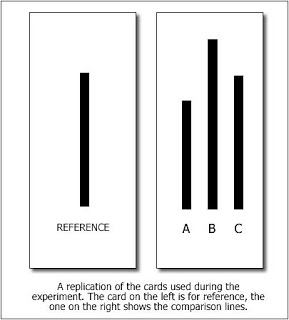
Stanley Milgram set up a laboratory experiment using deception and confederates to determine what factors were involved in individual decisions to conform with a group decision.
Question 10
10.
The mere exposure effect is the act of unconsciously adopting the beliefs of others around us.
Question 11
11.
Social norms develop in a group and community and the nature of the human being is to “go along with the crowd”. Using studies and theories discussed in the chapter on the social psychology of groups to expand upon the above statement.
Question 12
12.
Explain why people conform to the group even when it goes against their personal beliefs.
Question 13
13.
Discuss and offer examples of both the positive and negative implications of group conformity. Discuss the potential for political use of the power of the group for social control.
Question 14
14.
Discuss the methodology used in the early social psychological experiments with attention to ethical dilemmas related to the conduction of the research.
Question 15
15.
Describe two research studies related to bystander behaviour.