Look at the four diagrams below:
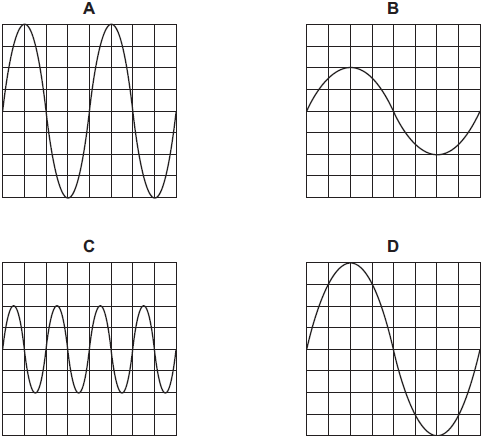
Describe wave A in comparison to the others by selecting the two boxes that are true.
Look at the four diagrams below:
Describe wave A in comparison to the others by selecting the two boxes that are true.
Learning Intentions
WALT assess our knowledge of Sound.
Success Criteria
I can:
Describe how sounds are produce
Recognize the properties of waves.
Interpret waveforms on an oscilloscope.
Describe the link between loudness & amplitude and frequency & pitch.
Sound is a type of...
Sound is cause by the ______________________ of particles
A region of spread out particles is called a _______________
When particles are squashed together it is called a __________________
Look at the picture of a sound wave below. Label the following
an area that show's a compression
an area that shows a rarefaction
(tick all that are correct)
Sound cannot travel through...
The AMPLITUDE determines the _____________________ of a sound.
The FREQUENCY determines the _____________________ of a sound.
Choose the option that best completes the sentence.
The larger the amplitude...
Choose the option that best completes the sentence.
The higher the frequency...
Look at the four diagrams below:
Describe wave A in comparison to the others by selecting the two boxes that are true.
Look at the four diagrams below:
Describe wave B in comparison to the others by selecting the two boxes that are true.
Look at the four diagrams below:
Describe wave C in comparison to the others by selecting the two boxes that are true.
Look at the four diagrams below:
Describe wave D in comparison to the others by selecting the two boxes that are true.
Look at the four diagrams below:
Which two waves have the same frequency?
Look at the four diagrams below:
Which two waves have the same pitch?