Log in
Sign up for FREE
arrow_back
Library

Unit 8 WWI and the Russian Revolution Honors Test

star
star
star
star
star
Last updated almost 5 years ago
23 questions
1
MWH.4.CE
1
MWH.4.CE
1
MWH.4.CE
MWH.4.E
1
MWH.4.CE
1
MWH.4.CE
MWH.4.E
1
MWH.3.P
1
MWH.3.P
1
MWH.4.CE
1
MWH.4.CE
1
MWH.4.CE
1
MWH.4.CE
1
MWH.4.CE
1
MWH.4.CE
1
MWH.4.CE
1
MWH.4.CE
3
MWH.4.CE
2
MWH.4.CE
1
MWH.4.CE
1
MWH.4.CE
MWH.4.E
1
MWH.4.CE
MWH.4.E
5
5
5
Question 1
1.

Question 2
2.

Question 3
3.

Question 4
4.

Question 5
5.

Question 6
6.

Question 7
7.

Question 8
8.

Question 9
9.

Question 10
10.

Question 11
11.

Question 12
12.

Question 13
13.

Question 14
14.

Question 15
15.

Question 16
16.

Question 17
17.

Question 18
18.

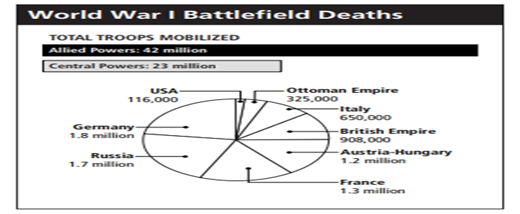
Use the chart to answer questions 19 and 20.

Question 19
19.

Question 20
20.

Question 21
21.

Tell me about trench warfare. How did trench warfare develop? What strategies were used to fight this new type of war? What was life like in the trenches? (USE SPECIFIC EXAMPLES and DETAILS)

Question 22
22.

Alliances were a major factor in the progress and outcome of WWI. What were the advantages and disadvantages of the Central Powers alliances?

Question 23
23.

Alliances were a major factor in the progress and outcome of WWI. What were the advantages and disadvantages of the Triple Entente/Allied Powers alliances?

Which of the following was the most direct cause of World War I?
Japanese military expansion
Ethnic tensions in Europe
The spread of communism
Independence movements in colonies
Which of these happened first, following the assassination of Archduke Franz Ferdinand on June 28, 1914?
Austria-Hungary declared war on Serbia
France invaded Belgium
Russia mobilized its forces for a possible war
Germany declared war on Russia
In the excerpt below what is President Wilson referring specifically to?
“II. Absolute freedom of navigation upon the seas, outside territorial waters, alike in peace and in war, except as the seas may be closed in whole or in part by international action for the enforcement of international covenants.”
--Woodrow Wilson, Fourteen Points Speech, 1918
Unrestricted Submarine warfare
The attack on Pearl Harbor
The sinking of the Titanic
Italian dominance in the Mediterranean
In what way did industrialization affect the fighting in World War I?
Trains were used for the first time in modern warfare
Aircraft carriers allowed planes to strike deep within enemy territory in areas far from land bases
An economic depression caused a shortage of weapons along the Western front in France
Mass-produced weapons caused a larger number of deaths than in previous conflicts
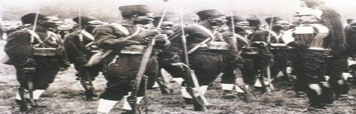
The image below from World War I could be best used to show which of the following?
The war was limited to Europeans only
Colonized peoples refused to participate in combat
Imperial powers did not accept their subjects as troops
Colonized peoples often fought for the countries that controlled them
Which was not an outcome of the execution of Czar Nicholas II and his family?
Pressure on the other Allied forces during World War I
Bolsheviks came to power
Russia entering World War I on the same side as Germany
The end of the Romanov dynasty
What was the most significant effect that World War I had on Russia?
Russia defended the Eastern Front successfully and was perceived as a super power
The Romanov dynasty was overthrown and executed because the people blamed them for getting Russia involved
Russia formed stronger economic and political ties with the Allied powers throughout the war
Russia focused on building up its technology and became fully industrialized by the end of the war
Immediately after the end of World War I and the collapse of the Ottoman Empire, European countries increased their involvement in Middle Eastern political and economic affairs. Which of these best explains how this change took place?
European Jews were fleeing the expansion and oppression of the German government
European people moved there to take advantage of the better climate
European powers drew up new political borders in the region without consulting political, cultural, or historic realities
European governments were able to establish peace in the region for the first time in decades
Why did the US Congress refuse to ratify the Treaty of Versailles (1919)?
It felt the League of Nations would restrict America’s sovereignty
The United States did not receive enough territory
It punished Germany too harshly
President Wilson was against the League of Nations
Which provision of the Treaty of Versailles is most aligned with Woodrow Wilson’s Fourteen Points?
The creation of a “general association of nations” to protect political independence
The limititation of Germany’s military power to an amount only adequate for defense
Germany was forced to sign a “war guilt clause”
The fact that Germany was saddled with $33 billion worth of reparations
Who did the Black Hand represent?
Russian nationalists
French nationalists
Austrian nationalists
Serbian nationalists
What event in Sarajevo ignited the Great War?
The marriage of Ferdinand and Sophie
An alliance between Serbia and Germany was broken.
The heir to the Austro-Hungarian Empire was assassinated.
People rose up and revolted over high taxes
Which statement summarizes the Schlieffen Plan?
Attack France first, then England
Ally with Russia, then fight France
Attack Russia first, then France
Attack France first then Russia
The Zimmerman not exposed the German plan to
Plant German spies in the US
Help Mexico regain US territory if Mexico attacked the US
Sink passenger ships without warning
Make a truce with Russia
Who was forced to assume full responsibility for World War I?
Austria-Hungary
Germany
England
Serbia
Which of the following were causes of causes of WWI?
Militarism
Nationalism
Communism
Alliances
What were the two major fronts of WWI?
Alpine front
Eastern front
Northern front
Western front
Which region was known as the “powder keg of Europe”?
Poland
Alsace-Lorraine
The Middle East
The Balkans
Which countries each lost more than a million troops from battlefield deaths?
Ottoman Empire, Italy, France, Germany
USA, British Empire, France, Russia
all of the above
Austria-Hungary, France, Russia, Germany
Which country lost the smallest number of troops from battlefield deaths?
Ottoman Empire
British Empire
USA
France