Designed to provide initial assessment of students' reading comprehension skills for baseline data.
Excerpt from The Woman in White by Wilkie Collins
In one moment, every drop of blood in my body was brought to a stop by the touch of a hand laid lightly and suddenly on my shoulder from behind me.
I turned on the instant, with my fingers tightening round the handle of my stick.
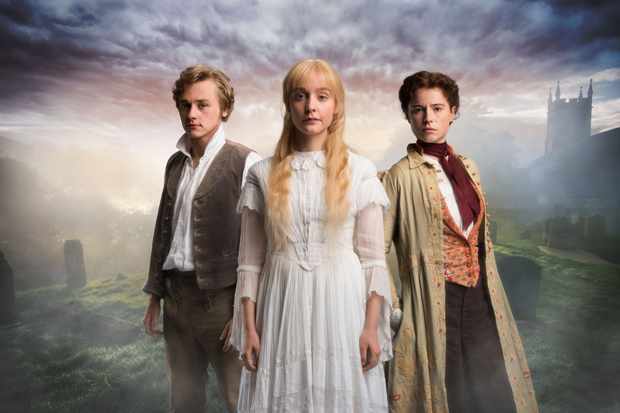
There, in the middle of the broad bright high-road – there, as if it had that moment sprung out of the earth or dropped from the heaven – stood the figure of a solitary woman, dressed from head to foot in white garments, her face bent in grave inquiry on mine, her hand pointing to the dark cloud over London, as I faced her.
I was far too seriously startled by the suddenness with which this extraordinary apparition stood before me, in the dead of night and in that lonely place, to ask what she wanted.
The strange woman spoke first. “Is that the road to London?” she said.
I looked attentively at her, as she put that singular question to me. It was then nearly one o’clock. All I could discern distinctly by the moonlight was a colorless, youthful face, meager and sharp to look at about the cheeks and chin; large, grave, wistfully attentive eyes; nervous, uncertain lips; and light hair of a pale, brownish-yellow hue. There was nothing wild, nothing immodest in her manner: it was quiet and self-controlled, a little melancholy and a little touched by suspicion; not exactly the manner of a lady, and, at the same time, not the manner of a woman in the humblest rank of life. The voice, little as I had yet heard of it, had something curiously still and mechanical in its tones, and the utterance was remarkably rapid. She held a small bag in her hand: and her dress – bonnet, shawl, and gown all of white – was, so far as I could guess, certainly not composed of very delicate or very expensive materials. Her figure was slight, and rather above the average height – her gait and actions free from the slightest approach to extravagance. This was all that I could observe of her in the dim light and under the perplexingly strange circumstances of our meeting. What sort of a woman she was, and how she came to be out alone in the high-road, an hour after midnight, I altogether failed to guess. The one thing of which I felt certain was, that the grossest of mankind could not have misconstrued her motive in speaking, even at that suspiciously late hour and in that suspiciously lonely place.
“Did you hear me?” she said, still quietly and rapidly, and without the least fretfulness or impatience. “I asked if that was the way to London.
Put the events from the text into the correct sequence.
The woman dressed in white asks whether this is the road to London for a second time.
The woman dressed in white asks whether this is the road to London.
The narrator forgets to ask what the woman dressed in white wants.
The narrator feels a hand on his shoulder.
The narrator is surprised by the appearance of a woman dressed in white.
The narrator observes the woman and is confused about why she is walking alone on the road.
Which of these literary devices relating to structure are present in the text? Select all that apply.
What is the setting of this text? Be as specific as possible.
"The narrator is reliable."
What is the overall mood (atmosphere) of this text?
What is the tone of this text?
Excerpt from "We Shall Fight on the Beaches", by Winston Churchill
Great Britain’s Prime Minister, Winston Churchill, delivered this speech to the House of Commons [U.K. equivalent of Congress] on June 4, 1940. At the time, the British effort in World War II was not going well, and the U.S. had not yet entered the war.
"I have, myself, full confidence that if all do their duty, if nothing is neglected, and if the best arrangements are made, as they are being made, we shall prove ourselves once again able to defend our Island home, to ride out the storm of war, and to outlive the menace of tyranny, if necessary for years, if necessary alone.
At any rate, that is what we are going to try to do. That is the resolve of His Majesty’s Government - every man of them. That is the will of Parliament and the nation.
The British Empire and the French Republic, linked together in their cause and in their need, will defend to the death their native soil, aiding each other like good comrades to the utmost of their strength.
Even though large tracts of Europe and many old and famous States have fallen or may fall into the grip of the Gestapo and all the odious apparatus of Nazi rule, we shall not flag or fail.
We shall go on to the end, we shall fight in France, we shall fight on the seas and oceans, we shall fight with growing confidence and growing strength in the air, we shall defend our Island, whatever the cost may be, we shall fight on the beaches, we shall fight on the landing grounds, we shall fight in the fields and in the streets, we shall fight in the hills; we shall never surrender, and even if, which I do not for a moment believe, this Island or a large part of it were subjugated and starving, then our Empire beyond the seas, armed and guarded by the British Fleet, would carry on the struggle, until, in God’s good time, the New World, with all its power and might, steps forth to the rescue and the liberation of the old."
Put the points from the text into the correct sequence.
The British nation want to win the war.
Britain and its empire will fight in every place, by every method, until (if necessary) the US enters the war.
Many countries have been defeated by the Nazis, but Britain will win nevertheless.
Britain will win the war, even if it has to fight for years alone.
Britain and France will work together to win the war.
How is the text organized?
Pick one paragraph in the text, and write 1 sentence that summarizes the main idea of that paragraph. Think about:
What is the author saying about the topic in this paragraph?
What do the first and last sentences say?
What idea do the details in this paragraph support?
What is the main idea of the entire text? Summarize it in 1-2 sentences. Think about:
What message about the topic does the author want the reader to remember?
What idea do the details in this text support?
Which kinds of supporting details does the author use in this text? Select all that apply.
What was the author's purpose when writing this text?
Which statement would the author most likely agree with?
Which statement would the author most likely disagree with?
Which features of effective arguments are present in this text? Select all that apply.
Which statement best explains why the nature of Shakespeare's relationship to the American public changed?
Which word means the same as "alien" (paragraph 8) in this article?
How does the author organize this passage?
Why does the author most likely include the quotes by Alexis de Tocqueville and Karl Knotz in paragraph 2?
Read the statement from paragraph 5. (See question 5 for the quote.) Which strategy is the author using in this sentence?