Log in
Sign up for FREE
arrow_back
Library

Poetry Terms Practice

star
star
star
star
star
Last updated over 5 years ago
15 questions
5
5
5
5
5
5
5
0
5
Figurative language is a tool that authors use, especially poets, to help readers visualize and think about something in a different way. It is not meant to be taken literally, but usually is used to bring up some idea, feeling, or image in a reader's mind. See if you can identify some of these examples of figurative language from a variety of poems, and the other poetic tools or devices that many poets use.
Question 1
1.

"The cup danced joyfully across the table." This line has an example of which type of figurative language?

Question 2
2.

"Pink and purple popsicles" This line uses what type of figurative language?

Question 3
3.

"Cathy is as cute as a kitten." This line uses what form of figurative language?

Question 4
4.

"The city was a jungle" This line uses what form of figurative language?

Question 5
5.

"His heart was a block of ice" This line uses what form of figurative language.

Question 6
6.

"It took Thomas a million years to finish his homework." This line has uses what form of figurative language?

Question 7
7.

"The lucky lady led the way." This line uses what kind of figurative language?

Question 8
8.

What consonant letter sound is repeated in the line: "The lucky lady led the way"

Question 9
9.

Dreams

Langston Hughes, 1902 - 1967

Hold fast to dreams For if dreams die Life is a broken-winged bird That cannot fly.
What is the MOOD you think the author wants us to feel reading this first stanza of the poem "Dreams"? (Notice how he describes unfulfilled dreams)

5
5
5
5
5
5
Question 10
10.

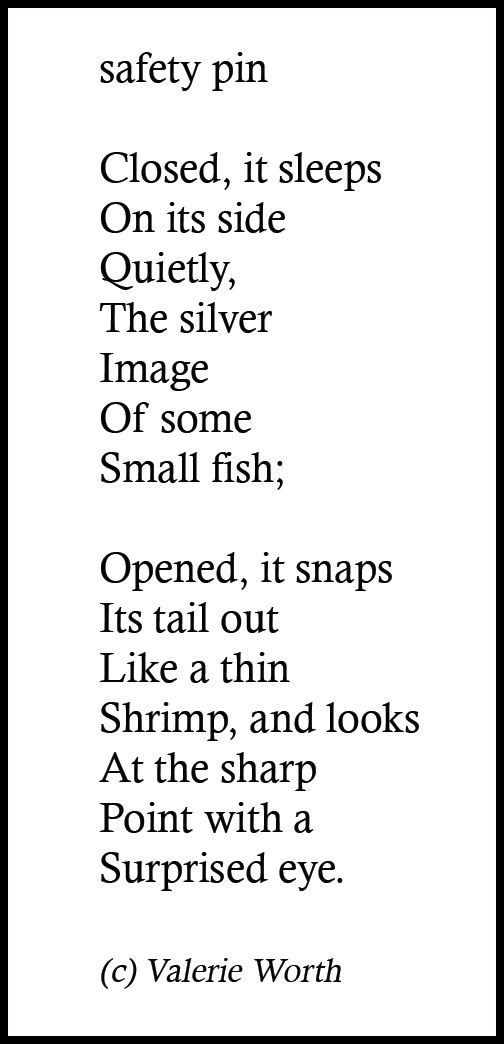
When the writer writes that the safety pin is "sleeping on its side quietly" when it's closed, what figurative language is the writer using?

Question 11
11.

This detail that compares an open safety pin to the tail of a thin shrimp is a type of figurative language called what?

Question 12
12.

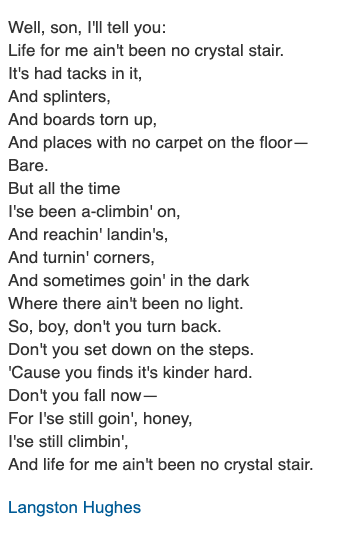
What can these splinters and tacks symbolize?

Question 13
13.

What's a possible theme (statement) for this poem?

Question 14
14.

"Teacher, preacher" has a repeating long e vowel sound. This is an example of what type of figurative language?

Question 15
15.

What does this "voice" symbolize or represent?