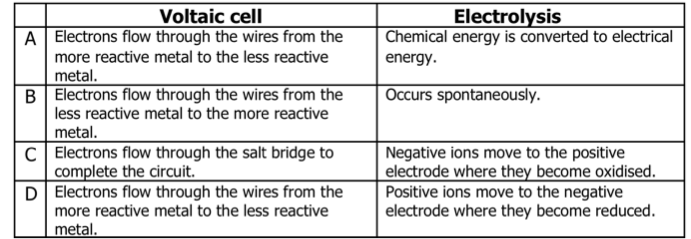
Identify the row with both correct statements for the following electrochemical processes:
[Level 1-2]
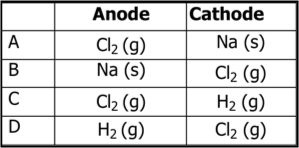
Water in swimming pools can be purified using a chlorinating cell, where an aqueous solution of sodium chloride is electrolysed to produce chlorine. Identify the products formed at the anode and cathode.
[Level 5-6]
In a voltaic cell the redox reactions occur spontaneously. Which statement(s) accurately describe the processes of a voltaic cell? [Level 1-2]
In the electrolysis of molten sodium chloride, sodium ions: [Level 5-6]
The reactivity series lists metals in order of reactivity. The most easily oxidised metals can be found
[Level 3-4]
Which of the following equations represents the reduction of a metal? [Level 3-4]
i. Identify which is oxidation and which is reduction. [Level 1-2]
ii. Combine the half-equations to form a balanced redox equation. [Level 7-8]
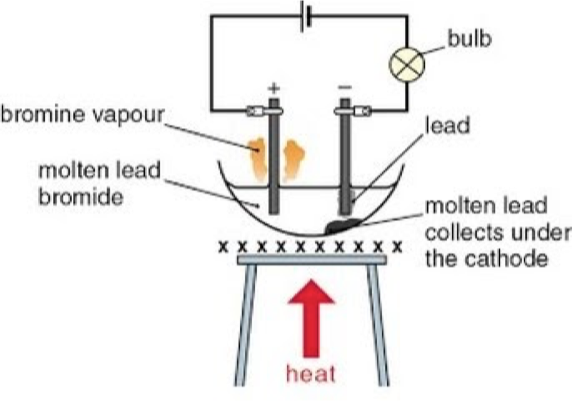
A student performed the electrolysis of molten lead (II) bromide (PbBr2) using the apparatus show.
The student made a number of observations
The light bulb did not light up straight away
Brown gas was observed at the positive electrode
Molten metal was observed at the negative electrode.
i. Explain why the bulb did not initially light up. [level 7-8]
ii. Write the half-equation for the reaction taking place at the positive electrode [level 5-6]
iii. Write the half-equation for the reaction taking place at the negative electrode [level 5-6]
iv. Explain why lead is formed at the negative electrode and why this reaction taking place at the negative electrode is viewed as a reduction reaction?
[level 7-8]
The diagram shows a voltaic cell:
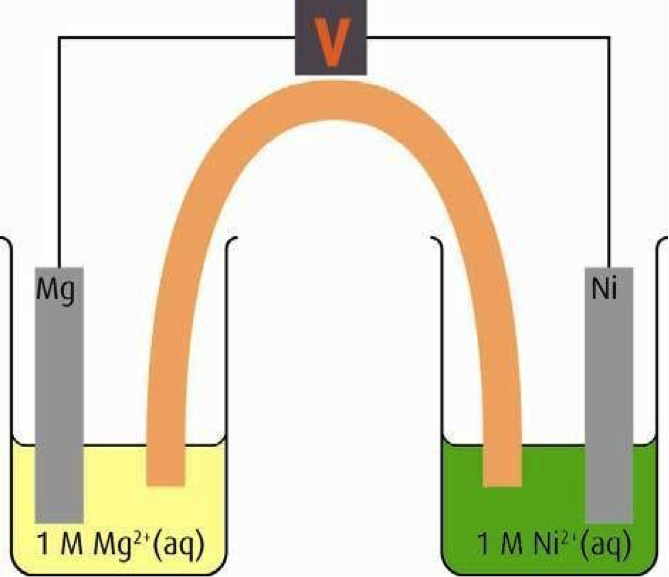
Source: Harwood, Richard, and Ian Lodge. Cambridge IGCSE Chemistry Coursebook. Cambridge University Press, 2014.
i. State and explain the direction of electron flow in the external circuit. [level 3-4]
ii. State and explain whether oxidation or reduction occurs at each electrode. [level 5-6]
iii. State which electrode is the cathode and which is the anode. [level 3-4]
iv. Explain the function of the salt bridge. [level 7-8]
v. Explain whether the voltage will increase or decrease when the nickel half-cell is replaced by a Cu/Cu2+ half-cell. [level 7-8]
A student added different metals to solutions of metal ions and recorded the observations
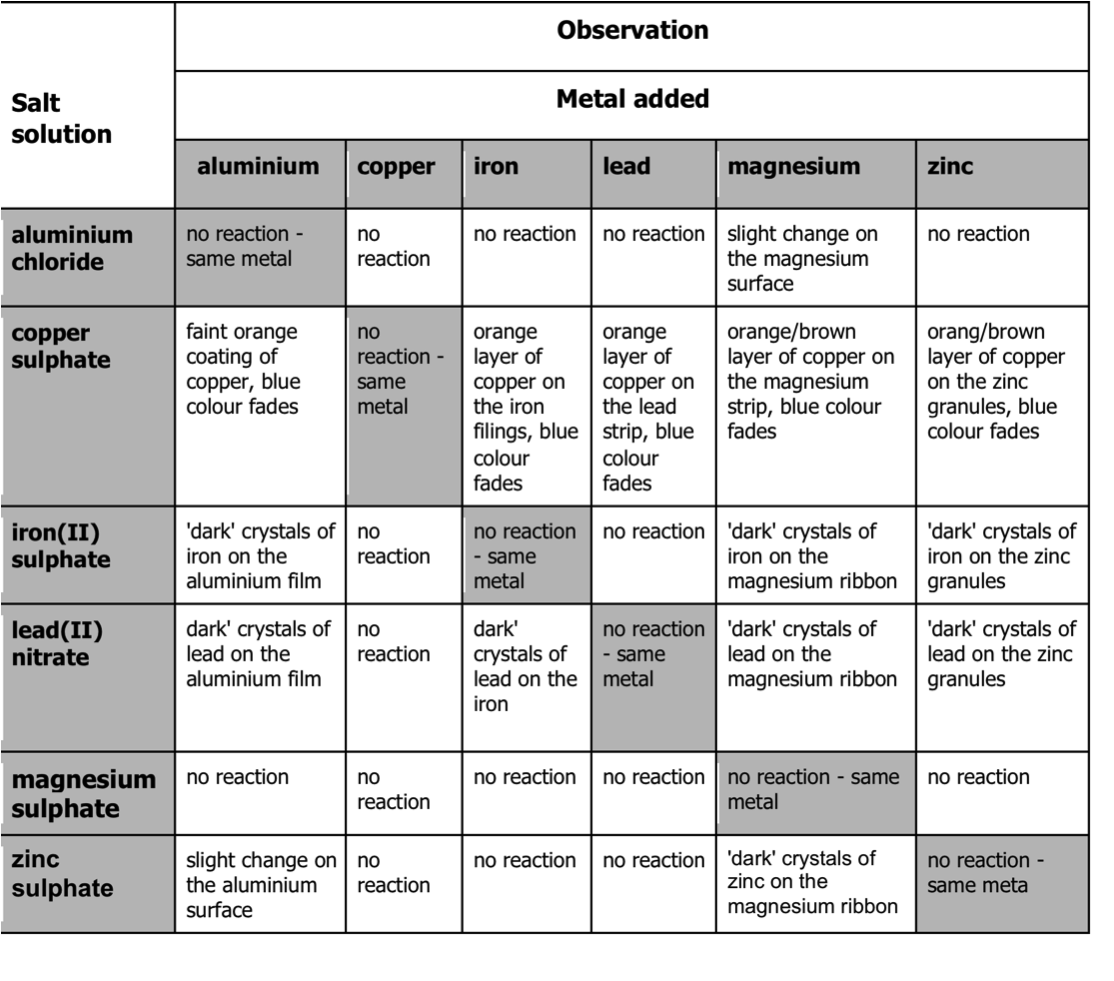
i. Identify what is the most reactive metal [level 1-2]
ii. Identify what is the least reactive metal [level 1-2]
iii. For the metals tested, write a reactivity series, starting with the most reactive.
[level 3-4]
iv. With the aid of chemical reactions (half equations and overall balanced equation), explain the observations for the reaction of magnesium with copper sulphate. [level 7-8]
i. Write down a balanced equation for the redox reaction between aluminium oxide and carbon. [level 5-6]
ii. Identify the element that is oxidized and the element that is reduced. Justify your answers. [level 7-8]
Using a simple voltaic cell, as shown, a student carried out an experiment to investigate the order of reactivity of tin, nickel and iron.
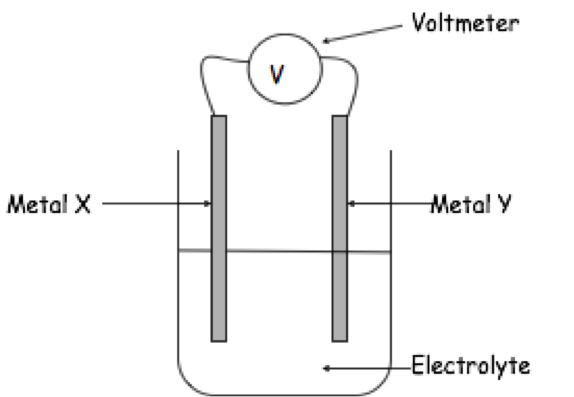
The following results were obtained:
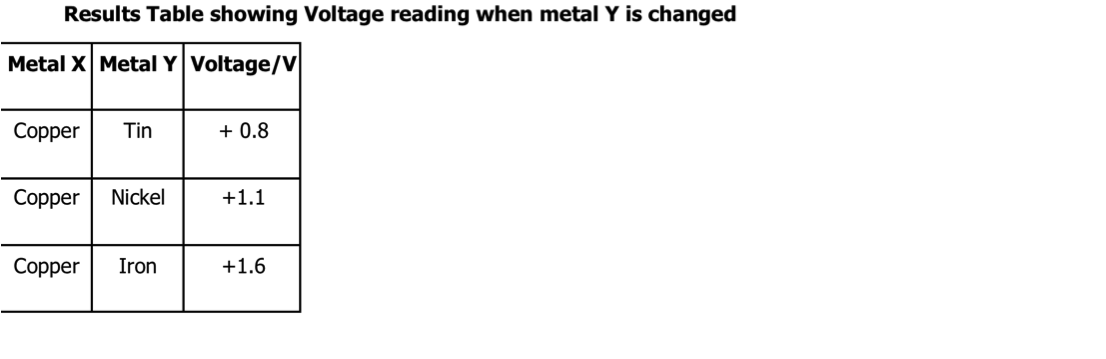
i. Explain why the student decided to have copper as metal X in each experiment?
[level 3-4]
ii. List these metals in order of reactivity (most reactive first). [level 3-4]