Grade 8 Development
star
star
star
star
star
Last updated about 6 years ago
9 Nsɛmmisa
8
2
6
6
11
7
10
18
Human development is defined as the process of enlarging people's freedoms and opportunities and improving their well-being. Human development is about the real freedom ordinary people have to decide who to be, what to do, and how to live. The human development concept was developed by economist Mahbub ul Haq.
What is Human Development? (8)
"We all know that there are rich countries and poor countries. The United States is one of the richest countries in the world with one of the highest standards of living. The Central African Republic is one of the poorest countries in the world. Mexico is somewhere in between. But just how big are these differences between the rich and the poor countries? And how do we measure these differences"?
GDP is the value of all goods and sevices produced in a country's borders in a specific time period.
Explain what Real GDP Per Capita is and provide an example of how it is used to compare the wealth of individuals in a country. (2)
"Australia is ranked 22nd in the world according to its gross national income. This is measured by a nation's wealth. Qatar in the Middle East is ranked number one. Australia is second in the world according to the United Nations Human Development Index. Only Norway is ranked above Australia. The Human Development Index (HDI) understands that income isn't the only measure of human wellbeing".
Gross National Income (GNI) per capita is the total income received by the country from its residents and businesses regardless of whether they are located in the country or abroad.
(a) When you measure the wealth of a country, what do you look at? (Name three things) (3)
(b) Explain how these three factors are used to determine the well being of it's people. (3)
"According to the United Nations, it no longer judges a country by a particular stage that it is at in its development. Nonetheless, countries are ranked higher in terms of the comforts and opportunities afforded to its citizens. We now call this the Human Development Index".
The Human Development Index (HDI) is a statistical tool used to measure a country's overall achievement in its social and economic dimensions. The social and economic dimensions of a country are based on the health of people, their level of education attainment and their standard of living.
(a) According to the United Nations countries are no longer judged according to their stage of development but rather according to the ________ ________ ________ ________ ________ ________ ________. (1)
(b) When countries were judged by their stage of industrialization, which country was ranked number one in the word? (1)
(c) If we look at todays human index which countries are ranked in the top three in the world? (1)
(d) Name the three main categories of the HDI. (3)
"Development is complicated. A country's development is often measured with two groups taken into consideration these groups are economic development and social development".
There are many different ways which are used to try to determine how developed a country is. These are called indicators of development. Watch the video and then complete linking question below.
Link indicators of development with the correct description (11)
| Draggable item | arrow_right_alt | Corresponding Item |
|---|---|---|
Percentage of GNP spent on education (%) | arrow_right_alt | The number of children who die before they are 1 year old, measured per 1000 born. You would expect a less developed country to have a high rate due to poorer diet and health care. |
Access to clean water (%) | arrow_right_alt | The average age that someone living in that country will live to. You would expect it to be highest in the more developed countries, where there is better access to health care and a better diet. |
The Human Development Index | arrow_right_alt | The amount of food eaten by a single person on average. There is a recommended daily calorie intake for an adult which is not reached by many developing countries, especially in rural areas. |
Daily calorie intake | arrow_right_alt | The total population divided by the number of doctors in the country |
Percentage working in agriculture (%) | arrow_right_alt | The percentage of the population who are literate (in other words they can read and write). |
Percentage living in urban areas (%) | arrow_right_alt | The amount of money spent each year on education, as a percentage of the total wealth of the country. |
Infant mortality rate (per 1000) | arrow_right_alt | A less developed country would be expected to have a far higher percentage of people still working in agriculture, mainly as subsistence farmers, growing only enough for them and their family. A more developed country would have far more technology in farming, and therefore less workers, as well as having far more people working in the manufacturing and service industries. |
The indicators of development used in the index are: | arrow_right_alt | As countries develop, there tends to be a mass in-migration into the cities, causing rapid urban growth. Therefore you would expect a more developed country to have a higher percentage of people living in the urban areas |
Population per doctor | arrow_right_alt | Many people in LEDC's do not have access to clean water. This can lead to outbreaks of diseases such as cholera, dysentry and typhoid. |
Adult literacy (%) | arrow_right_alt | The Human Development Index was devised by the United Nations in 1990 and uses a number of indicators of development to give each country in the world a development score. The score ranges from 0 to 1, with 1 being the most developed. No country has reached a score of 1, although some, such as Japan and Canada have attained marks well over 0.9. |
Life expectancy (years) | arrow_right_alt |
|
"Which countries have grown the fastest in recent years many people might name Singapore or Korea but Poland or Morocco might not readily come to mind. This is because for many decades we have thought of national growth in terms of GDP which shows the total value of goods and services a country produces".
What GDP does not show is some of the things that matter most to it's people.
(a) What is Sustainable Economic Assessment (SEDA)? (4)
(b) What do SEDA rankings show and together with GDP what do they reveal? (3)
Development includes TWO aspects of improvement in the life of people:
• STANDARD OF LIVING is the value of their possessions and savings, the type of home they live in and whether they own items such as a washing machine, television, car, telephone and computer. • QUALITY OF LIFE is the general well-being of a person. It includes the standard of living, but it is also affected by education, health care, services, utilities, environment, and social, political and religious freedom.
Name and discuss 5 indicators that help determine your quality of life. (10)
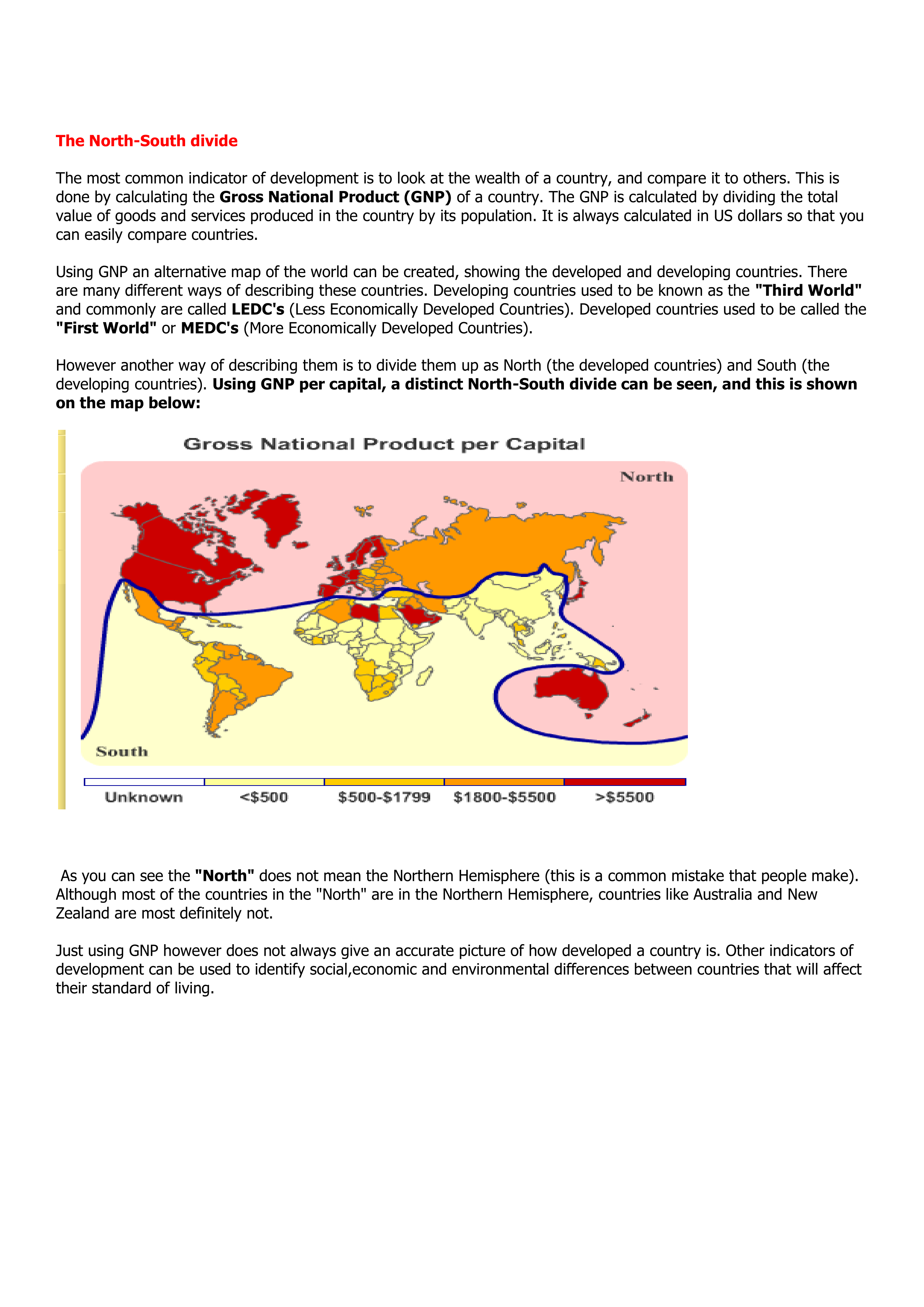
What is meant by the North-South divide? (Do not copy and paste, use your own words to explain.) (5)
"Most of what we call ‘politics’ really revolves around the question of what you need to do to make a country richer. Rather than ask this of any specific country, let's imagine designing a country from scratch. How could you make it as rich as possible? Suppose the brief was to design ‘Richland’: an ideal wealth-creating society. What would be the chief characteristics you need to build into this society? What would a nation look like that was ideally suited to success in modern capitalism"?
(a) What are the chief characteristics needed to make a country rich? (8)
(b) What are some of the disadvantages of striving to become rich? (10)