Class
Name
After more than 30 years of research, Charles Darwin proposed his theory of [level 1-2]
Define the term population [level 3-4]
Inherited traits are passed from parent to offspring and are encoded in DNA, while acquired traits are not. Circle the acquired traits in the list below. [level 1-2, 3-4]
Evolution occurs as a result of variation within a population. The two mechanisms for variation are [level 3-4]
Heredity is the passing on of inherited traits from one generation to the next and forms the basis of evolution. What type of traits are more likely to be passed on to the next generation?
[level 1-2]
Fossils provide evidence of change in an organism over time. The oldest fossils are usually found [level 1-2]
Fossils provide evidence of change in an organism over time. The oldest fossils are usually found [level 1-2]
Explain why a brown rabbit that is placed in the snowy Arctic does not survive [level 1-2]
A frog has a random mutation in the gene that controls tongue length so its tongue becomes very long and it can catch more flies. What would happen to the number of frogs with this gene? [level 3-4]
When two species with different ancestors come to resemble each other, this is an example of [level 5-6]
The blue whale has a hip bone but has no apparent use for it.
This type of structure is called- [level 5-6]
The photograph shows a snowy owl. The snowy owl lives in the Arctic.
It eats small mammals such as mice.
Describe how each of the following adaptations helps the snowy owl to survive?

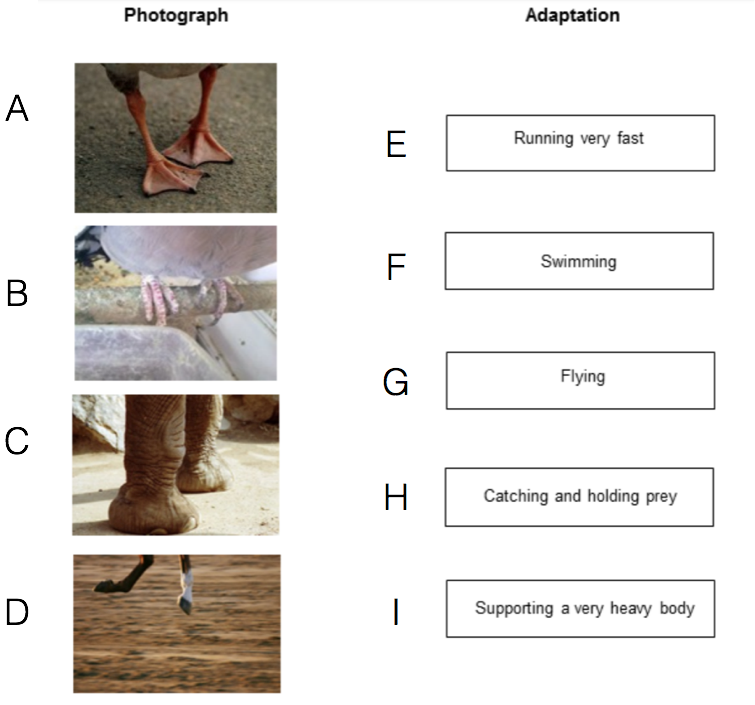
An animal’s feet are adapted to the animal’s way of life. The photographs show the feet of four different animals. Write the two letters for each combination of the photograph of feet with the correct adaptation. You can separate each combination of letters with a semicolumn. [level1-2]
a) Complete the following sentence. Darwin suggested the theory of evolution by natural____________[level 1-2]
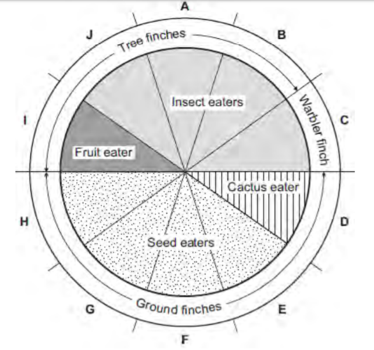
The pie chart shows information about ten species of finch, A − J.
b) How many of the species of finch eat insects? [level 3-4]
c) Describe finch species G. Use only information from the pie chart. [level 5-6]
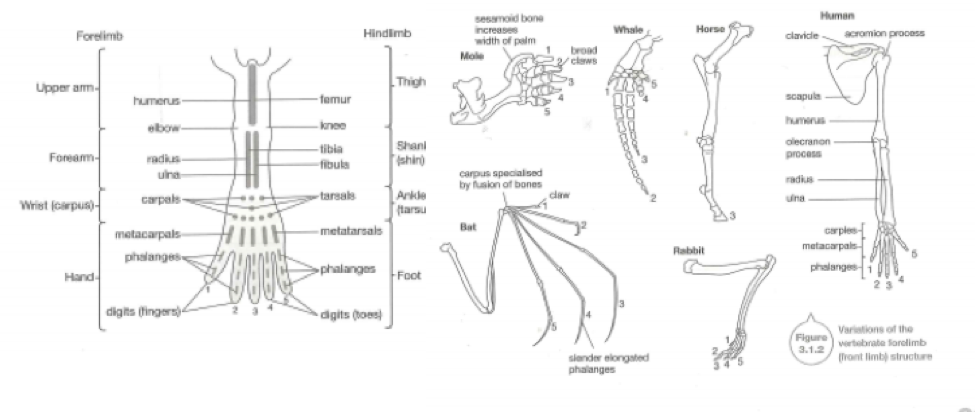
The limbs of vertebrates have a common basic pattern of limb bones called the pentadactyl limb. This pattern is shown in figure 1 below.
Fig1: generalized Limb structure Fig2: Different vertebrate limbs
Some different vertebrate limbs are shown in figure2 above, note, they are not drawn to scale.
a) Identify two different vertebrate limbs that are least like the generalised vertebrate limb. [level 3-4, 5-6]
b) Explain your choice. [level 5-6, 7-8]
c) Explain how the bat, horse, and mole limbs are suited to their particular purpose. [level 3-4, 5-6, 7-8]
d) According to scientific studies of these animals, bats are the closest to humans in terms of ancestry, and rabbits are the second closest.
Discuss whether the animals closest to humans have a more similar limb structure than the others.
[level 5-6, 7-8]
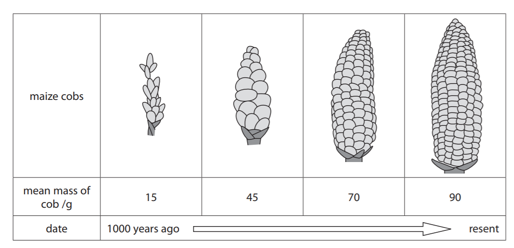
The diagram shows the development of maize cobs over the last 1000 years of cultivation.
Describe how scientists and farmers use plant breeding programmes to produce maize plants with larger cobs. [level 3-4, 5-6, 7-8]
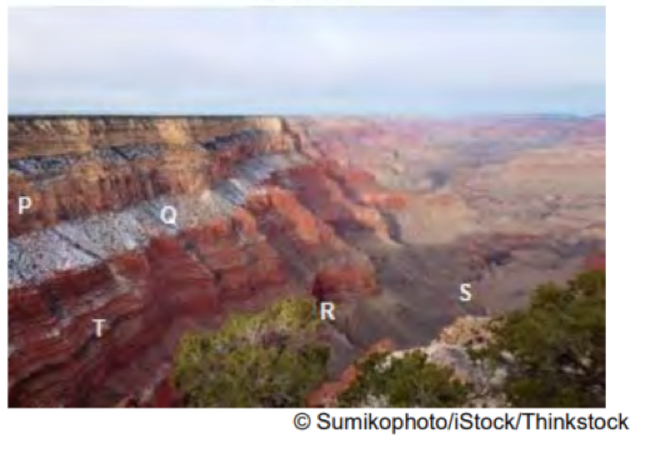
The image below is a photograph of the Grand Canyon. The layers of rock contain fossils.
Scientists found five fossils of different species of animal P, Q, R, S and T, at the positions shown.
a) Was animal R alive at an earlier or later time than animals P and Q? Explain how you know this. [level 1-2]
a) Describe the process by which the fossils above may have formed.
[level 3-4, 5-6]
Fossils provide evidence for what early life forms were like. From the evidence, scientists think that life began on Earth more than 3 billion years ago. Many early life forms were soft-bodied.
c) Explain why this makes it difficult for scientists to be certain about what these early life forms were like. [level 5-6, 7-8]
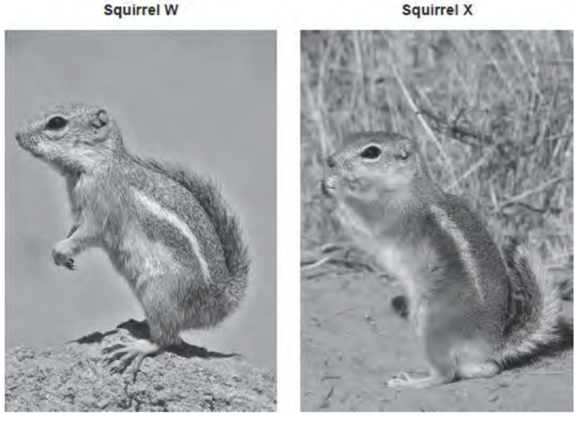
The figure below shows two species of ground squirrel, W and X.
Squirrel W lives on the high ground to the south of the Grand Canyon. Squirrel X lives on the high ground to the north of the Grand Canyon. The land to the north of the Grand Canyon is about 300 metres higher than the land on the south side. The north side also has lower winter temperatures and has more rain and snow than the south side.
a) The two species of squirrel are very similar. Describe one way, which you can see in Figure 2, in which squirrel X is different from squirrel W. [level 1-2]
b)The Grand Canyon was formed about 6 million years ago. Explain how the two different species of squirrel could have developed from a common ancestor. [level 3-4, 5-6]
c) Squirrels W and X are separate species, but they are still very similar. Suggest why the two species have not become more different over time. [level 5-6, 7-8]