Rotate △ABC 90° clockwise about the origin. List the coordinates of the image in problem #2.
1 point
1
Question 2
2.
List the coordinates of △A'B'C' from problem #1.
2 points
2
Question 3
3.
Dennis and Eduardo are studying transformations using triangles. △ABC and △DEF are both plotted on a coordinate plane.
Dennis notices that if he rotates △ABC 270° counterclockwise about the origin and then translates it down 4 units, the result is △DEF.
Eduardo says that he can first translate △ABC down 4 units and then rotate it 270° counterclockwise about the origin in order to get △DEF .
Is Eduardo correct? Explain your answer and tell whether △ABC and △DEF are congruent.
Type your answer in the box below.
1 point
1
Question 4
4.
Quadrilateral KLMN has vertices K(2, 0), L(4, 0), M(5, –2), and N(1, –2). Graph the image after a counterclockwise rotation of 90° about the origin. Determine the coordinates of the image and choose the correct response in problem #5.
1 point
1
Question 5
5.
Refer to Quadrilateral KLMN in problem #4. What are the coordinates of K ’L’M ’N ’ ?
1 point
1
Question 6
6.
Megan draws a triangle on coordinate axes. She reflects the triangle across the y-axis and then translates it 5 units to the right. Which statement is true about the triangle formed from these transformations?
1 point
1
Question 7
7.
Peter draws Figure 1 and Figure 2, as shown below.
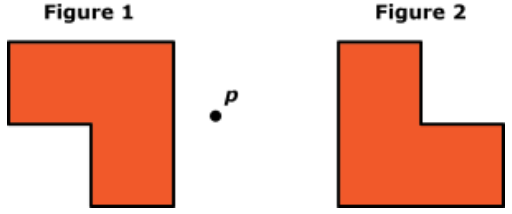
Peter claims that the two figures are congruent since Figure 2 can be obtained by translating Figure 1 to the left and then rotating it clockwise around point P.
How many degrees must the rotation be in order for Peter's claim to be correct? Enter the smallest possible degree measure.