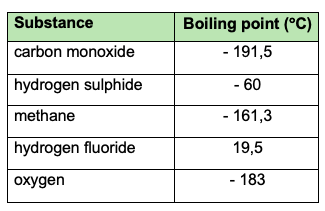
Which answer correctly arranges these compounds in order of DECREASING boiling point?

Which answer correctly arranges these compounds in order of DECREASING boiling point?
Which of the following compounds has the lowest boiling point?
Which of the following contain polar covalent bonds, but experience no net dipole?
Identify the best explanation for differences in boiling points in each set of examples, by dragging them to appropriate explanation.
noble gases
butan-2-ol and butane-1,2-diol
hexane and methane
2-bromopentane and 2-bromo-2-methylbutane
halogens
NH3 and PH3
Differences in intermolecular forces strength
Differences in electron number and therefore the strength of the temporary dipole
Differences in opportunities for London forces
Differences in number of hydrogen bonds formed
Which answer correctly arranges these compounds in order of DECREASING boiling point?
Which substance has the lowest boiling point?
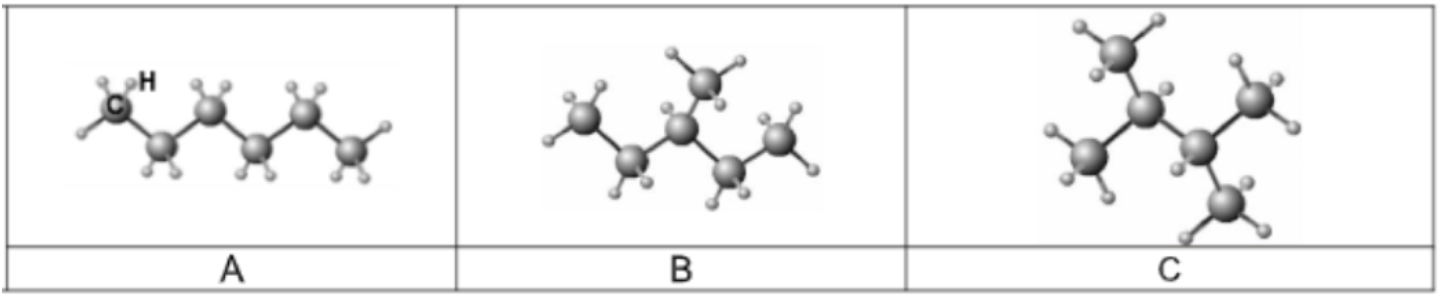
Which option correctly arranges the substances in order of INCREASING boiling point?
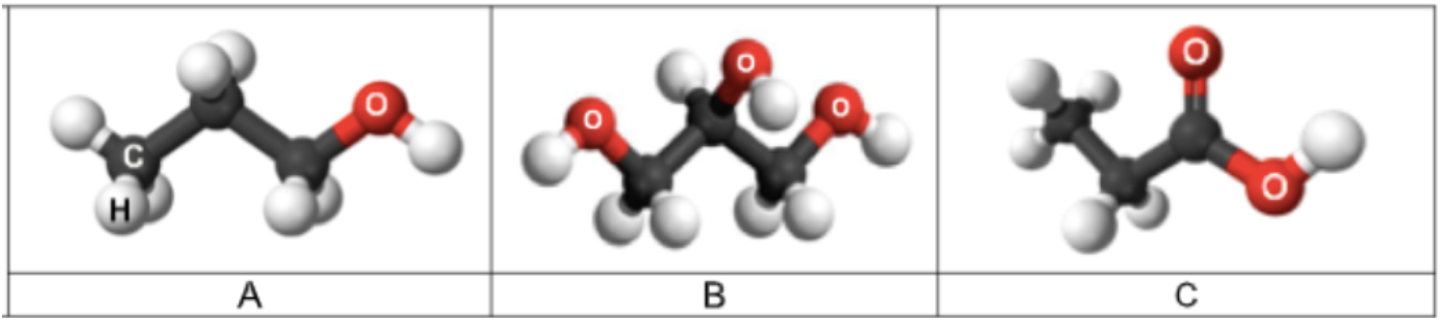
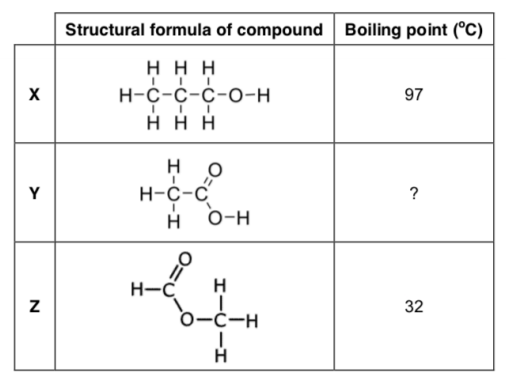
Consider substances X, Y and Z, which all have a molar mass of 60 g.mol-1:
Which one of the following is the most likely boiling point of Y?
Match the following substances with the statement that best describes it.
| Draggable item | arrow_right_alt | Corresponding Item |
|---|---|---|
bromine | arrow_right_alt | A substance with a giant network structure in which the atoms are held together by covalent bonds |
carbon dioxide | arrow_right_alt | A substance with hydrogen bonding forces |
graphite | arrow_right_alt | A substance with a high melting point due to strong electrostatic attraction between cations and anions in the crystal lattice. |
barium oxide | arrow_right_alt | A substance which has London forces between atoms in liquid or solid state |
hydrogen bromide | arrow_right_alt | A molecular substance with non-polar covalent bonds |
sodium | arrow_right_alt | A molecular substance which has dipole-dipole intermolecular forces |
ammonia | arrow_right_alt | A substance that can conduct electricity in both the solid and liquid phase |
helium | arrow_right_alt | A linear molecular substance with polar covalent bonds |
A molecule of hexane is considered to be non-polar. Which one of the statements best describes the reason why the molecule is non-polar?
The table below lists three properties of solids.

Which one of the solids (A-D) has its particular properties listed correctly?
A scientist investigates a factor that influences the boiling points of alkanes. He determines the boiling points of the first six straight chain alkanes. Which one of these is the independent variable in this investigation?
Which of these hypothetical substances will be a liquid at room temperature?

Which of the following exists as a solid in a molecular crystal lattice with dipole-dipole forces between particles/subunits?
Question 1 (9 marks)
Surface tension can be used as an indication of the strength of the intermolecular forces in a substance. Watch the video illustrating an experiment to determine which substance (A, B or C) has the strongest intermolecular forces, and answer the questions that follow:
If you are unable to view the video: copy this link and watch it in separate window: https://drive.google.com/open?id=1Q-wqRmwSCm6v1DILa2huP7dTN58RvCFR
1.1 What is the independent variable in this experiment? [Link for video https://drive.google.com/open?id=1PwV0P8vsYTWPz-eOt_ZjDE44_EJDH0xK]
1.2 What is the dependent variable in this experiment?
1.3 Complete the table of results for the experiment shown in the video (using the text tool instead of the pen tool may be easier, the size of the text is adjusted using the pen thickness button):
1.4 Match each of these substances to the IMF that is most likely present based on these results.
| Draggable item | arrow_right_alt | Corresponding Item |
|---|---|---|
B | arrow_right_alt | hydrogen bonding |
C | arrow_right_alt | London forces |
A | arrow_right_alt | dipole-dipole forces |
1.5 Suggest ONE controlled variable for this experiment.
Question 2 (16 marks)
Consider the boiling points of the substances in the table and answer the questions that follow:
2.1 The boiling point of methane is greater than that of oxygen because ....
2.3 Draw TWO hydrogen sulphide molecules, indicating and labelling the following:
- the elements
- the partial charges
- intramolecular forces (name them)
- intermolecular forces (name them)
(Consider using the circle shape to represent atoms, remember you have an eraser too )
2.4 Why is the hydrogen sulphide molecule 'bent" in shape?
2.5 What determines bond polarity?
2.6 Carbon monoxide and hydrogen fluoride have vastly different boiling points. Use your knowledge of intermolecular forces to explain why their boiling points differ so greatly. Type each point on a new line!