Ɛhia
5
Ɛhia
5
Ɛhia
5
Ɛhia
5
Ɛhia
10
Ɛhia
5
Ɛhia
10
Ɛhia
40
Ɛhia
40
Ɛhia
40
Ɛhia
40
Ɛhia
40
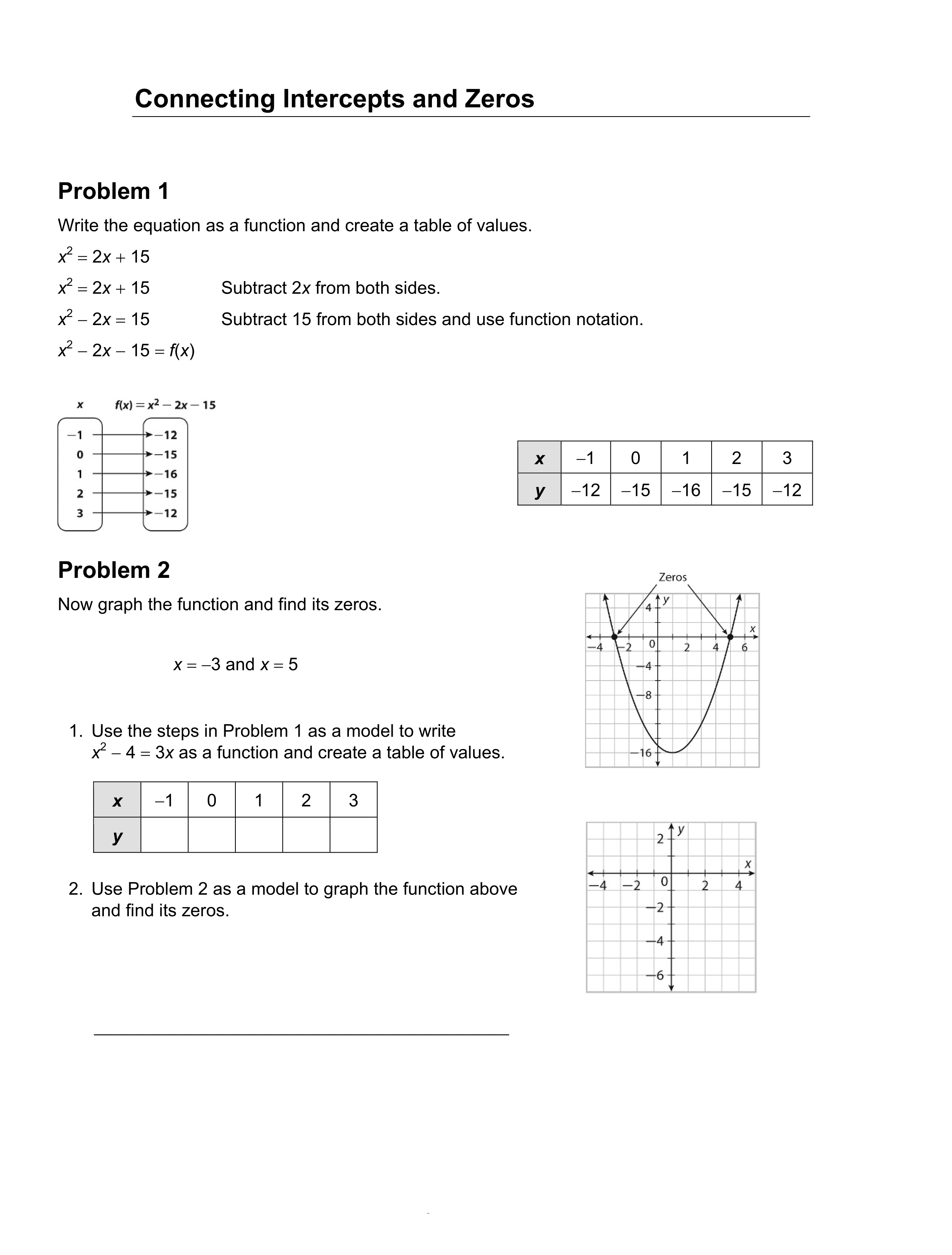
A competitive diver stands at the end of a 30-foot platform and falls forward into a dive.
The function h(t) = −16t² + 30, where t represent the time in seconds, gives the height h, in feet, of the diver as he falls.
How long is the diver in the air? Round your answer to the nearest tenth of a second.
When is he 20 feet in the air? Round your answer to the nearest tenth of a second.
Nature A bird is in a tree 60 feet off the ground and drops a twig that lands on a
rosebush 25 feet below. The function h (t) = -16t² + 60, where t represents the time
in seconds, gives the height h, in feet, of the twig above the ground as it falls.
When will the twig land on the bush? Round your answer to the nearest hundredth place.
If the bush was not there, when would the twig hit the ground? Round your answer to the nearest hundredth place.
A basketball player named Orlando successfully makes a free throw. The height of the ball above the ground can be modeled by the quadratic function f(t) = −16t² + 27t + 6 where t is the time the ball is in the air. The basket is 10 feet above the ground.
How long does it take the ball to get to the basket? Round your answer to the nearest tenth of a second.
If Orlando shoots an airball, how long would it take to hit the ground? Round your answer to the nearest tenth of a second.
A baseball coach uses a pitching machine to simulate pop flies during
practice. The quadratic function ƒ (x) = -16x² + 70x + 10 models the height in feet
of the baseball after x seconds.
How high does the ball get in the air? Round your answer to the nearest tenth of a second.
How long is the baseball in the air if the ball is not
caught? Round your answer to the nearest tenths place.
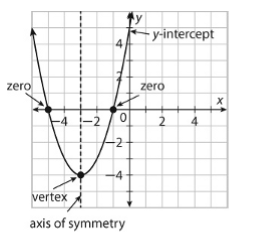
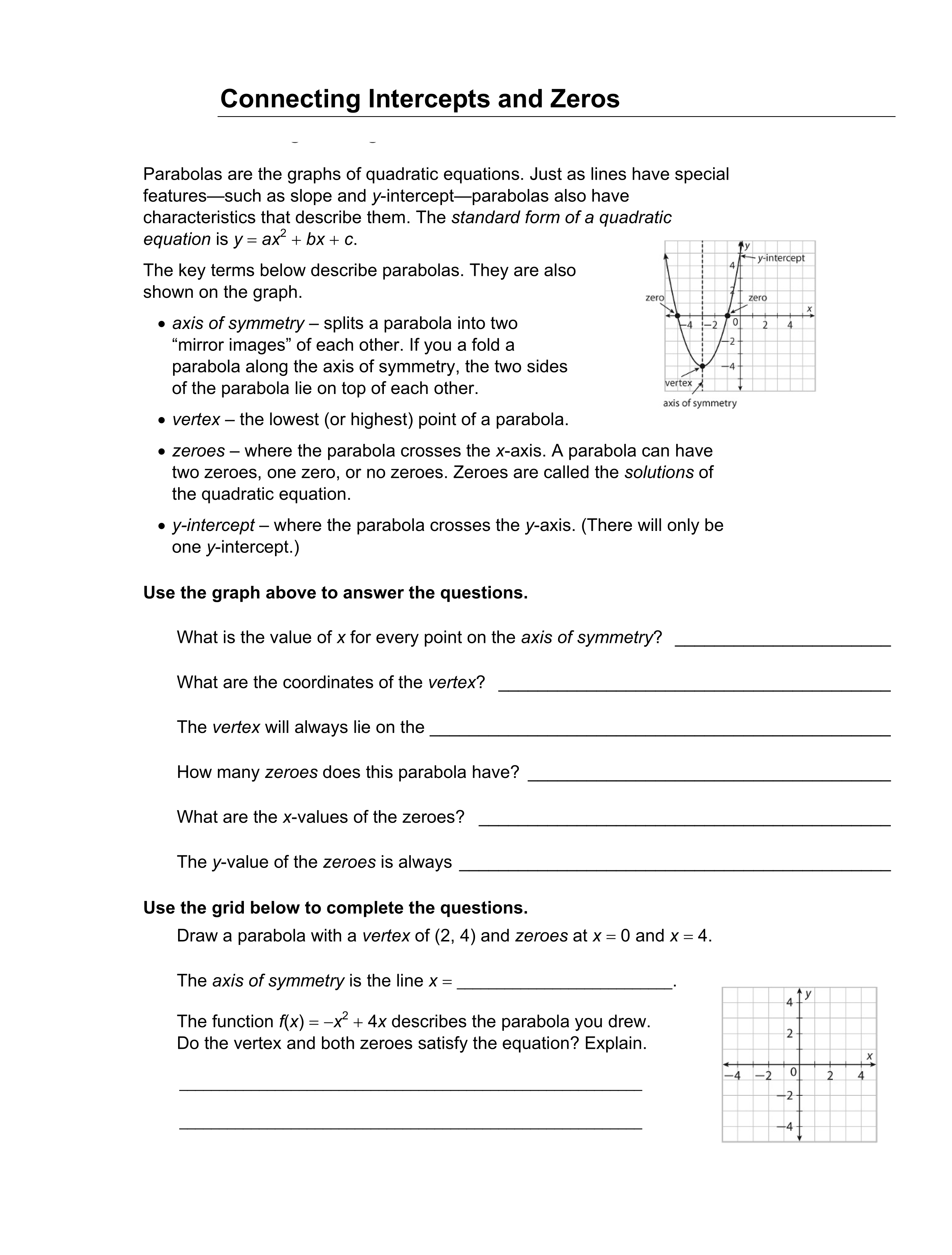
What is the value of x for every point on the axis of symmetry?
What are the coordinates of the vertex?
The vertex will always be on the_____________
How many zeros does this parabola have?
What are the x-values of the zeroes?
Left zero [Your answer should be in the coordinate form (x,y) ]
Right zero [Your answer should be in the coordinate form (x,y) ]
The y-value of the zeroes is always______________
What are two other names that mean the same as the "zeroes of the quadratic equation" ? (If you do not know do a quick search on Google.)
Use the graph to find the features of this quadratic equation.
What is the axis of symmetry? (Use the form x=__ for your answer.
What is the vertex? [Your answer should be in the coordinate form (x,y) ]
What is one zero of the equation? (Write your answer in the form x=___)
What is another zero of the equation?(Write your answer in the form x=___)
Use the graph to find the features of this quadratic equation.
What is the axis of symmetry? (Use the form x=__ for your answer.
What is the vertex? [Your answer should be in the coordinate form (x,y) ]
What is one zero of the equation? (Write your answer in the form x=___)
What is another zero of the equation?(Write your answer in the form x=___)
Use the graph to find the features of this quadratic equation.
What is the axis of symmetry? (Use the form x=__ for your answer.
What is the vertex? [Your answer should be in the coordinate form (x,y) ]
What is one zero of the equation? (Write your answer in the form x=___)
What is another zero of the equation?(Write your answer in the form x=___)
Use the graph to find the features of this quadratic equation.
What is the axis of symmetry? (Use the form x=__ for your answer.
What is the vertex? [Your answer should be in the coordinate form (x,y) ]
What is one zero of the equation? (Write your answer in the form x=___)
What is another zero of the equation?(Write your answer in the form x=___)
Use the graph to find the features of this quadratic equation.
What is the axis of symmetry? (Use the form x=__ for your answer.
What is the vertex? [Your answer should be in the coordinate form (x,y) ]
What is one zero of the equation? (Write your answer in the form x=___)
What is another zero of the equation?(Write your answer in the form x=___)
Fill the table of values and graph the Quadratic Function.
What is the axis of symmetry? (Use the form x=__ for your answer.)
What is the vertex? [Your answer should be in the coordinate form (x,y) ]
What is one zero of the equation? (Write your answer in the form x=___)
What is another zero of the equation?(Write your answer in the form x=___)
Fill the table of values and graph the Quadratic Function.
What is the axis of symmetry? (Use the form x=__ for your answer.)
What is the vertex?
What is one zero of the equation?(Write your answer in the form x=___)
What is another zero of the equation?(Write your answer in the form x=___)
Fill the table of values and graph the Quadratic Function.
What is the axis of symmetry? (Use the form x=__ for your answer.)
What is the vertex?
What is one zero of the equation?(Write your answer in the form x=___)
What is another zero of the equation?(Write your answer in the form x=___)
Fill the table of values and graph the Quadratic Function.
What is the axis of symmetry? (Use the form x=__ for your answer.)
What is the vertex?
What is one zero of the equation?(Write your answer in the form x=___)
What is another zero of the equation?(Write your answer in the form x=___)
Fill the table of values and graph the Quadratic Function.
What is the axis of symmetry? (Use the form x=__ for your answer.)
What is the vertex?
What is one zero of the equation?(Write your answer in the form x=___)
What is another zero of the equation?(Write your answer in the form x=___)
Fill the table of values and graph the Quadratic Function.
What is the axis of symmetry? (Use the form x=__ for your answer.)
What is the vertex?
What is one zero of the equation?(Write your answer in the form x=___)
What is another zero of the equation?(Write your answer in the form x=___)