Log in
Sign up for FREE
arrow_back
Library

Geometry 4-2 Complete Lesson: Triangle Congruence by SSS and SAS

star
star
star
star
star
Last updated almost 4 years ago
26 questions
Note from the author:
A complete formative lesson with embedded slideshow, mini lecture screencasts, checks for understanding, practice items, mixed review, and reflection. I create these assignments to supplement each lesson of Pearson's Common Core Edition Algebra 1, Algebra 2, and Geometry courses. See also mathquest.net and twitter.com/mathquestEDU.
30
10
10
10
10
10
5
5
10
10
10
10
Question 1
1.

Solve It! Are the triangles shown congruent?

10
Question 2
2.

How do you know?

10
Question 3
3.

Take Note: Summarize The Side-Side-Side (SSS) Postulate.

10
Question 4
4.

Take Note: Triangles are rigid figures. What does that mean?

Question 5
5.

Problem 1 Got It? Complete the proof on the canvas.

You may also complete your work on paper or on a whiteboard and upload a clear picture of it to the canvas.

10
Question 6
6.

Take Note: In a triangle, what is an included side? What is an included angle? You may use the canvas to illustrate your responses.

10
Question 7
7.

Take Note: Summarize The Side-Angle-Side (SAS) Postulate.

10
Question 8
8.

Problem 2 Got It?

10
Question 9
9.

Problem 3 Got It?

10
Question 10
10.
10
Question 11
11.
10
Question 12
12.
10
Question 13
13.
10
Question 14
14.
10
Question 15
15.
Question 16
16.

Compare and Contrast: How are the SSS Postulate and the SAS Postulate alike? How are they different?

10
Question 18
18.

Reasoning: A carpenter trims a triangular peak of a house with three 7-ft pieces of molding. The carpenter uses 21 ft of molding to trim a second triangular peak. Are the two triangles formed congruent? Explain. You may use the canvas to help illustrate your thinking.

Question 19
19.

Review Lesson 4-1: Two quadrilaterals are congruent as described in the congruence statement below.
Match corresponding parts from the quadrilaterals.

Draggable itemarrow_right_altCorresponding Item
\overline{HE}
arrow_right_alt
\angle{E}
\angle{G}
arrow_right_alt
\overline{AB}
\overline{EF}
arrow_right_alt
\angle{C}
\angle{A}
arrow_right_alt
\overline{DA}
\angle{GFE}
arrow_right_alt
\angle{CBA}
Question 20
20.

Review Lesson 2-2: Write the converse of the statement. Determine whether the statement and its converse are true or false.

If x = 3, then 2x = 6.

Question 21
21.

Review Lesson 2-2: Is the converse of the statement true or false?

If x = 3, then x² = 9.

Question 22
22.

Review Lesson 4-2: In △JHK, name the side that is included between ∠J and ∠H.

Question 23
23.

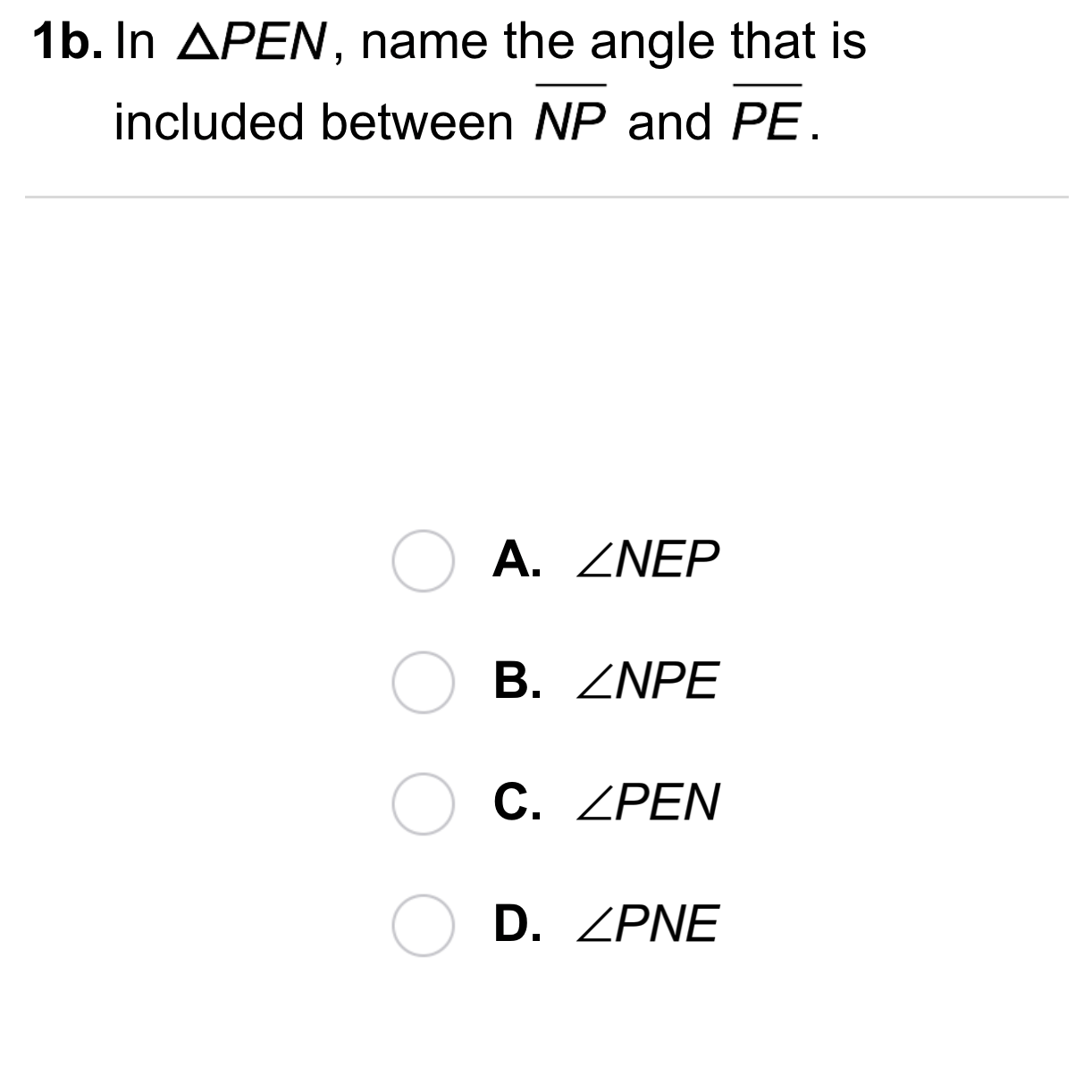
Review Lesson 4-2: In △NLM, name the angle that is included between side NM and side LN.

Question 24
24.

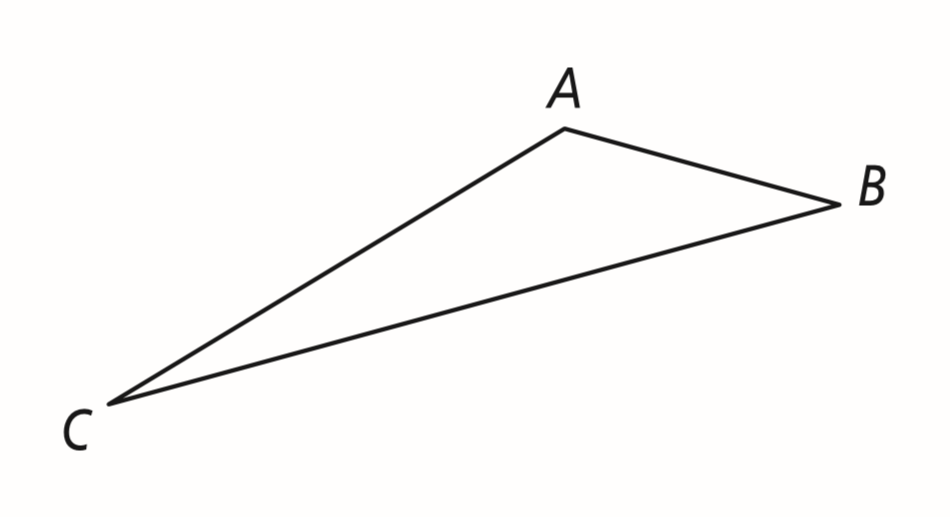
Vocabulary Review: Use the diagram below to match corresponding items.
You may need to zoom out to see all of the items. You can also match each item from the left column by selecting it (click it) then selecting (clicking on) the mate for it.

Draggable itemarrow_right_altCorresponding Item
included side between \angle{B} and \angle{A}
arrow_right_alt
\angle{A}
included angle between \overline{AB} and \overline{CA}
arrow_right_alt
\overline{CA}
included side between \angle{A} and \angle{C}
arrow_right_alt
\angle{C}
included side between \angle{B} and \angle{C}
arrow_right_alt
\overline{BC}
included angle between \overline{BC} and \overline{CA}
arrow_right_alt
\angle{B}
included angle between \overline{BC} and \overline{AB}
arrow_right_alt
\overline{}
Question 25
25.

Use Your Vocabulary: What is a postulate?

Question 26
26.

Reflection: Math Success