Log in
Sign up for FREE
arrow_back
Library

Geometry 3-2 Complete Lesson: Properties of Parallel Lines

star
star
star
star
star
Last updated about 4 years ago
26 questions
Note from the author:
10
30
G.CO.9
10
10
20
10
10
10
10
10
10
A complete formative lesson with embedded slideshow, mini lecture screencasts, checks for understanding, practice items, mixed review, and reflection. I create these assignments to supplement each lesson of Pearson's Common Core Edition Algebra 1, Algebra 2, and Geometry courses. See also mathquest.net and twitter.com/mathquestEDU.
10
10
Question 2
2.

Take Note: Summarize Postulate 3-1: The Same-Side Interior Angles Postulate. You may use the canvas to help illustrate your description.

Question 3
3.

Problem 1 Got It? If you know the measure of one of the angles, can you always find the measures of all 8 angles when two parallel lines are cut by a transversal? Explain.

You may use the canvas to help illustrate your explanation.

10
Question 4
4.

Take Note: Summarize Theorem 3-1: The Alternate Interior Angles Theorem. You may use the canvas to help illustrate your description.

10
Question 6
6.

Problem 2 Got It? Complete the proof on the canvas. Use a color other than black for your work.

10
Question 7
7.

Take Note: Summarize Theorem 3-3: The Alternate Exterior Angles Theorem. You may use the canvas to help illustrate your description.

10
G.CO.9
10
G.CO.9
10
G.CO.9
10
G.CO.9
10
10
10
10
10
10
Question 18
18.

Compare and Contrast: How are the Alternate Interior Angles Theorem and the Alternate Exterior Angles Theorem Alike? How are they different?

Question 19
19.

In Problem 2, you proved that angles 1 and 8, in the diagram below, are supplementary.


What is a good name for this pair of angles? Explain.

Question 20
20.

Question 21
21.

Question 22
22.

Draggable itemarrow_right_altCorresponding Item
arrow_right_alt
arrow_right_alt
arrow_right_alt
Question 23
23.

Question 24
24.

Question 25
25.

Question 26
26.

Reflection: Math Success

Question 1
1.

Question 5
5.

Take Note: Summarize Theorem 3-2: The Corresponding Angles Theorem. You may use the canvas to help illustrate your description.

Question 8
8.

Question 9
9.

Question 10
10.

Question 11
11.

Question 12
12.

Question 13
13.

Question 14
14.
Question 15
15.
Question 16
16.
Question 17
17.
Review Lesson 3-1: Drag each of the statements on the left into the appropriate category.
Skew lines are coplanar.
Skew lines intersect.
Parallel lines intersect.
Rays are parallel.
Intersecting lines are coplanar.
Always
Sometimes
Never
Review Lesson 2-2: Write the converse of the conditional statement and determine its truth value.

If two angles are vertical angles, then they are congruent.
If two angles are not congruent, then they are not vertical angles; true.
If two angles are not vertical angles, then they are not congruent; false.
If two angles are congruent, then they are vertical angles; false.
Vocabulary Review: Match each symbol with its meaning.
=
congruent
||
equivalent
\cong
parallel
Vocabulary Review: Classify each angle as acute, obtuse, or right.

You may need to zoom out to see all of the items. You can also place each item from the left column by selecting it (click it) then selecting (clicking on) the category for it.
Acute
Obtuse
Right
Use Your Vocabulary: Use the diagram to complete each sentence on the right using the correct point from the left.
B
A
C
The interior of the circle contains point __?__.
The exterior of the circle contains point __?__.
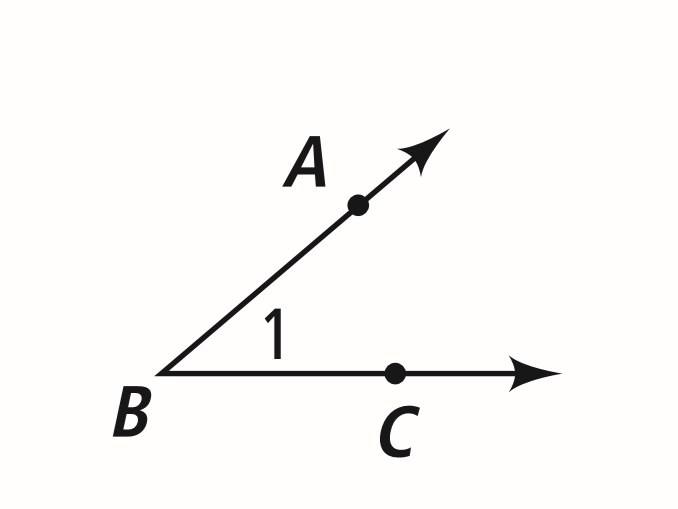
Use Your Vocabulary: Use the diagram to complete each sentence on the right using the correct item(s) from the left.

C
∠1
∠CBA
∠BAC
A
B
∠CAB
The vertex of ∠ABC is __?__.
Two other names for ∠ABC are __?__ and __?__. (order does not matter)
Solve It! Look at the map of streets in Clearwater, Florida. Nicholson Street and Cedar Street are parallel. Which of these pairs of angles appear to be congruent? Select all that apply.
∠7 and ∠8
∠10 and ∠12
∠9 and ∠11
∠5 and ∠8
∠8 and ∠6
∠12 and ∠9
Problem 3 Got It?
A
B
C
D
Problem 3 Got It?
A
B
C
D
Problem 3 Got It?
A
B
C
D
Problem 3 Got It?
A
B
C
D
Problem 4 Got It?
A
B
C
D
Problem 4 Got It?
A
B
C
D
A
B
C
A
B
C
D
A
B
C
D
A
B
C
D