French Placement Exam

Last updated over 5 years ago
142 questions

BIENVENUE À LICK!

FRENCH PLACEMENT EXAM
0

What is your name please? (first and last name)

1

What grade will you be at Lick-Wilmerding next year? (9, 10, 11, or 12)

0

What is your home address?

0

What is your email address?

0

What is your phone number?

0

Please tell me about your prior French language study. Write the letter and answer for each question below:

(a) At what school did you study French and in what grades?
(b) How long was each class session?
(c) How may days a week did class meet?
(d) How many years did you study?
(e) What level did you reach? (For example, French 1, French 2, etc.)

0

Have you ever lived in a French-speaking country for more than 3 consecutive months? If so, at what age, where, and for how long?

0

Is French spoken fluently by anyone in your home?

BONNE CHANCE!


INSTRUCTIONS: Write as much as you can based on what you know; we do not expect you to be able to answer every question. You should feel free to leave sections blank. Do not be afraid to skip any questions you may not know. This placement test is used for more than one level, so please just relax and just do your best.

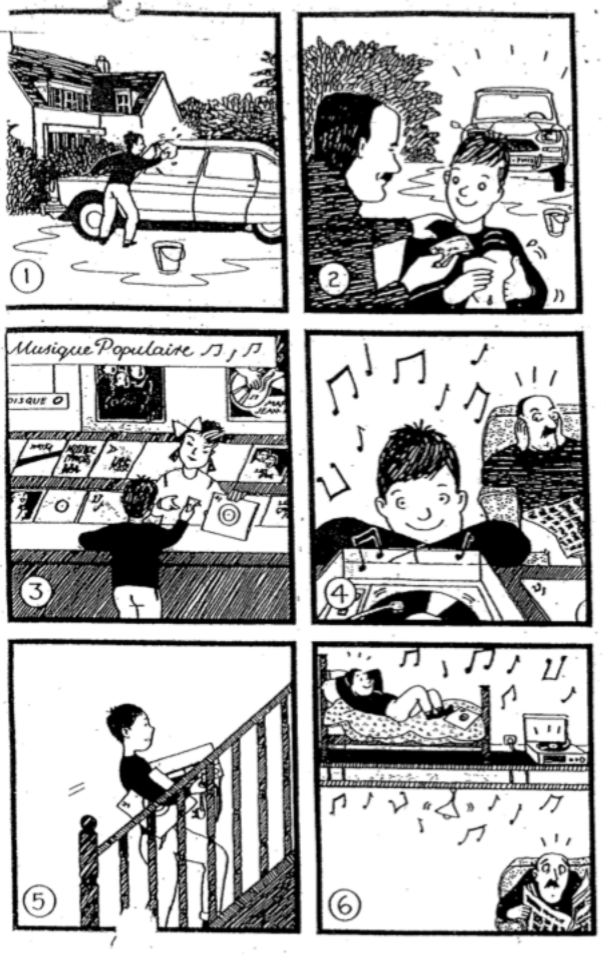
Please begin with the picture story immediately below, but do not spend more than 15 minutes on it.
1

A. PICTURE STORY: Describe the story in the above image. (15 minutes)
  • Use past tenses if you are able to, otherwise use the present tense.
  • Use as much vocabulary and as many varied structures and verbs as you can.
  • Use at least three adjectives.
  • Try to avoid using English. If you don't know a word in French, try to describe it in French ("the thinkg that...")

B. PRESENT TENSE: Conjugate the verbs in the present tense with the subject indicated.

Modèle: parler: je __________ Answer: parle
1

faire: je __________

1

faire: nous __________

1

faire: ils __________

1

aller: je __________

1

aller: nous __________

1

aller: ils __________

1

avoir, j' __________

1

avoir, nous __________

1

avoir, ils __________

1

dormir, je __________

1

dormir, nous __________

1

dormir, ils __________

1

écrire, j' __________

1

écrire, nous __________

1

écrire, ils __________

1

vouloir, je __________

1

vouloir, nous __________

1

vouloir, ils __________

C. VERBS: Please give the French infinitive form of the following verbs.

Modèle: to speak answer: parler
1

to take

1

to put

1

to read

1

to buy

1

to wait for

1

to say

1

to go home

1

to go out (with a friend, from a place)

D. ARTICLES: Fill in the blank with the French equivalent for the word in parentheses (definite, indefinite, partitive article, etc.) Look for gender clues in the sentence!
1

Pour le déjeuner, nous allons manger __________ (some) soupe chaude.

1

Pour le déjeuner, nous allons manger __________ (some) poulet froid.

1

Nous ne manageons pas __________ (any) escargots.

1

Ma soeur adore __________ (the) cuisine chinoise.

1

Elle n'aime pas __________ (the) petits pois.

1

Je n'aime pas __________ (this) chanson; elle est mauvaise.

1

__________ (these) chansons sont meilleures.

E. ADJECTIVES: Complete the following sentences with the French translation of the phrase given in parentheses. Pay attention to adjective agreement and position.
1

C'est __________ (a tall girl).

1

Ce sont trois __________ (good books).

1

Il a __________ (a black dog).

1

Ce sont des __________ (French mothers).

F. PRESENT AND PAST TENSES: Conjugate the verbs with the subject indicated in the "présent" and "passé composé" (auxiliary verb + past participle).

Modèle: parler-je (présent) Answer: je parle
Modèle: parler-je (passé composé) Answer: j'ai parlé
1

habiter-il (présent)

1

habiter-il (passé composé)

1

rendre-je (présent)

1

rendre-je (passé composé)

1

finir-nous (présent)

1

finir-nous (passé composé)

1

descendre-elle (présent)

1

descendre-elle (passé composé)

1

arriver-ils (présent)

1

arriver-ils (passé composé)

1

pouvoir-tu (présent)

1

pouvoir-tu (passé composé)

1

sortir-vous (plural) (présent)

1

sortir-vous (plural) (passé composé)

1

mettre-je (présent)

1

mettre-je (passé composé)

1

écrire-elles (présent)

1

écrire-elles (passé composé)

G. VERBS IN CONTEXT: Use the clues in the sentences to conjugate the verbs in the appropriate tense.
ATTENTION: Some verbs remain in the infinitive. Also note that some sentences continue to the next question.

Modèle: Aujourd'hui, je __________ à mon ami. Answer: parle
Modèle: Mais hier, je __________ à mes grand-parents. Answer: ai parlé
1

En général, je __________ (aimer) le dessert . . .

1

. . . mais tu __________ (ne pas aimer) les gâteaux.

1

Mes parents veulent __________ (parler) à Robert après l'école.

1

L'été dernier, on __________ en France, . . .

1

. . . __________ (manger), . . .

1

. . . et __________ (beaucoup grossir)

If you are placing into French 2, you do not need to continue. If you are placing into French 3, 4 or Honors 4, please answer those sections you are able to answer.
_______________________________________________________________________________________________________________
H. REFLEXIVE VERBS: Write the conjugation of the reflexive verb that corresponds to the subject prompts below.
Modèle: (have a good time) Ils __________ Answer: Ils s'amusent.
1

(brush one's teeth) Il __________

1

(comb one's hair) Je __________

1

(wash oneself) Vous

1

(wash one's face) Nous __________

I. VOCABULARY: Translate the following verbs into the French infinitive form.
Modèle: to speak Answer: parler
1

to believe

1

to listen to

1

to look for

1

to sell

1

to have to

1

to try to

1

to want to

1

to need to

J. SIMPLE FUTURE: Conjugate the verbs in the simple future (NOT aller + infinitif) with the subject indicated.
Modèle: parler - je Answer: je parlerai
1

chanter - tu

1

partir - ils

1

aller - elle

1

faire - vous

K. OTHER TENSES: Conjugate the verbs with the given subject in the indicated tense.
Modèle: parler - je (imparfait) Answer: je parlais
1

avoir -- nous (imparfait)

1

finir - on (imparfait)

Modèle: parler - je (conditionnel) Answer: je parlerais
1

perdre - vous (conditionnel)

1

être - Paul et Louise (conditionnel)

L. VERBS IN CONTEXT: Use the temporal clues in the sentences to conjugate the verbs in the appropriate tense: conditionnel * futur * imparfait * infinitif * passé composé * présent
ATTENTION: Some tenses may be used more than once.
Modèle: Hier, je ____________________ (parler) avec mon professeur. Answer: ai parlé
1

Si tu ____________________ (prendre) le bus, tu arriveras plus vite!

1

Quand il était petit, mon père ____________________ (aller) à la plage tous les week-ends avec ses parents.

1

Il ____________________ (faire) du roller quand il est tombé.

1

Demain matin nous ____________________ (partir) très tôt.

1

Si j'avais de l'argent, je ____________________ (voyager) autour du monde.

1

Ils téléphoneront quand ils ____________________ (être) dans notre rue.

1

Hier soir, est-ce que tu ____________________ (faire) tes devoirs?

1

Mes amis viennent de ____________________ (sortir), mais ils ont oublié leurs clés de voiture!

M. OBJECT PRONOUNS: Fill in the blank with the appropriate direct or indirect object pronoun, or "y" or "en."
1

Louise n'a pas ses devoirs. Elle ____________________ a laissés chez elle.

1

Combien de cours a-t-elle cet après-midi? Elle ____________________ a quatre.

1

Marie a mon livre; je ____________________ ____________________ (two-word answer) ai prêté.

1

Manu connaît bien Paris; il ____________________ est allé l'été dernier.

N. RELATIVE AND INTERROGATIVE PRONOUNS: Complete the sentences with the appropriate relative pronouns (that, who, which) or interrogative word (who, what, where, when, how).
ATTENTION: Not all the examples in brackets will be used.
1

(HENRI): ____________________ allez-vous y aller?
(MARIE): En métro et en bus. On n'a pas de voiture.

1

(LUCIE): ____________________ vont-ils arriver?
(AÏDA): Probablement ce soir.

1

(ANDREI): La voiture ____________________ il a achetée coûtait cher?
(GEORGES): Assez, mais ses parents l'ont aidé à la payer.

1

(TAREQUE): ____________________ est-ce que tu vas aller en vacances cet été?
(JULIO): Nous allons aller à la Guadeloupe.

1

(LUCIA) Est-ce que c'est toi ____________________ as fait ce dessin?
(MARIA) Non, c'est un dessin de mon frère.

1

(JEAN): Ce n'est pas le livre ____________________ nous avons besoin.
(LAURA): Zut alors! Je vais chercher le bon livre.

O. SUBJUNCTIVE OR NOT? Complete the sentence logically, using an appropriate second verb and correct conjugation.
ATTENTION: Some sentences do NOT require the subjunctive.
1

J'espère que ____________________.

1

Elle est heureuse que ____________________.

1

Il faut que ____________________.

1

Nous sommes sûrs que ____________________.

P. DEMONSTRATIVE/INTERROGTIVE ARTICLES AND PRONOUNS: Fill in the blank with the French equivalent for the word in parentheses.
ATTENTION: Where indicated, one sentence is broken up into more than one question (#113, 114 and 115 below).
1

____________________ (which) fille s'appelle Marie-Claire: . . . (continued to next question)

1

____________________ . . . (this one) ou (continued to next question)

1

____________________ (that one)?

1

Vous voyez ces garçons? ____________________ qui danse avec Hélène est un élève au lycée Urban.

1

J'ai deux pantalons possible. ____________________ (which one) va le mieux avec ma veste?

You may choose to leave the following sections blank if you do not know this more advanced grammar.
___________________________________________________________________________________________________________________________________
Q. ADVANCED VERB TENSES: Conjugate the verbs with the given subject in the indicated tense.
Modèle: parler - je (plus-que-parfait) Answer: j'avais parlé
1

oublier - nous (plus-que-parfait)

1

partir - ils (plus-que-parfait)

Modèle: parler - je (conditionnel passé) Answer: j'aurais parlé
1

rencontrer - vous (conditionnel passé)

1

aller - elle (conditionnel passé)

R. COMPOUND RELATIVE PRONOUNS: Complete the sentences with the appropriate relative expressions (that which / that who).
ATTENTION: Some will be used more than once.
1

Demandez au prof ____________________ vous allez faire la semaine prochaine.

1

Je pense que ____________________ est important est d'apprendre à l'école, pas seulement d'avoir de bonnes notes!

1

N'oubliez pas d'apporter ____________________ vous aurez besoin pour le pique-nique de demain!

1

On peut faire ____________________ on veut comme activité.

S. DIVERSE PRONOUNS: Fill in the blank with the missing words (one word per sentence except for #131).
1

____________________ pensez-vous du nouveau directeur?

1

Est-ce que c'est lui ____________________ va venir avec toi?

1

Elle aime les deux robes. Elle ne sait pas ____________________ choisir!

1

____________________ livres avez-vous lus en classe?

1

Elle était si surprise par la réponse qu'elle n'a ____________________ dit!

1

Sais-tu ____________________ ____________________ (two-word response) m'est arrivé hier?

T. VERBS IN CONTEXT: Complete the sentences with the appropriate verb tenses: plus-que-parfait * future simple (NOT aller + infinitive) * conditionnel passé * participe présent * infinitif passé * subjonctif présent * subjonctif passé
1

Si je ____________________ (savoir) que la réunion serait annulée, je ne serais pas venu!

1

Il s'est blessé en ____________________ du ski.

1

Après ____________________ (recevoir) le prix, elle s'est mise à pleurer.

1

Il veut que nous ____________________ (faire) ce travail pour demain!

1

Il est dommage qu'elle ____________________ (être) absente hier car nous avions un cadeau à lui donner.

1

Quand nous ____________________ (être) à Dakar, nous te téléphonerons.

1

Je t' ____________________ (aider) si j'avais plus de temps.

1

Il ____________________ (se rendre compte) de son erreur, il s'est excusé immédiatement.

1

Nous ____________________ (aller) les voir si nous n'avions pas eu tant de travail.

U. PASSIVE VOICE: Write two sentences (original or translated from the examples below) illustrating the use of the passive form (la voix passive).
English examples: The street was closed by the police.
The Nazis were defeated by the Allies in World War II.
1

Sentence 1 : ____________________

1

Sentence 2: ____________________

FIN
MERCI BEAUCOUP!