Log in
Sign up for FREE
arrow_back
Library
The Cell and Membrane Transport Study Guide
By Katelyn Owens
star
star
star
star
star
Share
share
Last updated almost 2 years ago
25 questions
Add this activity
6
6
1
2
3
4
zoom_in
4
6
1
Question 3
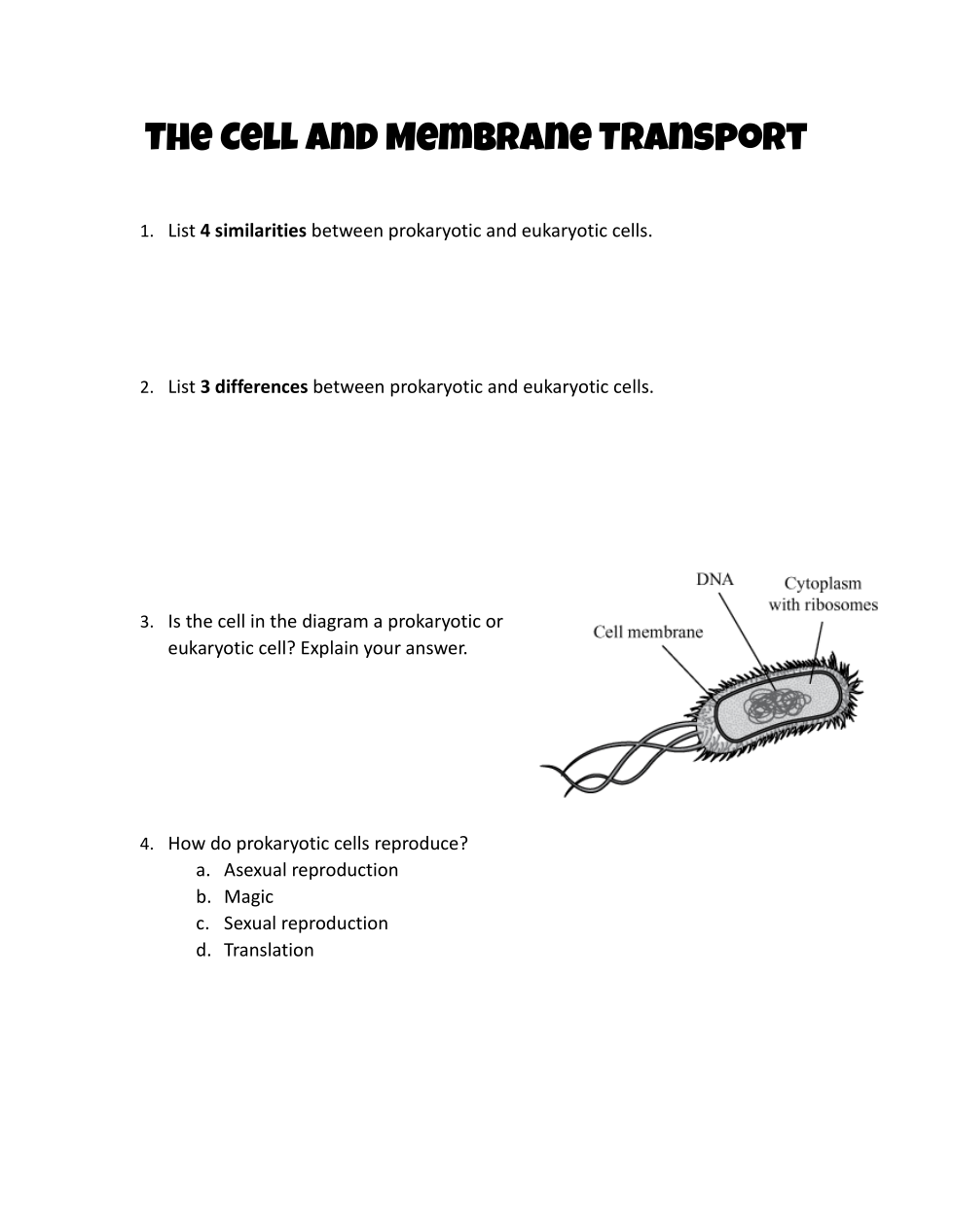
3.
Is the cell in the diagram a prokaryotic or eukaryotic cell? Explain your answer.
1
5
6
7
8
9
10
zoom_in
3
1
1
1
1
1
11
12
13
14
15
16
17
18
zoom_in
1
1
1
1
1
1
1
1
19
20
21
22
23
zoom_in
3
1
1
1
2
Question 23
23.
Explain the difference between diffusion and active transport.
Question 24
24.
Move the items to either passive or active transport. Move all tiles.
moves from high to low
moves from low to high
does not require energy
moves down concentration gradient
requires energy
moves against concentration gradient
Passive Transport
Active Transport
Question 25
25.
Move the descriptions to the correct solution type.
cells shrink
cell remains the same size
cells grow in size
water exits and enters the cell
water enters the cell
water exits the cell
Isotonic
Hypertonic
Hypotonic
Question 1
1.
Click on FOUR similarities between prokaryotic and eukaryotic
plasma membrane
nucleus
cytoplasm
golgi
ribosomes
cell wall
DNA
ER
Question 2
2.
Move the items to match either prokaryotic and eukaryotic cells
DNA is a double helix
Nucleus
Small and Simple
Large and Complex
DNA is circular
No nucleus
Prokaryotic
Eukaryotic
Question 4
4.
How do prokaryotic cells reproduce?
A. asexual reproduction
B. magic
C. sexual reproduction
D. translation
Question 5
5.
Click on all the organelles that are unique to
plant cells. Hint there are 3
mitochondria
nucleus
cell wall
ribosomes
large central vacuole
chloroplast
cytoplasm
Question 6
6.
Identify organelle #6
A. nucleus
B. cytoplasm
C. ribosome
D. mitochondria
Question 7
7.
Identify organelle #7
A. nucleus
B. cytoplasm
C. ribosome
D. mitochondria
Question 8
8.
Identify organelle #8
A. nucleus
B. plasma membrane
C. cell wall
D. mitochondria
Question 9
9.
Identify organelle #9. These organelles can be freely floating or attached to the ER.
A. ribosomes
B. plasma membrane
C. lysosomes
D. cytoplasm
Question 10
10.
Identify organelle #10. This is the jellylike material where all the organelles are located.
A. ribosomes
B. cytoskeleton
C. lysosomes
D. cytoplasm
Question 11
11.
What organelle makes ATP by performing cellular respiration?
A. chloroplast
B. ER
C. mitochondria
D. nucleus
Question 12
12.
What organelle makes proteins?
A. chloroplast
B. nucleur membrane
C. mitochondria
D. ribosomes
Question 13
13.
What organelle stores the DNA and controls the cell activities
A. chloroplast
B. nucleus
C. golgi
D. ribosomes
Question 14
14.
What organelle contains digestive enzymes and breaks down dead or decaying organelles?
A. lysosomes
B. nucleus
C. vacuole
D. cytoskeleton
Question 15
15.
What organelle converts sunlight into glucose by performing photosynthesis?
A. lysosomes
B. nucleus
C. chloroplast
D. ribosomes
Question 16
16.
What organelle surrounds the nucleus and contains pores for mRNA to exit the nucleus?
A. plasma membrane
B. nuclear membrane
C. golgi
D. ribosomes
Question 17
17.
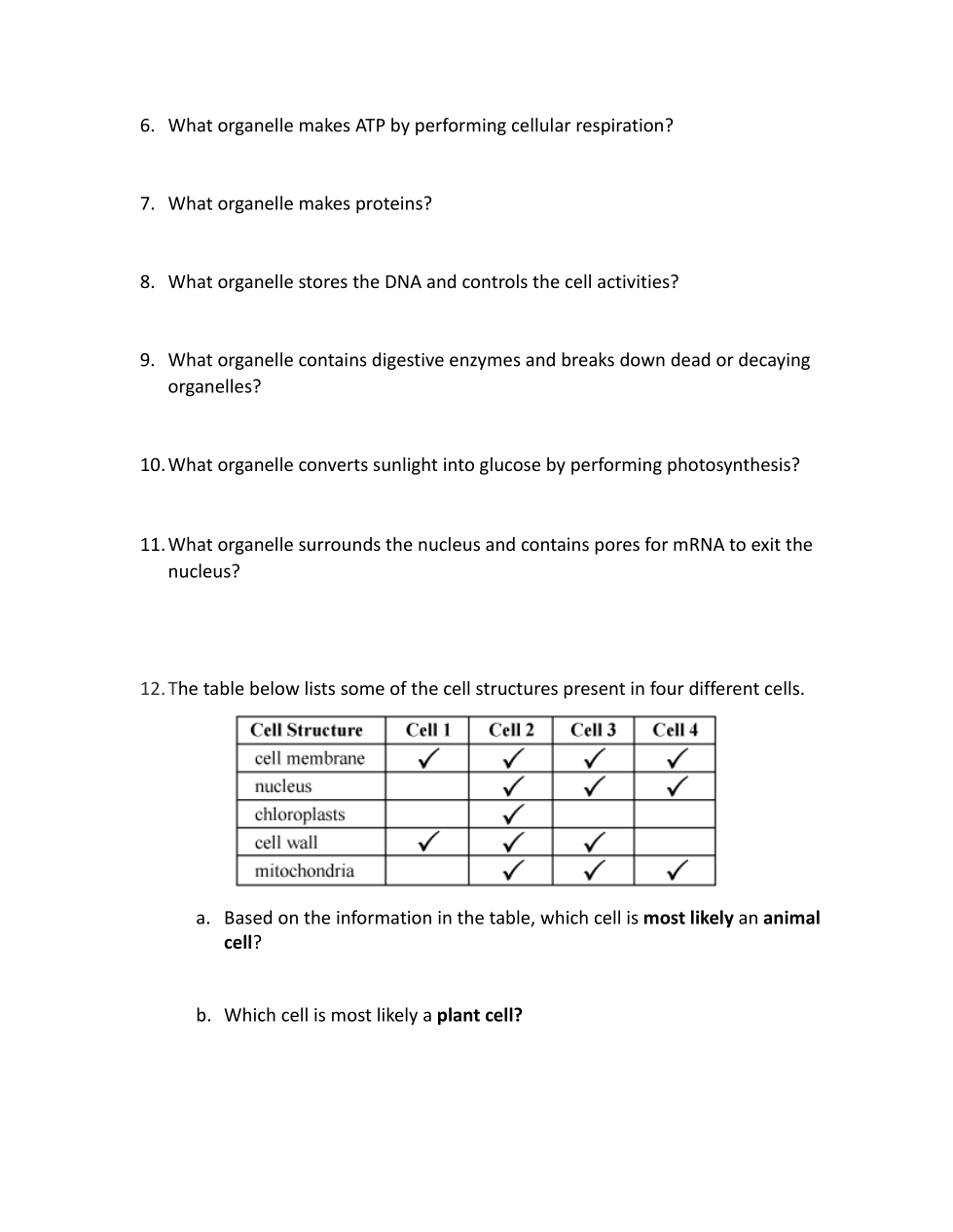
Based on the information in the table, which cell is most likely an
animal cell?
cell 1
cell 2
cell 3
cell 4
Question 18
18.
Based on the information in the table, which cell is most likely a
plant cell
?
cell 1
cell 2
cell 3
cell 4
Question 19
19.
Click on the three types of passive transport.
endocytosis
diffusion
exocytosis
facilitated diffusion
osmosis
Question 20
20.
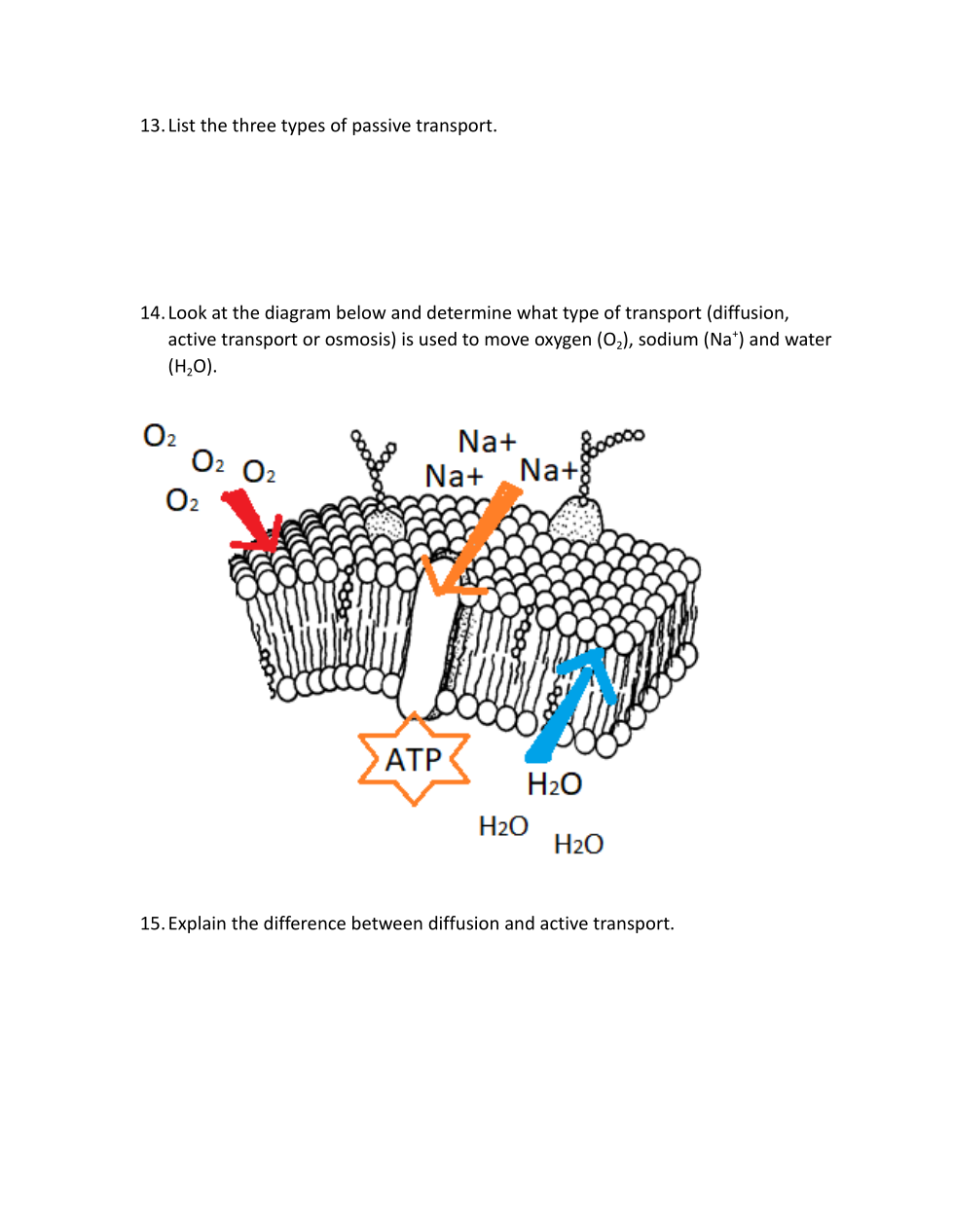
Looking at the diagram, what type of transport is used to move oxygen (O
2
)
A. Diffusion
B. Active Transport
C. Osmosis
Question 21
21.
Looking at the diagram, what type of transport is used to move sodium (Na+)
A. Diffusion
B. Active Transport
C. Osmosis
Question 22
22.
Looking at the diagram, what type of transport is used to move water (H
2
O)
A. Diffusion
B. Active Transport
C. Osmosis