Log in
Sign up for FREE
arrow_back
Library
Cellular Transport Worksheet
By Katelyn Owens
star
star
star
star
star
Share
share
Last updated over 1 year ago
19 questions
Add this activity
Note from the author:
Worksheet on passive and active transport
1
2
3
4
5
6
7
8
9
10
11
zoom_in
1
1
1
1
1
1
1
1
1
1
1
15
12
13
14
zoom_in
1
1
2
2
16
17
18
19
zoom_in
1
1
1
0
Question 19
19.
Explain the difference between diffusion and active transport.
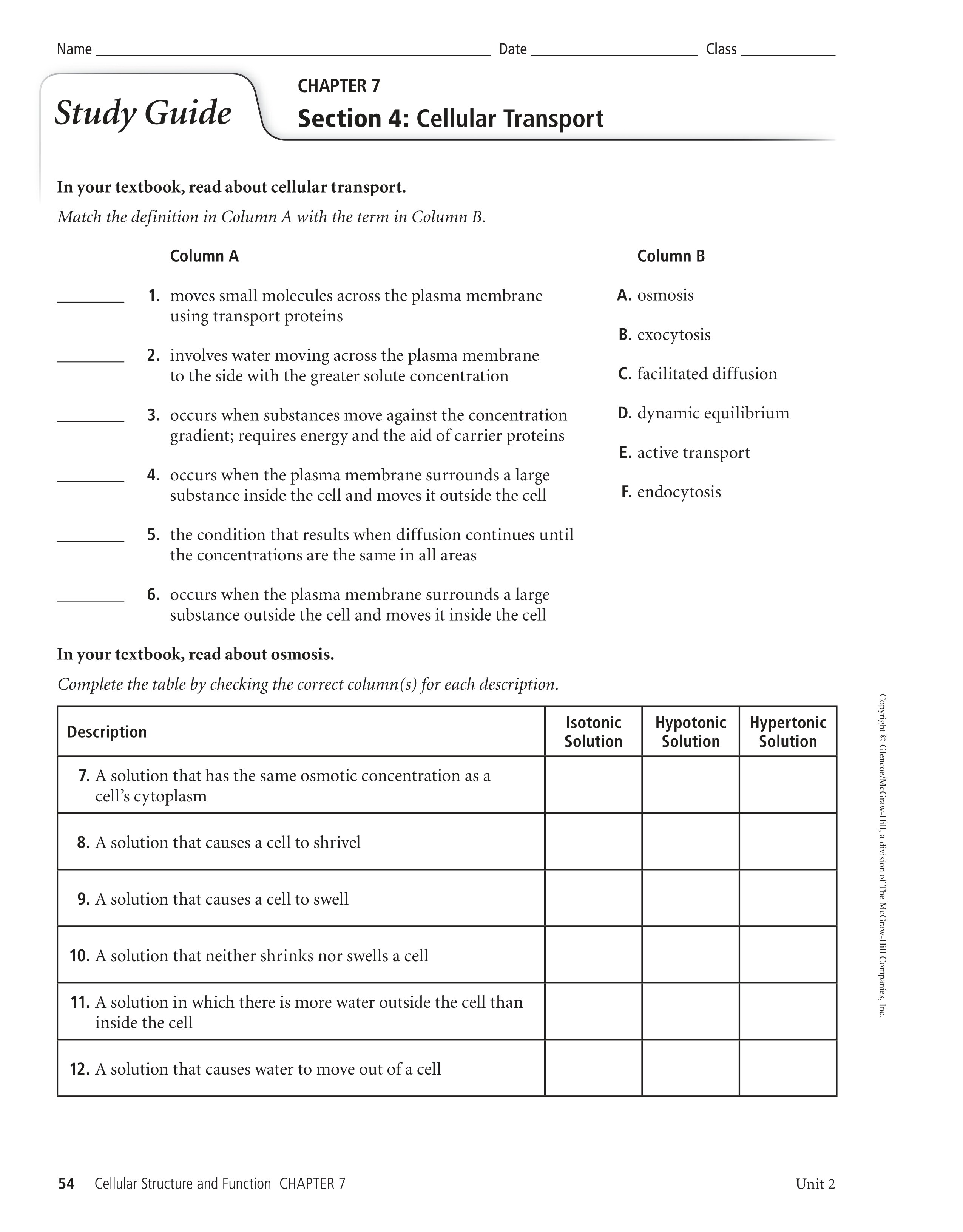
Question 1
1.
Moves small molecules from high to low concentration using transport proteins
A. osmosis
B. exocytosis
C. facilitated diffusion
D. dynamic equilibrium
E. active transport
F. endocytosis
Question 2
2.
involves water moving across the plasma membrane to the side with greater solute concentration (less water)
A. osmosis
B. exocytosis
C. facilitated diffusion
D. dynamic equilibrium
E. active transport
F. endocytosis
Question 3
3.
Occurs when substances move against the concentration gradient. Requires energy and the aid of carrier proteins
A. osmosis
B. exocytosis
C. facilitated diffusion
D. dynamic equilibrium
E. active transport
F. endocytosis
Question 4
4.
occus when the plasma membrane surrounds a large substance inside the cell and
moves it outside
the cell
A. osmosis
B. exocytosis
C. facilitated diffusion
D. dynamic equilibrium
E. active transport
F. endocytosis
Question 5
5.
occurs when the plasma membrane surrounds a large substance outside the cell and
moves it inside
the cell
A. osmosis
B. exocytosis
C. facilitated diffusion
D. dynamic equilibrium
E. active transport
F. endocytosis
Question 6
6.
a solution that has the
same
osmotic concentration as a cell's cytoplasm
Isotonic solution
Hypotonic solution
Hypertonic solution
Question 7
7.
a solution that causes a cell to shrivel or shrink in size
Isotonic solution
Hypotonic solution
Hypertonic solution
Question 8
8.
a solution that causes a cell to swell
Isotonic solution
Hypotonic solution
Hypertonic solution
Question 9
9.
a solution that neither shrinks nor swells a cell
Isotonic solution
Hypotonic solution
Hypertonic solution
Question 10
10.
a solution in which there is more water outsides the cell than inside the cell. Water enters the cell
Isotonic solution
Hypotonic solution
Hypertonic solution
Question 11
11.
a solution that causes water to move out of a cell
Isotonic solution
Hypotonic solution
Hypertonic solution
Question 12
12.
Name the two transport processes that allow large substances to cross the plasma membrane
A. Diffusion
B. Endocytosis
C. Osmosis
D. Exocytosis
Question 13
13.
Identify three transport process in cells that do not require energy
A.Osmosis
B. Phagocytosis
C.Endocytosis
D. Diffusion
E. Exocytosis
F. Facilitated Diffusion
G. Pinocytosis
Question 14
14.
A cell placed in salt water shrinks. What type of solution is salt water?
A. Isotonic
B. Hypotonic
C.Hypertonic
Question 15
15.
Match the description to the correct type of membrane transport
needs energy
moves from low to high
No energy
moves from high to low
Active Transport
Passive Transport
Question 16
16.
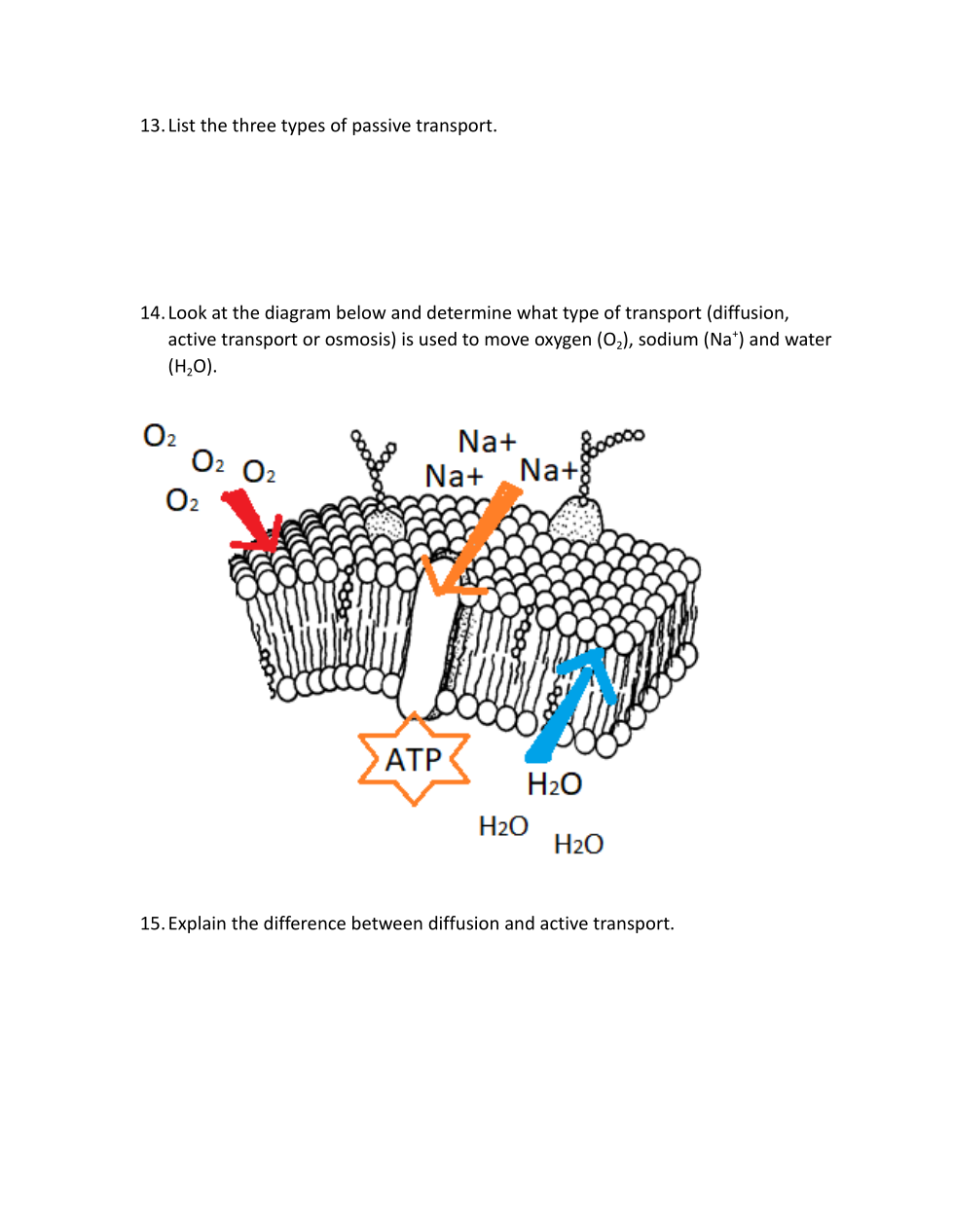
Looking at the diagram, what type of transport is used to move oxygen (O
2
)
A. Diffusion
B. Active Transport
C. Osmosis
Question 17
17.
Looking at the diagram, what type of transport is used to move sodium (Na+)
A. Diffusion
B. Active Transport
C. Osmosis
Question 18
18.
Looking at the diagram, what type of transport is used to move water (H
2
O)
A. Diffusion
B. Active Transport
C. Osmosis