This SAC is made up of 15 multiple choice questions and 6 short answer questions.
Please answer all questions in the spaces provided. Please submit your working out at the end of the SAC. (There is a section for working out submission).
Please make sure your working out is neat, clear and you write which question you are answering next to your working out.
1 point
1
Question 1
1.
Consider the following equation for the formation of hydrogen chloride gas.
H2(g) + Cl2(g) → 2HCl(g) ΔH = −184 kJ mol−1
When 2 moles of hydrogen gas react completely with 2 moles of chlorine gas:
1 point
1
Question 2
2.
The amount of energy required to raise 150 g of water by 40 °C is:
1 point
1
Question 3
3.
1650 mm Hg is equivalent to how many kPa?
1 point
1
Question 4
4.
The mass of 14.2 L of O2(g) measured at SLC is closest to:
1 point
1
Question 5
5.
Butane gas burns completely in air according to the equation:
2C4H10(g) + 13O2(g) → 8CO2(g) + 10H2O(g)
If 20 mL of butane reacts with 200 mL of oxygen at the same temperature and pressure, the
total volume of gases present at the end of the reaction would be:
1 point
1
Question 6
6.
Which of the following terms best describes a substance that dissolves when added to water?
1 point
1
Question 7
7.
Under certain conditions, hydrogen sulfide will burn in oxygen according to the equation:
2H2S(g) + O2(g) → 2S(s) + 2H2O(g)
If all measurements were made at the same temperature and pressure, the volume of water vapour, in mL, produced if 100 mL hydrogen sulfide reacted with 25.0 mL oxygen would be:
1 point
1
Question 8
8.
Which of the following compounds would appear as a precipitate in solution?
1 point
1
Question 9
9.
Consider the following equation:
aC6H14(g) + bO2(g) → cH2O(g) + dCO(g)
The coefficients that balance the equation are represented by a, b, c and d. These are, respectively:
ΔH for the reaction H2(g) + O2(g) → H2O2(l) would be:
1 point
1
Question 11
11.
Which of the following is an example of a precipitation reaction?
1 point
1
Question 12
12.
Choose the correct statement about the solubility of oxygen gas in water.
1 point
1
Question 13
13.
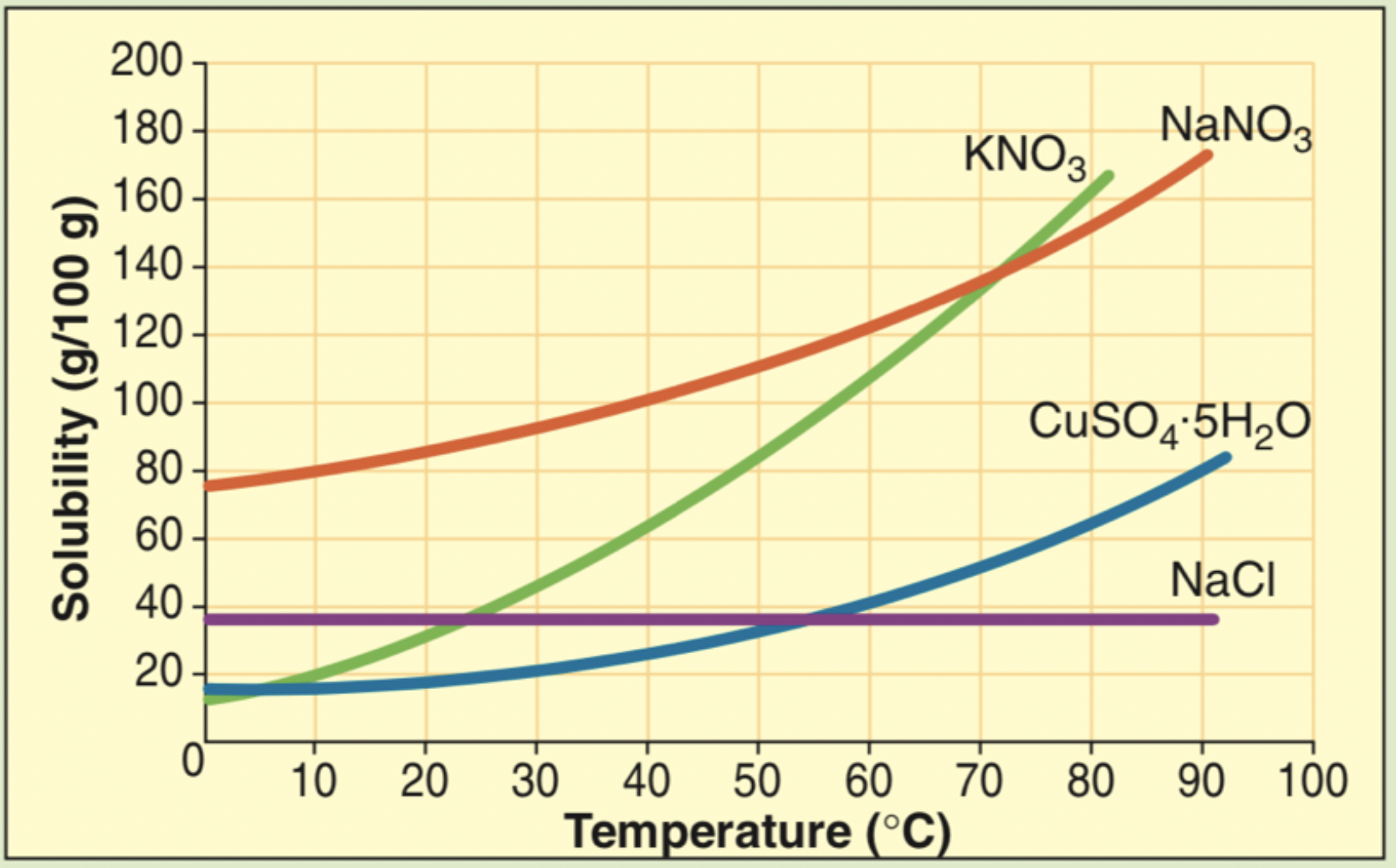
The solubility curve for the solution of KNO3 shows that potassium nitrate has a solubility in water of 37 g / 100 g at 20 °C and 110 g / 100 g at 60 °C.
What mass of KNO3 crystals will form if a saturated solution of KNO3 made up in 200g water at 60 °C is cooled to 20 °C?
1 point
1
Question 14
14.
200 g of water and 200 g of ethanol are poured into identical beakers. Both are initially at the same temperature. Each beaker is heated by the addition of 5000 J of heat energy.
Given that the specific heat capacities are:
Ethanol = 2.4 J g–1°C–1
Water = 4.2 J g–1°C–1
You would expect that, after heating, the temperature of the ethanol would be:
1 point
1
Question 15
15.
Select the alternative that represents a balanced equation for incomplete combustion of a fuel.
a.
b.
c. C2H6(g)+ 5O2(g) → 2CO(g) + 3H2O(g)
d.
2 points
2
Question 16
16.
Chemists use solubility tables to decide if an ionic substance is likely to be soluble or not. The table below is a typical example.
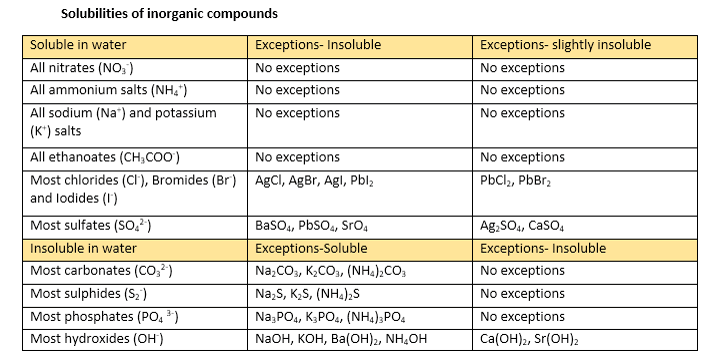
Use the infromation above to label each of the following as soluble, slightly insoluble, or insoluble.
CaSO4
AgCl
NaNO3
(NH4)2SO4
Soluble
Slightly Insoluble
Insoluble
2 points
2
Question 17
17.
When KCl and AgNO3 are mixed a precipitate will form.
Write a balanced equation for the reaction using the solubility table provided to predict the precipitate.
Show the states of all chemicals.
(ex. C2H6(g) + 3O2(g) = 2C(s) + 3H2O(g)) Use an equal sign to represent the arrow and don't worry about subscript and superscript
2 points
2
Question 18
18.
When barium nitrate and sodium sulfate are mixed a precipitate will form.
Write a balanced equation for the reaction using the solubility table provided to predict the precipitate.
Show the states of all chemicals.
(ex. C2H6(g) + 3O2(g) = 2C(s) + 3H2O(g)) Use an equal sign to represent the arrow and don't worry about subscript and superscript
2 points
2
Question 19
19.
When sodium iodide and lead (II) nitrate are mixed a precipitate will form.
Write a balanced equation for the reaction using the solubility table provided to predict the precipitate.
Show the states of all chemicals.
(ex. C2H6(g) + 3O2(g) = 2C(s) + 3H2O(g)) Use an equal sign to represent the arrow and don't worry about subscript and superscript
1 point
1
Question 20
20.
Write the net ionic reaction for the KCl and AgNO3 reaction from above
1 point
1
Question 21
21.
Write the net ionic reaction for the barium nitrate and sodium sulfate reaction from above
3 points
3
Question 22
22.
What will be the values of ∆H for
2Al(s) + 3/2 O2(g) → Al2O3(s)
1 point
1
Question 23
23.
What will be the values of ∆H for
2Al2O3(s) → 4Al(s) + 3O2(g)
1 point
1
Question 24
24.
What will be the values of ∆H for
Al2O3(s) → 2Al(s) + 3/2 O2(g)
3 points
3
Question 25
25.
b. Calculate the amount of energy that will be released from the reaction of 1.00 kg of aluminium.
(*Write you answer below and upload your working out at the end)
3 points
3
Question 26
26.
c. Calculate the amount of energy that will be released from the reaction of 1 kg of oxygen.
(*Write you answer below and upload your working out at the end)
3 points
3
Question 27
27.
Ammonium sulfate, an important fertilizer, can be prepared by the reaction of ammonia with sulfuric acid according to the following balanced equation:
2NH3 (g) + H2SO4(aq) → (NH4)2SO4 (aq)
Calculate the volume of NH3(in litres) needed at 20°C and 25.0atm to react with 150kg of H2SO4.
(*Write you answer below and upload your working out at the end)
Consider the following solubility curves and answer the questions that follow.
0.5 points
0.5
Question 28
28.
At what temperature is the solubility of CuSO4 • 5H2O 30g/100g?
*Units not needed
0.5 points
0.5
Question 29
29.
At what temperature is the solubility of CuSO4 • 5H2O 40g/100g?
*Units not needed
1 point
1
Question 30
30.
At what temperature will 60g of KNO3 dissolve in 50g of water?
*Units not needed
0.5 points
0.5
Question 31
31.
What is the solubility of NaCl at 35°C
0.5 points
0.5
Question 32
32.
What is the solubility of NaNO3 at 35°C
3 points
3
Question 33
33.
Distinguish between the terms 'unsaturated', 'saturated' and 'supersaturated'.
Propane undergoes complete combustion as follows:
C3H8 (g) + 5O2 (g) → 3CO2 (g) + 4H2O (g)
All volumes are measured at 120°C and 102kPa.
When 80mL of propane and 500mL of oxygen are reacted:
3 points
3
Question 34
34.
a. One of the gases does not react completely. Which gas is it and how much is unreacted?
2 points
2
Question 35
35.
b. What volumes of carbon dioxide and water are produced in the reaction?
A group of students was conducting an experiment to determine the molar heat of combustion of ethanol.
They set up the equipment as shown in the diagram below.
They used 200 mL (= 200 g) of water.
The mass of the spirit burner and ethanol at the beginning of the experiment was 82.5 g and at the conclusion the mass of the spirit burner and remaining ethanol was 81.2 g.
The maximum temperature rise of the water was found to be 26°C.
3 points
3
Question 36
36.
a. Calculate the students’ experimental value for the molar heat of combustion of ethanol.
(The specific heat of water is 4.18 J K-1 g-1.)
(*Write you answer below and upload your working out at the end)
2 points
2
Question 37
37.
b. When the students consulted their textbook they found the accepted value for the heat of combustion of ethanol to be 1360 kJ/mol, which was different from their experimental value.
Suggest reasons for the difference between the accepted and experimental values.
1 point
1
Question 38
38.
c. Suggest one change which could be made to the experiment to improve the accuracy of the results.