Log in
Sign up for FREE
arrow_back
Library

Algebra 2 2.1-2.4 Quiz Linear Relations and Functions, Writing Linear Equations, and Parallel and Perpendicular Lines

star
star
star
star
star
Last updated over 5 years ago
24 questions
Note from the author:
2
4
2
2
2
3
3
4
2
4
2
2
2
4
6
2
F.IF.9
2
F.IF.9
2
A.CED.2
F.IF.9
3
G.GPE.5
5
G.GPE.5
Linear Relations and Functions, Writing Linear Equations, and Parallel and Perpendicular Lines
Complete all questions carefully reading the directions first. If there is a show your work option, you must use it unless otherwise specified in the directions. You may use the drawing tools or you may do your work on paper and use the media icon to submit a picture of your work. Some of those questions as well as short answer questions may be manually scored as well.
Question 1
1.

Question 2
2.

Find the domain and range of the given relation.

Question 3
3.

Question 4
4.

State the domain and range in interval notation.

Question 5
5.

Use interval notation to describe the domain of this function.

Question 6
6.

Graph y=2x-3. Be sure to plot the point that represent the y-intercept, and 2 other points. Use the circle tool to make points and the line tool to connect them!

Question 7
7.

Find f(-2). Be sure your answer is in the proper form for full credit

Question 8
8.

Question 9
9.

Question 10
10.

For questions 11 and 12 find the slope of the line that passes through each pair of points. If you need to type a fraction, use the / to separate numerator from denominator.
Question 11
11.

Question 12
12.

Question 13
13.

8
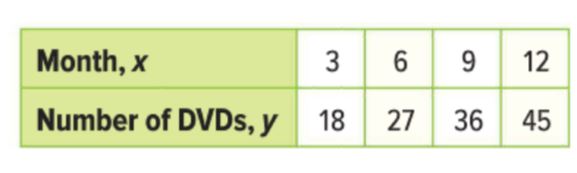
Jonas has a certain number of DVDs in his collection. The table shows the number of DVDs in the collection over several months. Assume the relationship between the two quantities is linear.
Question 15
15.

Find the rate of change. Be sure to include units right from the data in the format of ______ per ______

5
A.CED.2
F.IF.9
Question 17
17.

Graphing: What are the intercepts of 3x + y = 6? Graph the equation. Be sure to include relevant graph detail: label axes and use arrows to represent end behavior, as appropriate. Then type the coordinates too. Type the x-intercept first, then the y-intercept.

Question 18
18.

Question 19
19.

Question 20
20.

5
5
G.GPE.5
Question 23
23.

Question 24
24.

State the domain and range of the relation. { (-3,2), (4,1), (0,3), (5,-2), (2,7)}
D: {-3,4,0,5,2} R: {2,1,3,-2,7}
D: {-3,0,2,4,5} R: {-2,1,2,3,7}
D: {-2,1,2,3,7} R: {-3,0,2,4,5}
The relations represented in both #1 and #2 are functions.
True
False
Click on an equation then scroll to find the correct category to drop it in. Categories may have more than one equation or even none.
Linear Function
Not a linear function because there is an exponent other than 1
Not a linear function because variables are multiplied.
Not a linear function because it's not a function!
Write the equation in standard form. Then choose the option that represents B.

2
-1
5
Choose all of the rules for proper standard form
A, B, and C are real numbers with a GCF of 1
A, B, and C can have fractions.
Order of variables: Ax + By = C
A must be positive
B and C can't be negative
B must be positive
A, B, and C must be integers
undefinded
1
-1
-11
0
Lines with a slope of 0 are vertical.
True
False
Question 14
14.

Question 16
16.
Vocabulary: Tell whether the equation is in slope-intercept, point-slope, or standard form.
y + 2 = -2(x - 1)
standard form
slope-intercept form
point-slope form
Vocabulary: Tell whether the equation is in slope-intercept, point-slope, or standard form.
y = -¼x + 9
standard form
point-slope form
slope-intercept form
Error Analysis: Your friend says the line y = -2x + 3 is perpendicular to the line x + 2y = 8. Do you agree? Explain.
Show your work is optional.
Yes; After converting the second equation to slope-intercept form, we can see that its slope is 1/2. Since -2 and 1/2 are opposite reciprocals, the lines are perpendicular.
No; After converting the second equation to slope-intercept form, we can see that its slope is -1/2. Since -2 and -1/2 are not opposite reciprocals, the lines are not perpendicular.
Question 21
21.
Question 22
22.
What is an equation of the line that passes through (3, -1) and is parallel to the equation below?
Give your answer in slope-intercept form. Show your work optional.
y = -4x + 11
y = (-1/4)x + 11
y = 4x + 11
y = (1/4)x + 11
What is an equation of the line that passes through (2, -3) and is perpendicular to y = x - 5?

Give your answer in slope-intercept form.
y = x - 1
y = x + 1
y = -x + 1
y = -x - 1
Identify the type of slope shown by the line in each graph. Click then scroll to find and drop the type of slope into the correct category.
slope of 0
undefined slope
positive slope
negative slope
Graph A
Graph B
Graph C
Graph D
A
B
C
D
A
B
C
D
A
B
C