Unit 11 Toolbox
star
star
star
star
star
Last updated about 5 years ago
9 Nsɛmmisa

1
1
1
1
1
1
1
1
1
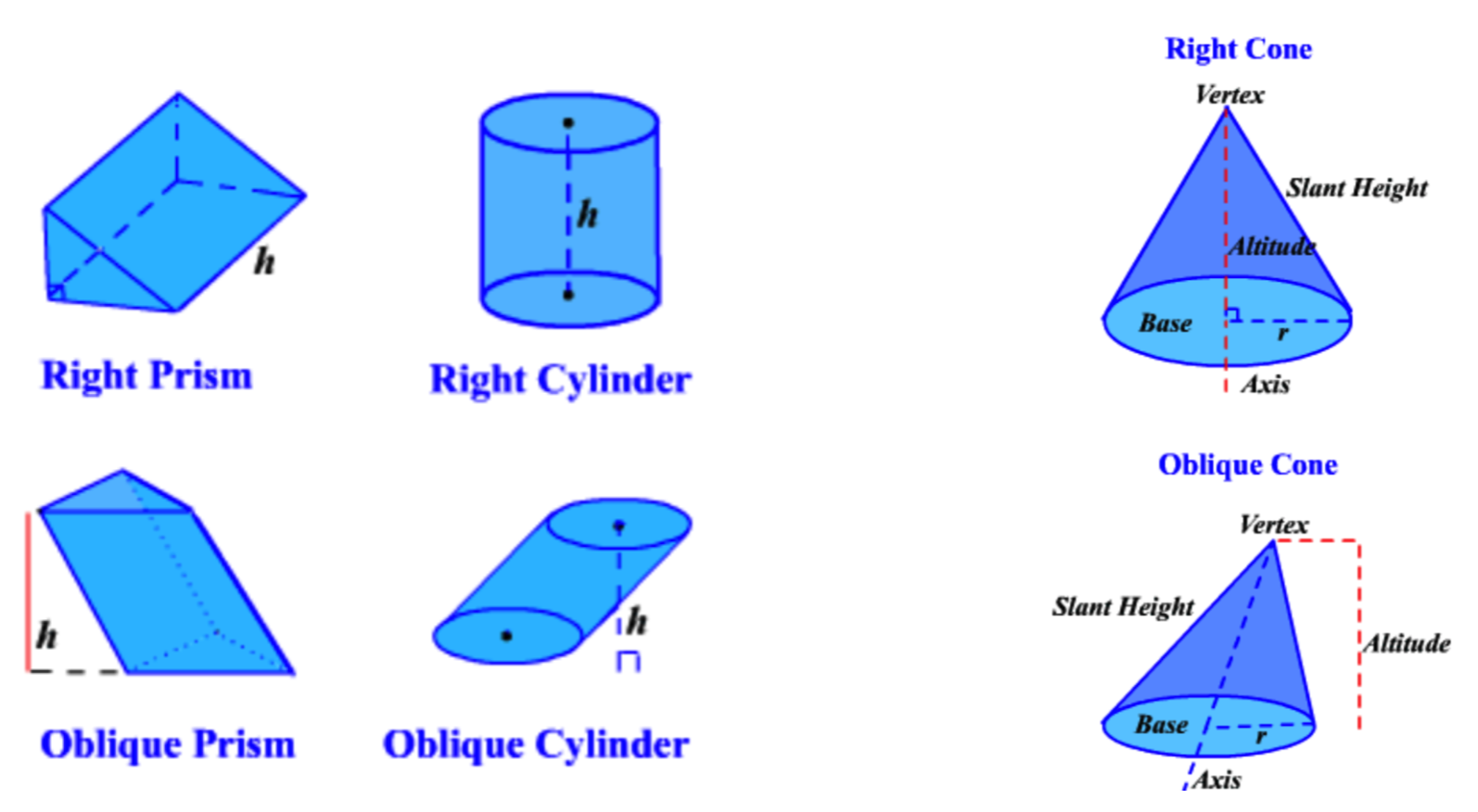
We will be calculating the volume of both right and oblique figures.
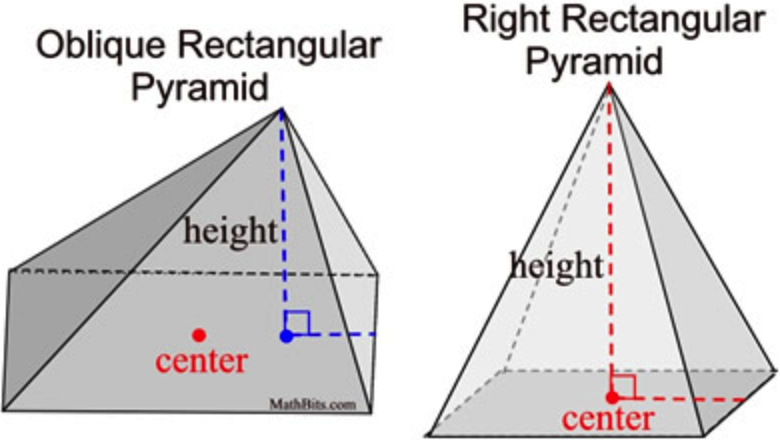
The axis of a 3-D figure is the segment connecting the center of the bases in cylindric solids (cylinders and prisms) or connecting the vertex and the center of the base in conic solids (cones and pyramids).
Unlike oblique figures, the axis of right figures is perpendicular to the base.
The altitude (height) is the distance between the bases in cylindric solids or the distance betwen the vertex and the base in conic solids.
Prism-Cylinder Volume Conjecture
Choose the correct formula for the volume of a right prism/cylinder.
B = area of the base
h = height of the solid
Oblique Prism-Cylinder Volume Conjecture
Choose the correct formula for the volume of a oblique prism/cylinder.
B = area of the base
h = height of the solid
Pyramid-Cone Volume Conjecture
Choose the correct formula for the volume of a right pyramid/cone.
B = area of the base
h = height of the solid
Oblique Pyramid-Cone Volume Conjecture
Choose the correct formula for the volume of a oblique pyramid/cone.
B = area of the base
h = height of the solid
Choose a more specific formula for the volume of a cylinder using the formula for the area of a circle for B.
Choose a more specific formula for the volume of a cone using the formula for the area of a circle for B.
A sphere is a 3D figure where all of the points on the sphere are the same distance from the center. This distance is the radius.
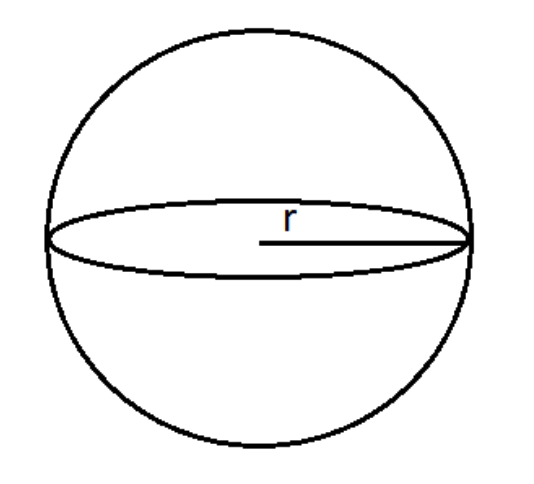
Choose the correct formula for the volume of a sphere.
Choose the correct formula for the surface area of a sphere.
Proportional Volumes Conjecture
If corresponding edge lengths(or radii, or heights) of two similar solids compare in the ratio of m/n, then their volumes compare in the ratio of. . .