Log in
Sign up for FREE
arrow_back
Library

Exploring Geometric Solids cloned 4/1/2021
star
star
star
star
star
Last updated almost 5 years ago
28 questions


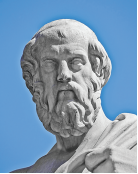
Plato (born 428/427 BCE, Athens, Greece-died 348/347, Athens) is one of the world's best known and most widely read and studied philosophers. Plato reasoned that because all objects are three-dimensional, their smallest parts, atoms, must be in the solid shape of regular polyhedrons, which are explainable by mathematics. There are only five regular polyhedrons, and these five geometric solids are commonly called the Platonic Solids. In Plato's view, all things are composed of the five different atoms: earth, air, fire, water and the cosmos(the stars and planets in the sky). Plato assigned each of the five regular solids to each of the five atoms.

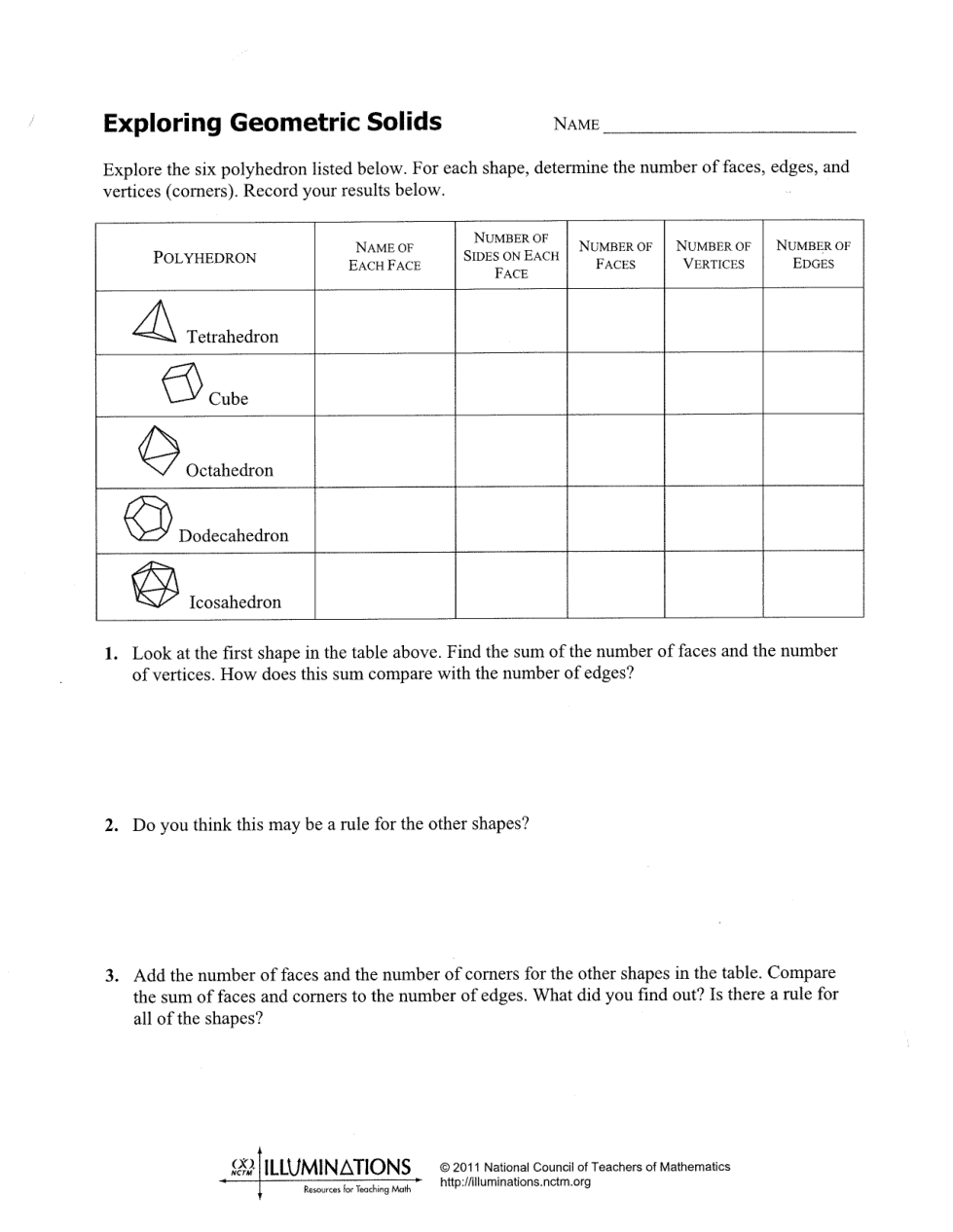
Use the applet to explore the five Platonic Solids.
https://www.nctm.org/Classroom-Resources/Illuminations/Interactives/Geometric-Solids/
1
1
1
1
1
1
1
1
1
1
1
1
1
1
1
1
1
1
1
1
1
1
1
1
1
1
1
1
Question 1
1.
Question 2
2.
Question 3
3.
Question 4
4.
Question 5
5.
Question 6
6.
Question 7
7.
Question 8
8.
Question 9
9.
Question 10
10.
Question 11
11.
Question 12
12.
Question 13
13.
Question 14
14.
Question 15
15.
Question 16
16.
Question 17
17.
Question 18
18.
Question 19
19.
Question 20
20.
Question 21
21.
Question 22
22.
Question 23
23.
Question 24
24.
Question 25
25.
Question 26
26.
Question 27
27.
Question 28
28.
equilateral triangle
square
regular pentagon
equilateral triangle
square
regular pentagon
equilateral triangle
square
regular pentagon
equilateral triangle
square
regular pentagon
equilateral triangle
square
regular pentagon
3
4
5
3
4
5
3
4
5
3
4
5
3
4
5
The sum is two more than the number of edges.
The sum is two less than the number of edges.
The sum is equal to the number of edges.
The is half the number of edges.
No
V + F = E
(V + F)/2 = E
V + F - 2 = E
V + F + 2 = E