Log in
Sign up for FREE
arrow_back
Library

Geometry Critter 1

star
star
star
star
star
Last updated over 3 years ago
10 questions
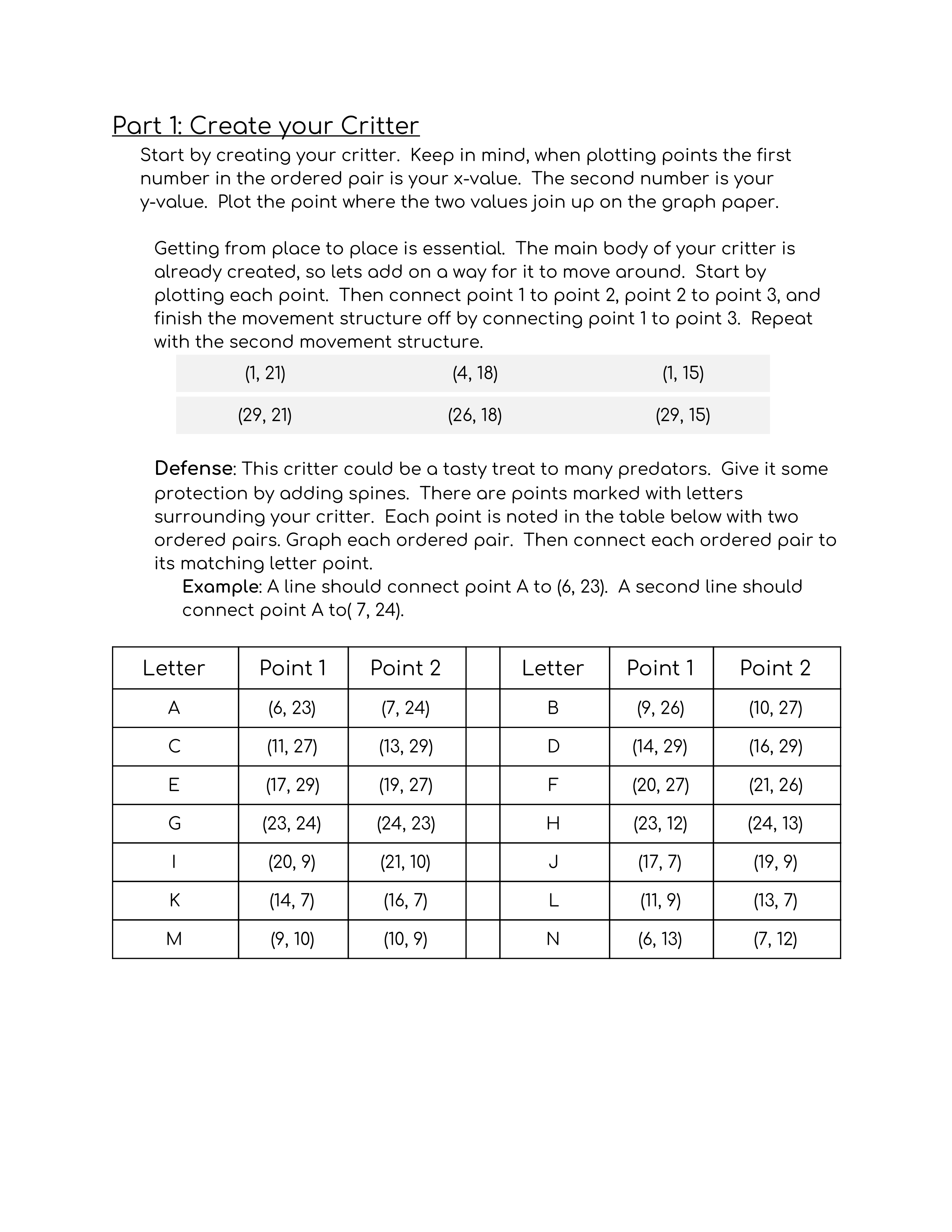
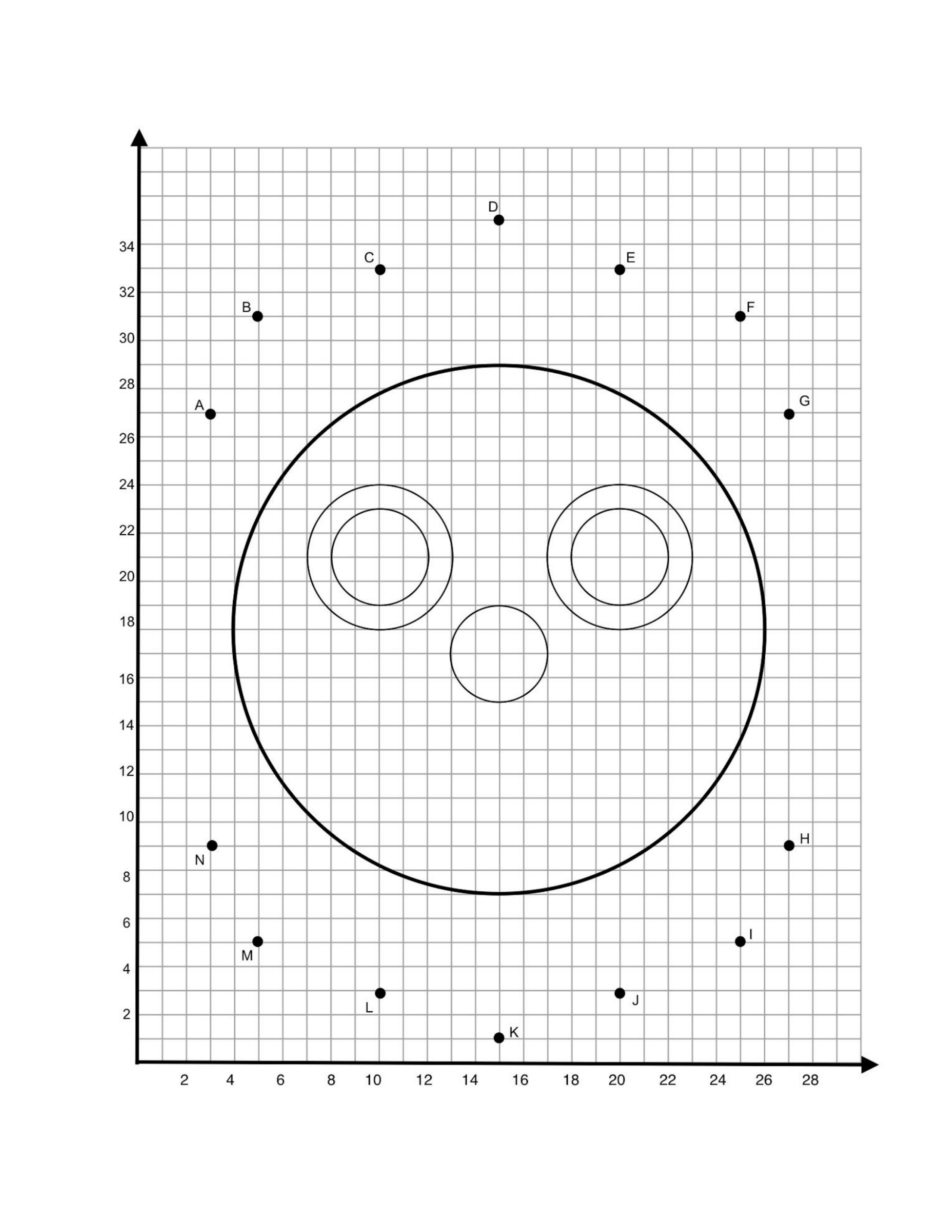
Part 1 requires you to graph your creature. If you have already graphed your creature. Use a camera to take a picture or scanner. Use the Google Slide to graph your creature if you cannot take a picture or scan in your creature.
  • 2 sets of coordinates are shown, one in each gray box.
  • Graph each set of coordinates.
  • Connect point 1 to point 2 and point 2 to point 3.
The creature image already has each lettered point on it. Each letter has two points.
  • Start by graphing point 1. Then connection point 1 to the letter's point.
  • Graph point 2. Then connection point 2 to the letter's point.
6
Question 1
1.

Option 1: Take a picture of your finished creature from your worksheet.
Option 2: Use the Google Slide to graph your creature. Then take a screenshot.
Then:
  • Click Show your Work.
  • Select the image icon from the tools on the left to upload your completed graph.
  • Select Done in upper right corner when finished.

3
Question 2
2.

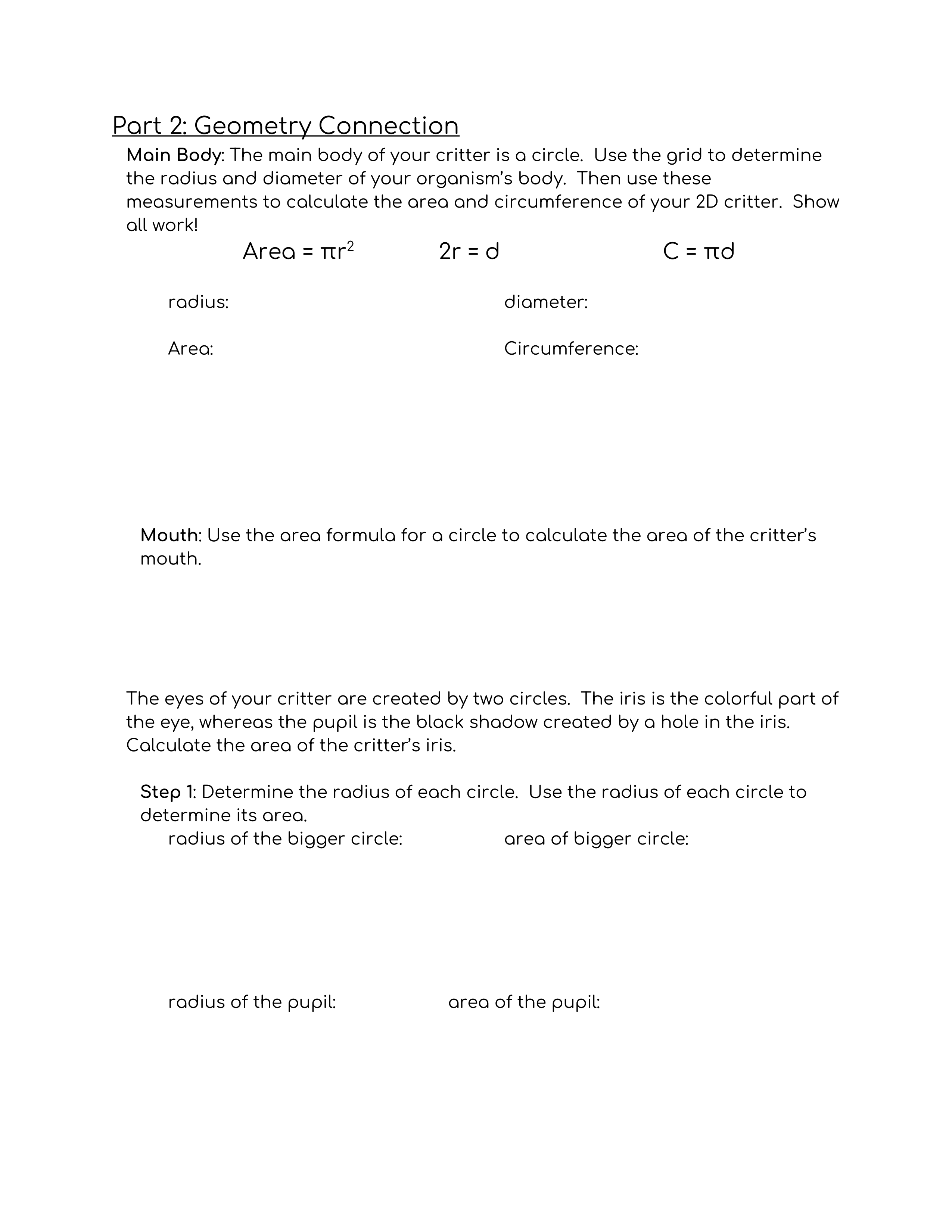
The radius of the critter's body is 11 blocks. Use the equations to calculate the diameter, area, and circumference of the critter's body. Show all of your work.

1
1
2
Question 5
5.

The radius of the pupil is 2 blocks. Calculate the area of the pupil. Do not include units in your answer.

1
1
Question 7
7.

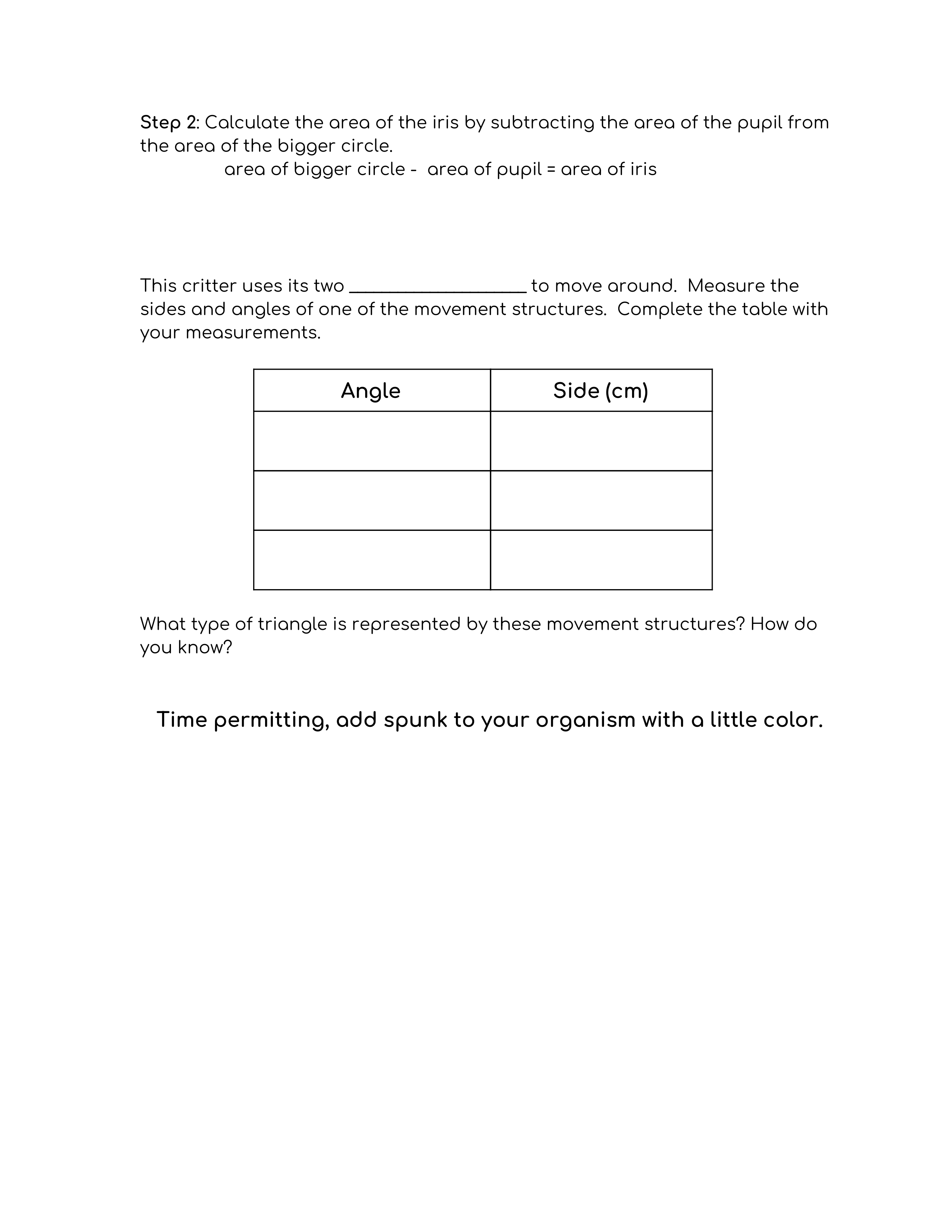
Fill in the blank. This critter uses its two ______________________ to move around. Measure the sides and angles of one of the movement structures. Complete the table with your measurements.

2
Question 8
8.

The side lengths have been provided. Use the answer bank to fill in the angle measurements. Each angle can be used more than once.

1
2
Question 3
3.

The diameter of the fish's mouth is 4 blocks. What is the area of the fish's mouth?

Question 4
4.

The radius of the bigger circle of the eye is 3 blocks. Calculate the area of the bigger cirlce.

Question 6
6.

Calculate the area of the iris by subtracting the area of the pupil from the area of the bigger circle.

Question 9
9.

What type of triangle is represented by these movement structures?

Question 10
10.

Explain how you know the movement structures are the type of triangle you selected in the question above.