Our lesson objectives are to find the probabilities of
mutually exclusive and overlapping events
independent and dependent events
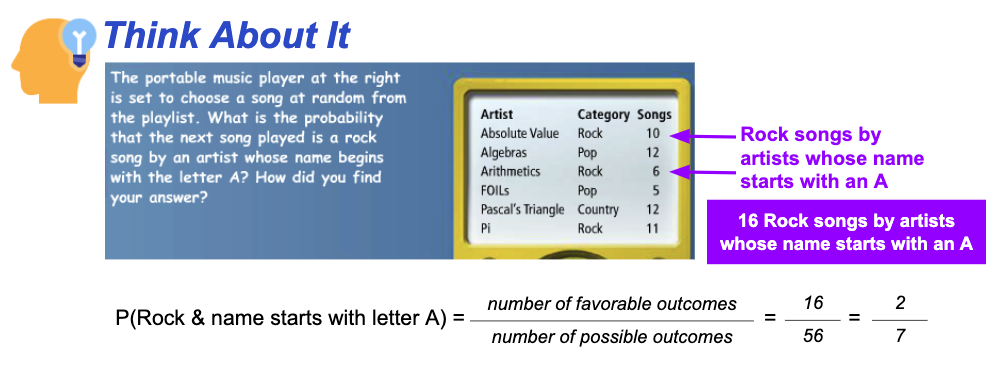
In the Think About It, you found the probability that the next song is both a rock song and also a song by an artist whose name begins with the letter A. This is an example of a compound event, which consists of two or more events linked by the word and or the word or.
You can write the probability of a compound event as an expression involving probability of simpler events. This may make the compound probability easier to find.
When two events have no outcomes in common, the events are mutually exclusive events. When events have at least one outcome in common, they are overlapping events.
You need to determine whether two events A and B are mutually exclusive before you can find P(A or B).
1 point
1
Question 1
1.
Suppose your roll a standard number cube. What is the probability that you roll an even number or a number less than 4?
1 point
1
Question 2
2.
Using a standard number cube, what is the probability of rolling a 2 or an odd number?
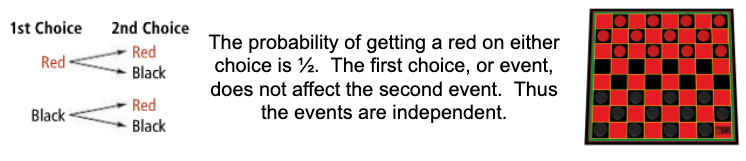
A standard set of checkers has equal numbers of red and black checkers. The diagram below shows the possible outcomes when randomly choosing a checker, putting it back, and choosing again.
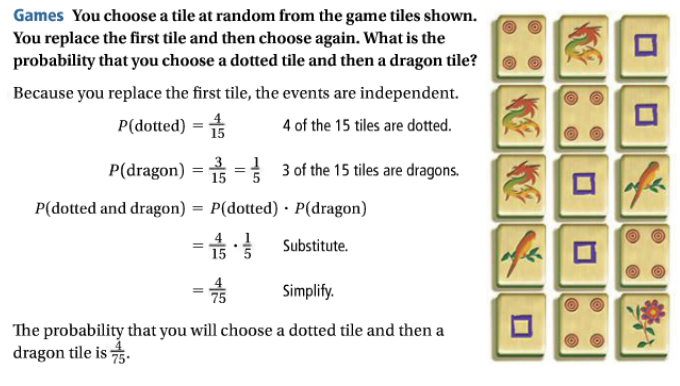
Two events are independent events if the occurrence of one event does not affect the probability of the second event.
Example: Selecting with Replacement
1 point
1
Question 3
3.
You roll a red number cub and a blue number cube. What is the probability that you roll a 5 on the red cube and a 1 or 2 on the blue cube?
1 point
1
Question 4
4.
What is the probability that you randomly choose a bird, then, after replacing the first tile, a flower?
Keep your answer as a fraction.
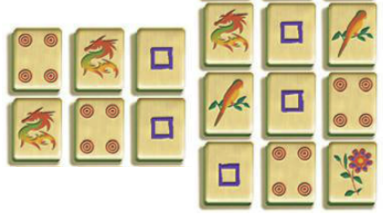
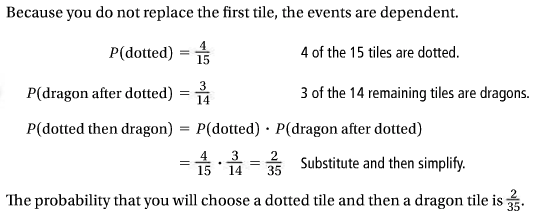
Two events are dependent events if the occurrence of one event affects the probability of the second event. For example, suppose in the tile problems that you do not replace the first tile before choosing another. This changes the set of possible outcomes for your second selection.
Example: Selecting Without Replacement
Suppose you choose a tile at random. Without replacing the first tile, you select a second tile. What is the probability that you choose a dotted tile and then a dragon tile?
Click here if you are having trouble accessing the video above.
1 point
1
Question 5
5.
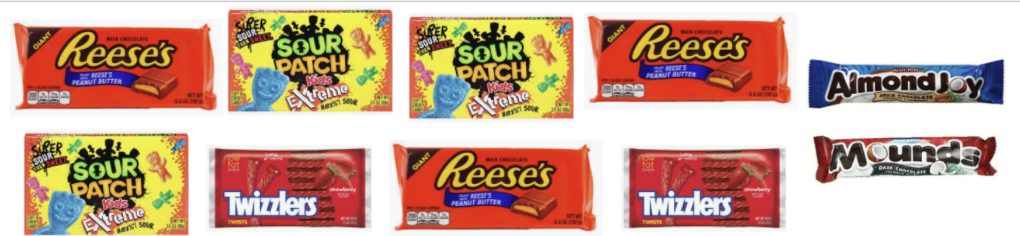
Miss Gowton has an assortment of candy prizes for her students.
What is the probability that the first student will choose a Twizzlers and the second student will then choose a Sour Patch Kids candy?
Lesson Check
2 points
2
Question 6
6.
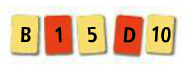
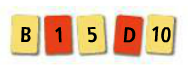
Use the cards below.
You choose a card at random. What is the probability of each event?
Draggable item
arrow_right_alt
Corresponding Item
P(B or number)
arrow_right_alt
4/5
P(red or 5)
arrow_right_alt
3/5
P(red or yellow)
arrow_right_alt
1
P(B or D)
arrow_right_alt
2/5
1 point
1
Question 7
7.
What is the probability of choosing a yellow card and then a D if the first card is not replaced before the second card is drawn?
2 points
2
Question 8
8.
You roll a blue number cube and a green number cube. Find each probability.
Draggable item
arrow_right_alt
Corresponding Item
P(blue 1 or 2 and green 1)
arrow_right_alt
1/4
P(blue even and green even)
arrow_right_alt
25/36
P(green less than 7 and blue 4)
arrow_right_alt
1/6
P(blue and green both less than 6)
arrow_right_alt
1/18
1 point
1
Question 9
9.
You choose a tile at random from a bag containing 2 A's, 3 B's, and 4 C's. You replace the first tile in the bag and then choose again. What is the probability of selecting an B and then a C?
1 point
1
Question 10
10.
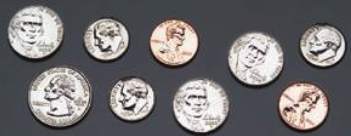
You pick a coin at random from the set shown below and then pick a second coin without replacing the first. What is the probability of selecting a dime then a penny?
1 point
1
Question 11
11.
Samples of a new drink are handed out at random from a cooler holding 5 citrus drinks, 3 apple drinks, and 3 raspberry drinks. What is the probability that an apple drink and then a citrus drink are handed out?