Theoretical and Experimental Probability
star
star
star
star
star
Last updated almost 4 years ago
15 Nsɛmmisa
1
1
1
1
1
1
1
1
1
1
1
1
1
1
1
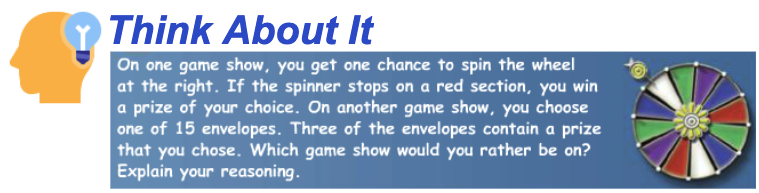
In the Think About It, spinning red and choosing the right envelop are desired outcomes. An outcome is the result of a single trial, such as spinning a wheel. The sample space is all the possible outcomes. An even is any outcome or group of outcomes. The outcomes that match a given event are favorable outcomes.

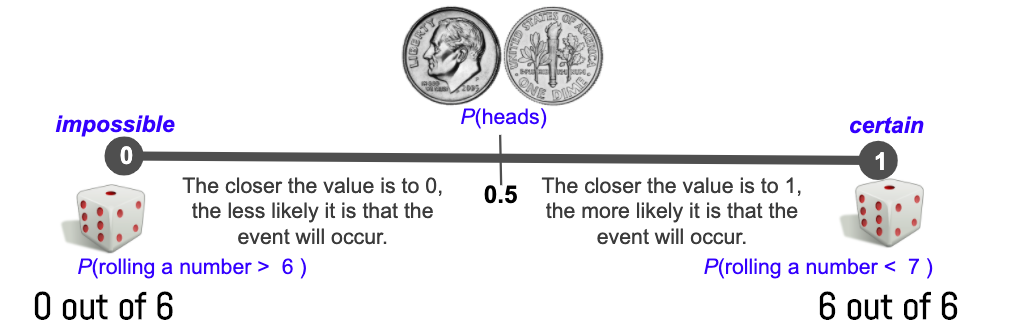
The probability of an event, or P(event), tells you how likely it is that the event will occur. You can find probabilities by reasoning mathematically or by using data collected from an experiment.
In the number-cube example above, the outcomes in the sample space are equally likely to occur. When all possible outcomes are equally likely, you can find the theoretical probability of an event using the following formula.

You can write probability as a fraction, decimal, or percent. The probability of an event ranges from 0 to 1.
Finding Theoretical Probability: Our solar system's 8 planets, in order of least to greatest distance from the sun, are:

You will randomly draw one of the names of the planets and write a report on the planet. What is the theoretical probability that you will select a planet whose distance from the sun is less than Earth's?
The complement of an event consists of all outcomes in the same sample space that are not in the event. The possible outcomes for rolling a number cube are 1, 2, 3, 4, 5, and 6. The outcomes of rolling an odd number are 1, 3, and 5. The outcomes for the complement of rolling an odd number are 2, 4, and 6.
The sum of the probabilities of an event and its complement is 1.
P (event) + P (not event) = 1 or P (not event) = 1 - P (event)
Example Finding the Probability of the Complement of an Event
In a taste test, 50 participants are randomly given a beverage to sample. There are 20 samples of Drink A, 10 samples of Drink B, 10 samples of Drink C, and 10 samples of Drink D. What is the probability of a participant not getting Drink A?
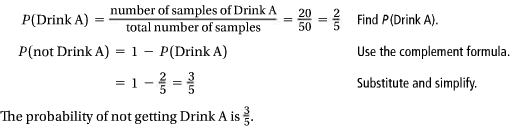
What is the probability of a participant not getting Drink B?
Odds describe the likelihood of an event as a ratio comparing the number of favorable and unfavorable outcomes.
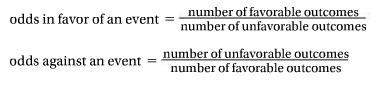
Example: Finding Odds

What are the odds against the spinner landing on a number greater than 2?
Experimental probability is based on data collected from repeated trials.
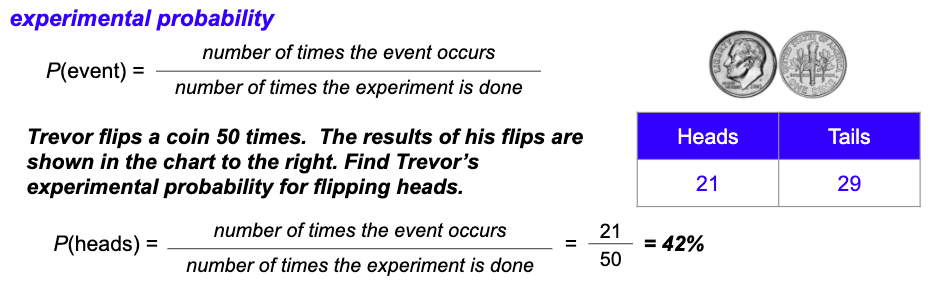
Example: Finding Experimental Probability
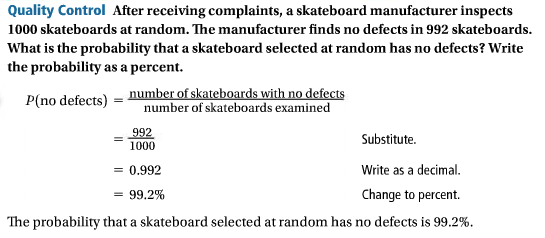
You toss a dart at a dartboard 500 times. You hit the bull's-eye 80 times. What is the experimental probability that you hit the bull's-eye? Select all that apply.
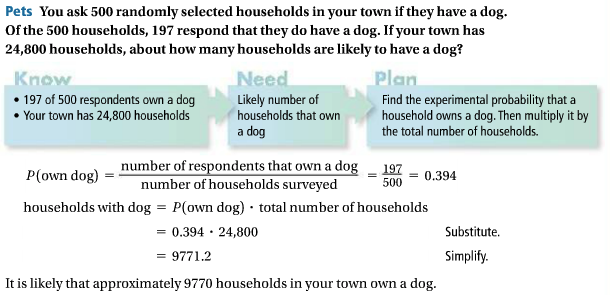
You can use experimental probability to make a prediction. Predictions are not exact, so round your results.
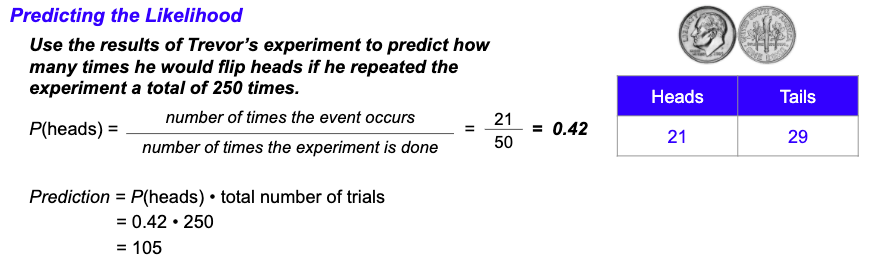
It is likely that Trevor will flip heads approximately 105 times out of 250 trials.
Example: Using Experimental Probability
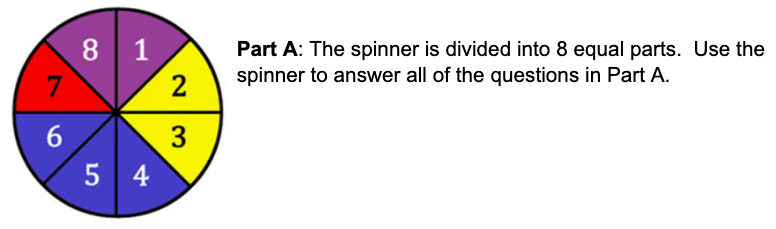
P (blue)
P (even number)
P (less than 3)
Find the odds in favor of spinning a greater than 5.
Find the odds in favor of landing on a number greater than 4.
Find the odds against landing on red.
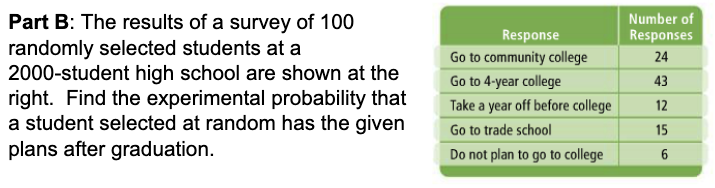
P (community college)
P (trade school or community college)
A park has about 500 trees. You find that 27 of 67 randomly chosen trees are oak trees. About how many trees in the entire park ar likely to be oak trees?
100 people were surveyed about their favorites party foods. The results of the survey are shown below.

If you are going to through a party for 650 people, approximately how many of your guests will prefer grilled cheese?
You've also decided to show a movie at your party. The table below shows the results of your 100 surveyed friends.

How many of your 650 guests are predicted to favor a comedy?