Inferences and Predictions

Last updated about 3 years ago
14 questions

Inferences and Predictions

The purpose of collecting samples is to study a larger population. Based on the sample data, inferences, or predictions about a population can be made. An inference is a conclusion made by interpreting data. An inference that is very likely to be true about the population is a valid inference.

Last year, 18 students in a class of 30 seniors said they planned to go to college. If there are a total of 400 students in the school this year, what prediction could be made about the total number of students who plan to go to college?

You can use a proportion to find out.
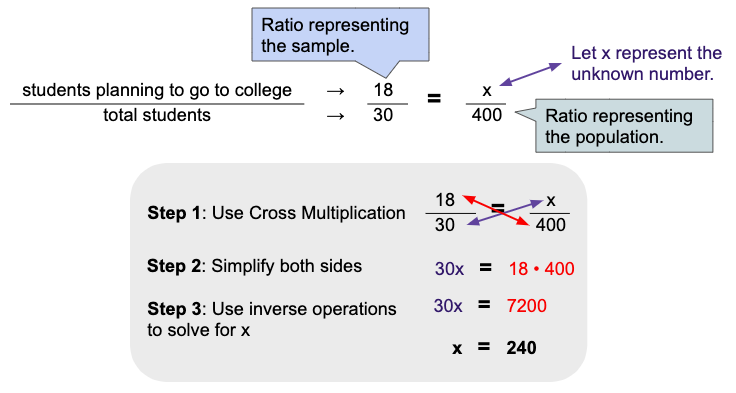
So, given that 8 students in a sample of 30 plan to go to college, you can predict that from a population of 400 students, 240 of them plan to go to college.

An inference is valid when it accurately represents the population. Valid inferences are formed by bias-free data. Tips to help ensure an inference is valid:
An unbiased sample: which is representative of the population and achieved randomly
Have multiple trials or sample groups: When using multiple trials, keep your methods the same between all trials. If using sample groups, the groups should be determined using the same method.

You want to determine students' favorite lunches in the school cafeteria. You survey three different groups of 100 random students from across all 12 grades.
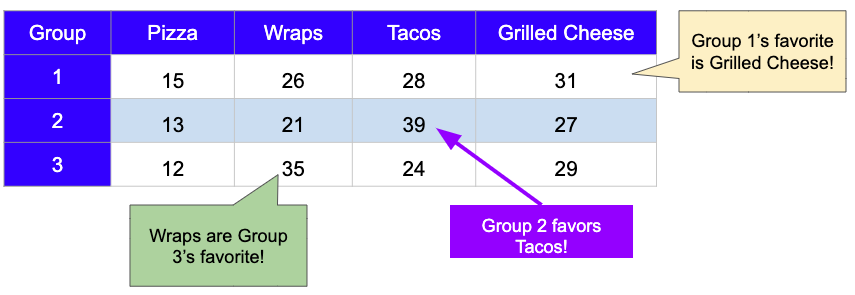
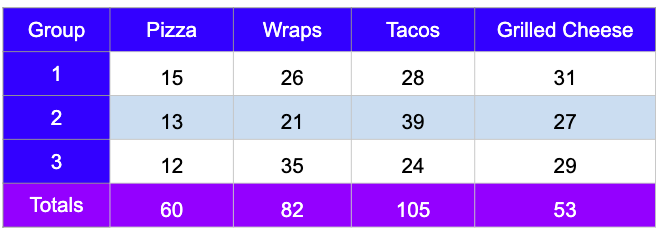
Each group has a different preference. Selecting just one group to answer your question could result in an invalid inference. Instead, add all the results of each group together to find the students' top choice is Tacos! Notice, each sample is chosen at random, contains 100 students, and is across all grade levels. So our groups are random, representative of the population, and the same size.
Use the information to answer Questions 1 - 2:
On a school baseball team, 30% of the players have a batting average of 0.325. Given this information, out of 200 players in a countrywide baseball league, how many are expected to bat over 0.325? Use the questions below to help solve the problem.
1

What is the population for this situation?

1

What is the sample for this situation?

2

A survey of families who took a summer vacation found that 3/4 of them traveled by car. If 10,860 families in one city take a summer vacation, how many would be expected to not travel by car?

2

Use the information to answer Questions 4 - 5:
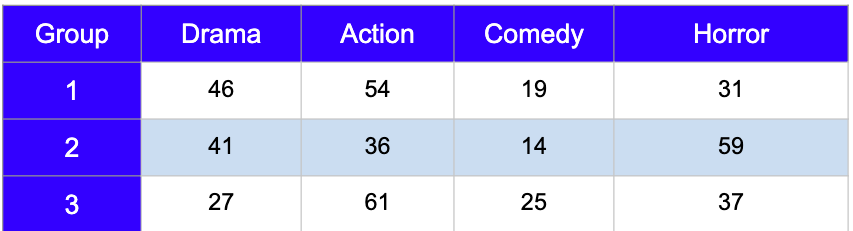
The table lists data collected from three random samples of 150 moviegoers about their movie preferences.
Make two valid inferences based on the data.

1

What is the best method for creating each sample of 150 moviegoers?

Predictions from Graphs

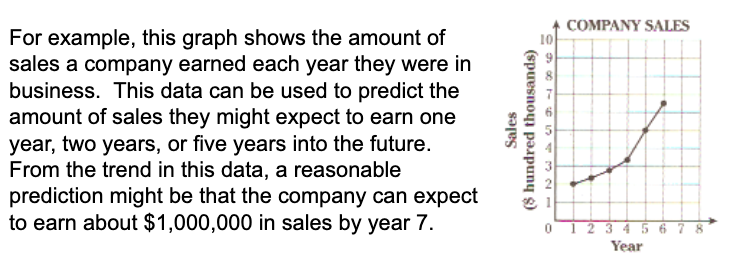
Data samples and trends found from data are often used to predict outcomes of larger populations or of future events.

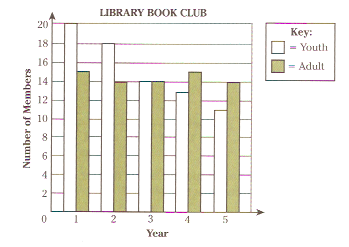
Example: The library formed a youth book club and an adult book club 5 years ago. The number of members in each book club is shown in the bar graph below.

Assuming the trend in number of members in each book club continues, about how many total members would be expected in both book clubs by year 6?
A. 8 B. 14 C. 22 D. 28

ANSWER: From this data, the number of members in the youth book club tends to decrease by about 2 people each year. The number of members in the adult book club tends to remain the same from year to year. In year 5, there were about 11 members in the youth club. So, in year 6, about 11 - 2 or 9 members would be expected. The number of members in the adult club is about 14 each year. So, in year 6, the total number of expected members in both clubs is about 9 + 14 = 23. OF the choices, C. 22 is the closest.
1

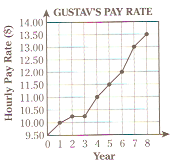
The line graph shows how Gustav's hourly rate of pay changed during the past eight years.
If Gustav stays in this job for 10 years, what can he expect his hourly rate to be?

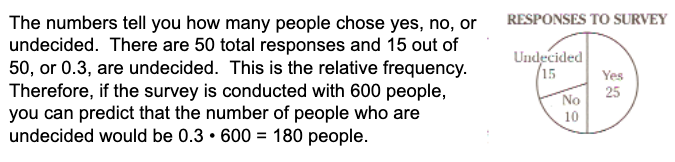
Predictions can be made on populations of data by finding probabilities of events occurring in samples. For example, the circle graph below at right shows the responses of 50 people to a survey question.

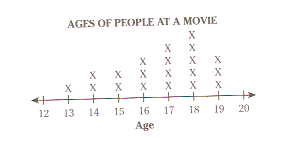
Example: The line plot below shows the ages of a sample of people at a movie theater.
If there are 280 people in the theater, which prediction about the audience would you expect to be true?
A. 50% will be younger than 16.
B. 50% will be older than 18.
C. About 70 people will be from 13 to 16 years old.
D. About 210 people will be from 16 to 19 years old.

ANSWER: The line plot shows 20 data values and 15 of 20, or 75%, are stacked above the ages of 16, 17, 18, and 19. If the audience consists of 280 people, then 75% of it could be expected to be from 16 to 19 years old: 0.75 • 280 = 210 people or choice D.
1

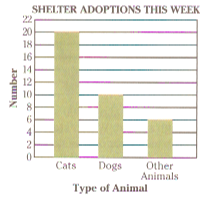
The bar graph below shows the numbers of different kinds of animals adopted from a shelter one week.

If 50 animals are adopted next week, which is the best estimate of the number of dogs that will be adopted?

1

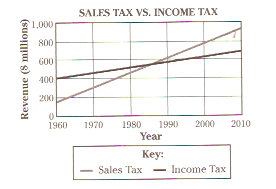
The line graph shows the revenue from sales tax and income tax in one state over time.

Which is the best estimate of the expected difference between revenue from sales tax and income tax in 2020?

1

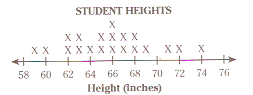
The line plot shows the heights of 20 randomly selected students at a high school.

There are a total of 1,200 students at the high school. Which statement is the most reasonable conclusion from the data?

3

Explain how you arrived at your answer for question 9. Feel free to show your work to help in your explanation.

Predictions from Scatter Plots
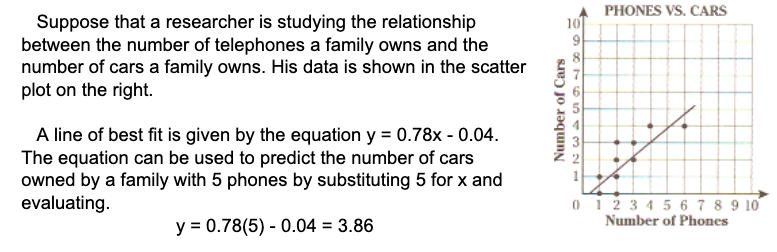
A scatter plot shows the relationship between two sets of data, which are written as ordered pairs and then graphed as points on a coordinate plane. A scatter plot can be used to identify trends, or correlations, in data. A line of best fit drawn through the points and its equation can model that relationship.

Once a line of best fit is drawn, or its equation determined, you can make predictions.
  • Interpolation: a prediction made for an x value within, but not included in the data set.
  • Extrapolation: a prediction made for an x value outside of the data set. Keep in mind extrapolation can be for an x value below the minimum or above the maximum value in the data set.

Based on the line of best fit, a family with 5 phones should be expected to own 3.86 cars. Given the context of the problem, it probably makes sense to round this number up to 4.

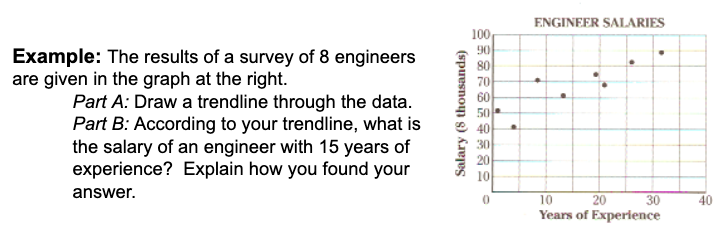
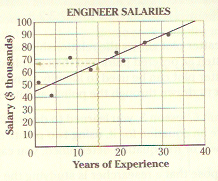
For Part A, try to draw a trendline that falls equally between the data points. It is possible to draw more than one trendline. However, your trendline should have about as many points on top as below it. Plus potentially intersect a few points. The important thing is that your line goes through the data reasonably well.

For Part B, use your trendline to estimate the salary. The salary of an engineer with 15 years of experience is about $66,000.
1

A scatter plot shows the relationship between the number of floors in office buildings downtown and the height of the buildings. The following equation models the line of best fit for the data.
What would be the expected height of a building with 20 floors?

1

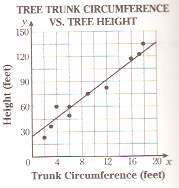
This scatter plot relates the circumference and height of 10 trees.

How tall would you expect a tree with a circumference of 8 feet to be?

1

A scatter plot relates the weight, in pound, of an order, to the charge, in dollars, to ship the order. The equation y = 0.25x + 6 describes the line of best fit. WHat would be the expected cost to ship a 50-pound order?

3

A scientist related the age and length of 20 baby sharks on this scatter plot.

Based on the data, what would be the expected length of a 12-month old shark?

HINT: Draw a trendline. Find the slope and y-intercept of your trendline. Then write the equation for your trendline in slope-intercept form: y = mx + b.