Log in
Sign up for FREE
arrow_back
Library
Kinex: DNA Replication Worksheet
By Katelyn Owens
star
star
star
star
star
Share
share
Last updated almost 2 years ago
16 questions
Add this activity
1
2
3
4
5
6
7
8
9
zoom_in
1
1
1
1
1
1
1
1
1
10
11
12
13
14
15
16
zoom_in
1
1
1
1
1
1
1
Question 1
1.
Question 2
2.
Question 3
3.
Question 4
4.
Question 5
5.
Question 6
6.
Question 7
7.
Question 8
8.
Question 9
9.
Question 10
10.
Question 11
11.
Question 12
12.
Question 13
13.
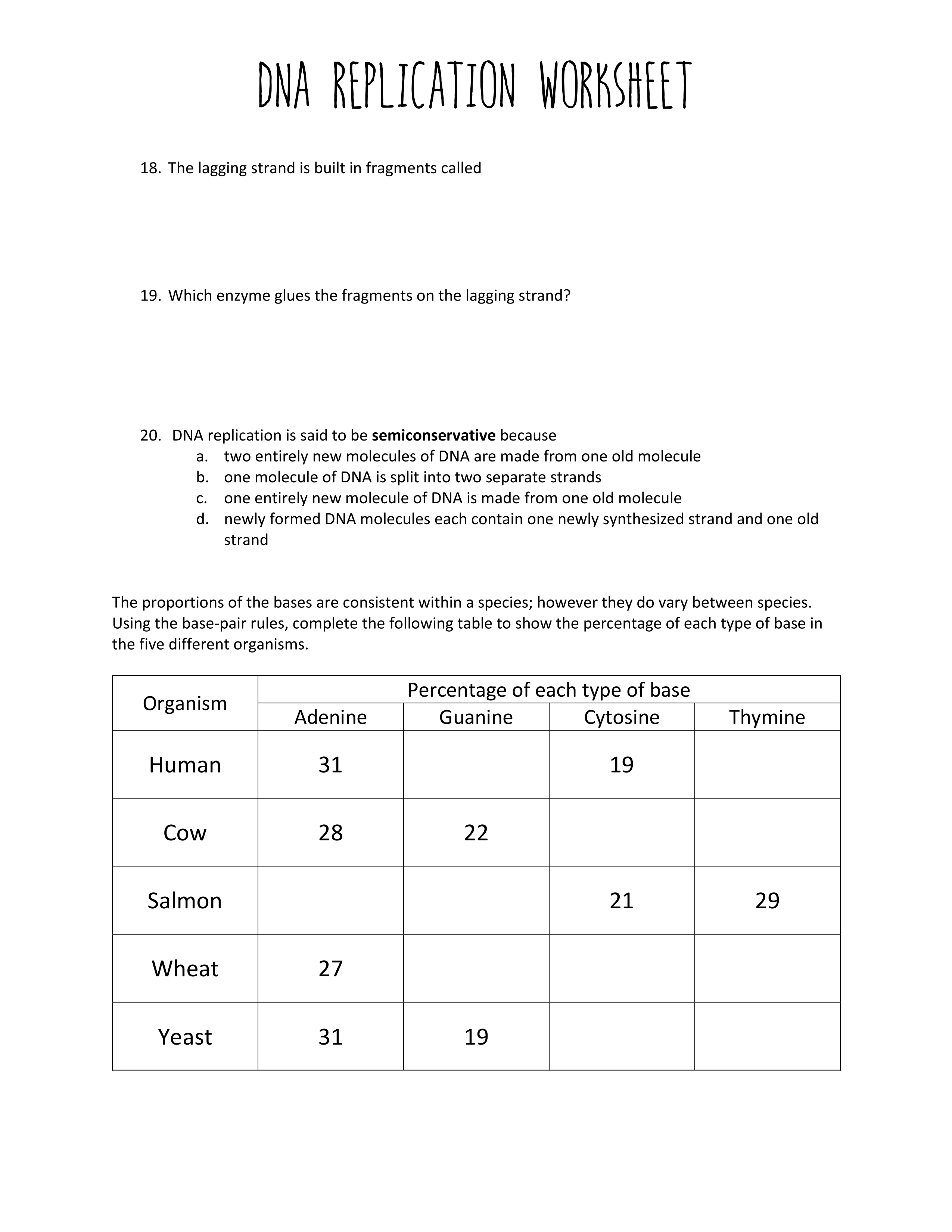
How much guanine is in the DNA if there is 31 As and 19 Cs?
Question 14
14.
How much thymine is in the DNA if there is 31 As and 19 Cs?
Question 15
15.
How much cytosine is in the DNA if there is 28 As and 22 Gs?
Question 16
16.
How much thymine is in the DNA if there is 28 As and 22 Gs?
When does DNA replication occur?
During G1
During S phase
During G2
During mitosis
The first enzyme involved in DNA replication is DNA helicase. What type of organic molecule is DNA helicase?
Carbohydrate
Protein
Lipid
Nucleic Acid
What is the role of DNA helicase in DNA replication?
To glue the Okazaki fragments together
To add free nucleotides
To separate the DNA strands
Once the DNA strands are separated, free nucleotides are added to the complementary strands by which enzyme?
Helicase
Ligase
Primer
Polymerase
The new DNA strand that is build continuously is called
Lagging strand
Leading strand
Template strand
The strand that is build in pieces is called the
Leading strand
Lagging strand
Template strand
Letter A is the
Template strand
Leading strand
Lagging strand
Replication fork
Letter B is the
Template strand
Leading strand
Lagging strand
Replication fork
Letter C is the
Template strand
Leading strand
Lagging strand
Replication fork
The lagging strand is built in fragments called
Owens fragments
Okazaki fragments
Ligase fragments
Primer fragments
Which enzyme glues the fragments on the lagging stand?
Helicase
Ligase
Polymerase
Single Binding Protein
DNA replication is said to be semiconservative because
A. two entirely new molecules of DNA are made from one old molecule
B. one molecule of DNA is spilt into two separate strands
C. one entirely new molecule of DNA is made from one old molecule
D. new formed DNA molecules each contain one newly synthesized strand and one old strand