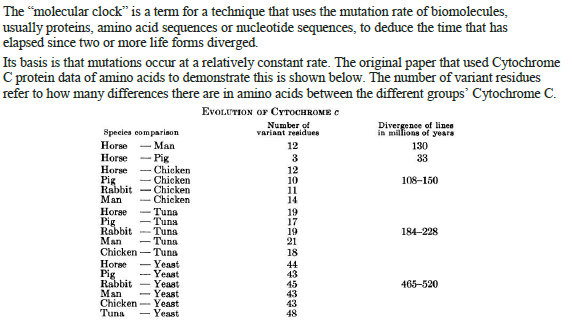
Use the information in the table to complete the questions below.
Question 11
11.
1.a) What is more closely related: the pig and horse, or man and horse? Explain using data.
1.b) Complete the cladogram below with a chicken in the end position and the other organisms arranged below it. Include the number of differences between the organisms.
Question 12
12.
Question 13
13.
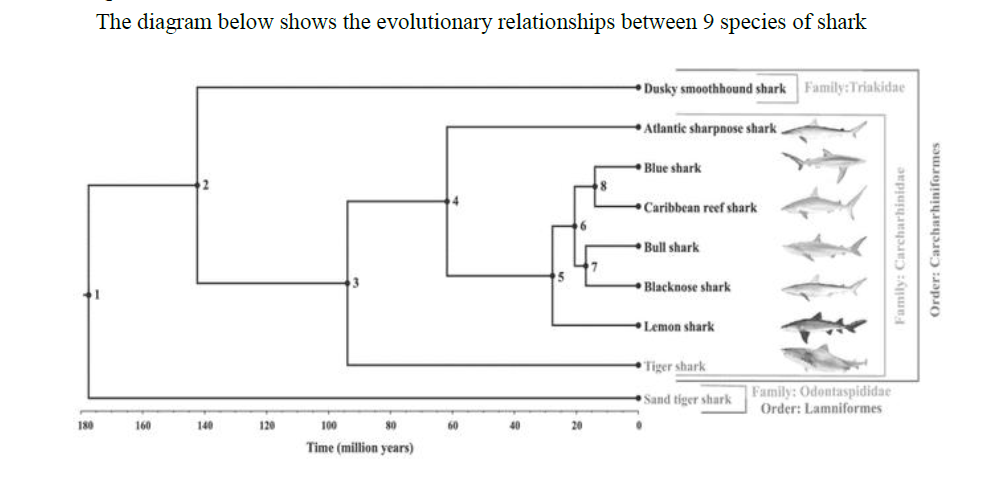
2.a) What does the branch length indicate in a phylogenetic tree?
Question 14
14.
2.b) Approximately how long ago did the blue shark and bull shark diverge?
Question 15
15.
2.c) How long ago did a dusky smooth hound shark and a lemon shark diverge? Suggest a reason for the divergence.
When determining molecular homology, the evolutionary history of a species can be seen in its DNA sequences. This means that
the more closely related two species are the more similar the DNA sequences
speciation occurs when DNA becomes more similar
homology is the study of same DNA sequences in all living things
the order of evolution happens in a predetermined sequence
The main reason for rapid changes in nuclear DNA gene sequences of a population is:
genetic drift
interbreeding with other populations
lack of gene flow
different selection pressures acting on favourable traits
Phylogenetic trees and cladograms help show relationships between different organisms. The difference between them is that
cladograms always represent closely related species on the same line
phylogenetic trees have branches that represent time and amount of change
phylogenetic trees have branches of equal distance for closely related species
cladograms always have humans at the top
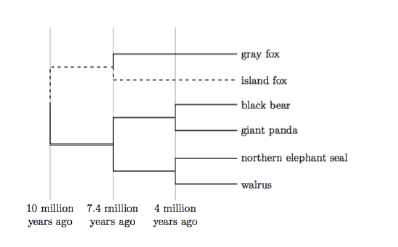
When considering the phylogenetic tree above, what can be determined?
The black bear and giant panda would be able to interbreed
The walrus and the giant panda have a recent common ancestor at 4mya
All branches have a common ancestor 10mya
The island fox became extinct 4mya
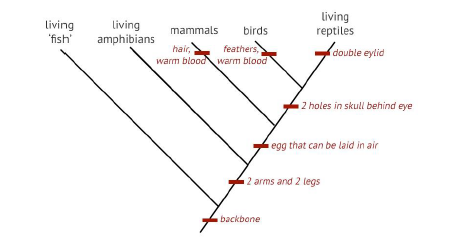
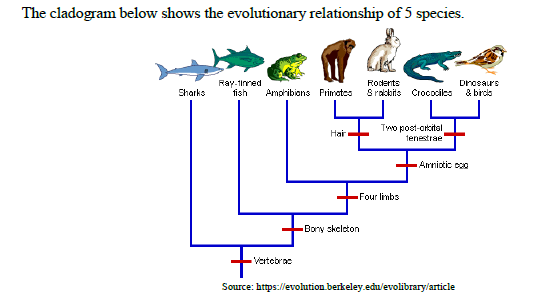
The cladogram above shows the evolutionary relationship of 5 species.
With respect to the diagram above, it is reasonable to say that:
living fish have all the features of the other organisms
all species have 2 arms and 2 legs
mammals, birds and living reptiles have warm blood
birds, mammals and living reptiles have eggs that can be laid in air
With respect to the diagram above, it is reasonable to say that:
crocodiles and birds are more closely related than primates and rabbits
all species with a bony skeleton have four limbs
amphibians do not have any features that are shared with other groups
vertebrae are an ancestral trait common to all groups shown.
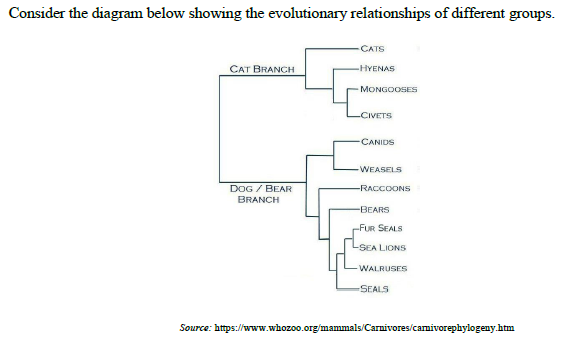
From the information in the diagram above, it can be said that:
racoons are more closely related to weasels than bears
canids and civets diverged from a common ancestor at the same time.
bears and seals have a common ancestor
fur seals and sea lion arose from walruses
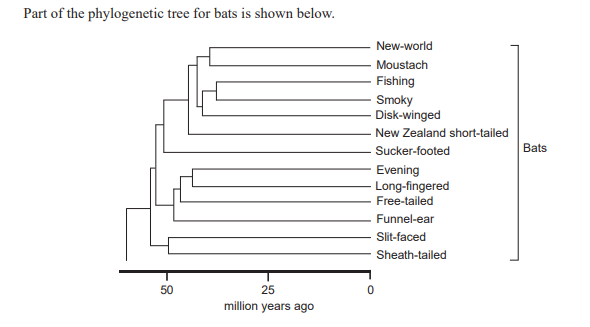
The most recent divergence of two bat species is the
slit-faced and sheath-tailed bats
evening and long-fingered bats
sucker-footed and New Zealand short-tailed bats
smoky and fishing bats
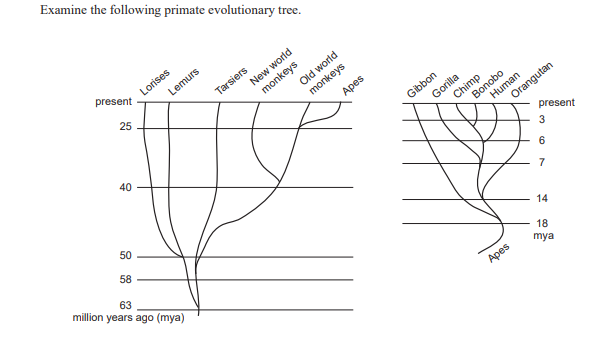
Analysis of the evolutionary tree above shows that
lorises is the oldest group in the evolutionary tree
gibbons and old world monkeys are unrelated
chimps and humans are more closely related than gorillas and chimps
the most recent group to evolve separately is humans