Algebra 1 1-3 Complete Lesson: Real Numbers and the Number Line
star
star
star
star
star
Last updated almost 6 years ago
29 Nsɛmmisa


10
10
10

10


10
10
10
10

10
10
10


10
10
10
10

10
10
10
10
10

10

100
10

Solve It! If the pattern continues, which will be the first figure to contain more than 200 square units? Explain your reasoning.
Problem 1 Got It? What is the simplified form of the expression?
Problem 1 Got It? What is the simplified form of the expression?
Problem 1 Got It? What is the simplified form of the expression?
Problem 2 Got It? What is the value of the expression to the nearest integer?
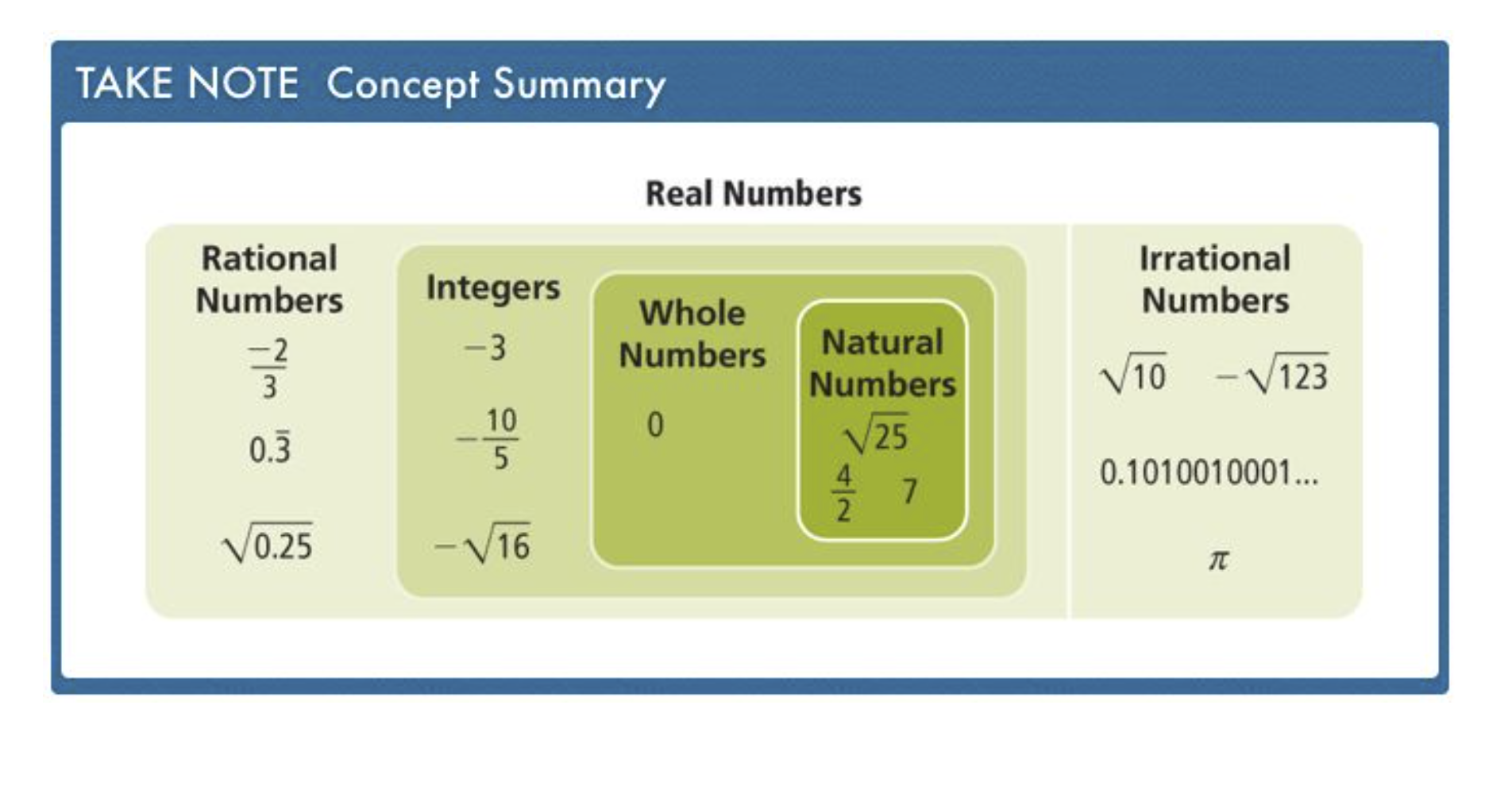
Problem 3 Got It? To which subsets of the real numbers does the number belong?
Problem 3 Got It? To which subsets of the real numbers does the number belong?
Problem 3 Got It? To which subsets of the real numbers does the number belong?
Problem 3 Got It? To which subsets of the real numbers does the number belong?
Problem 4 Got It? Fill in the circle to complete the inequality.

Problem 4 Got It? Reasoning: In Problem 4, is there another inequality you can write that compares the two numbers? Explain.
Problem 5 Got It? Graph and label the following numbers on a number line.
Label units on the number line and be precise.
Problem 5 Got It? Order the numbers from least to greatest.


Vocabulary: What are the two subsets of the real numbers that together form the set of real numbers?
Vocabulary: Give an example of a rational number that is not an integer.
Reasoning: Is √100 rational or irrational? Explain.
Evaluate: Evaluate the expression for the given values of the variables.
Enter only a number.
Evaluate: Evaluate the expression for the given values of the variables.
Enter only a number
Translate: Write an algebraic expression for the word phrase.
the sum of 14 and x
Simplify: Simplify the expression.
Enter only a number.
Simplify: Simplify the expression.
Enter only a number.
Vocabular Review: Identify the numbers that are perfect squares.
1
12
16
100
121
200
256
Perfect squares
Notes: Take a clear picture or screenshot of your Cornell notes for this lesson. Upload it to the canvas. Zoom and pan as needed.
For a refresher on the Cornell note-taking system, click here.
Reflection: Math Success