Algebra 1 1-3 Guided Practice: Real Numbers and the Number Line
star
star
star
star
star
Last updated almost 6 years ago
25 Nsɛmmisa


10
10
10

10


10
10
10
10
10

10
10
10

Solve It! If the pattern continues, which will be the first figure to contain more than 200 square units? Explain your reasoning.

Take Note: What is a square root of a number?
Take Note: Use the math input tool to type the radical expression:
Take Note: What is a radicand?
Problem 1 Got It? What is the simplified form of the expression?
Problem 1 Got It? What is the simplified form of the expression?
Problem 1 Got It? What is the simplified form of the expression?

Take Note: What is a perfect square?
Take Note: Which of the following are perfect squares? Select all that apply.
Problem 2 Got It? What is the value of the expression to the nearest integer?

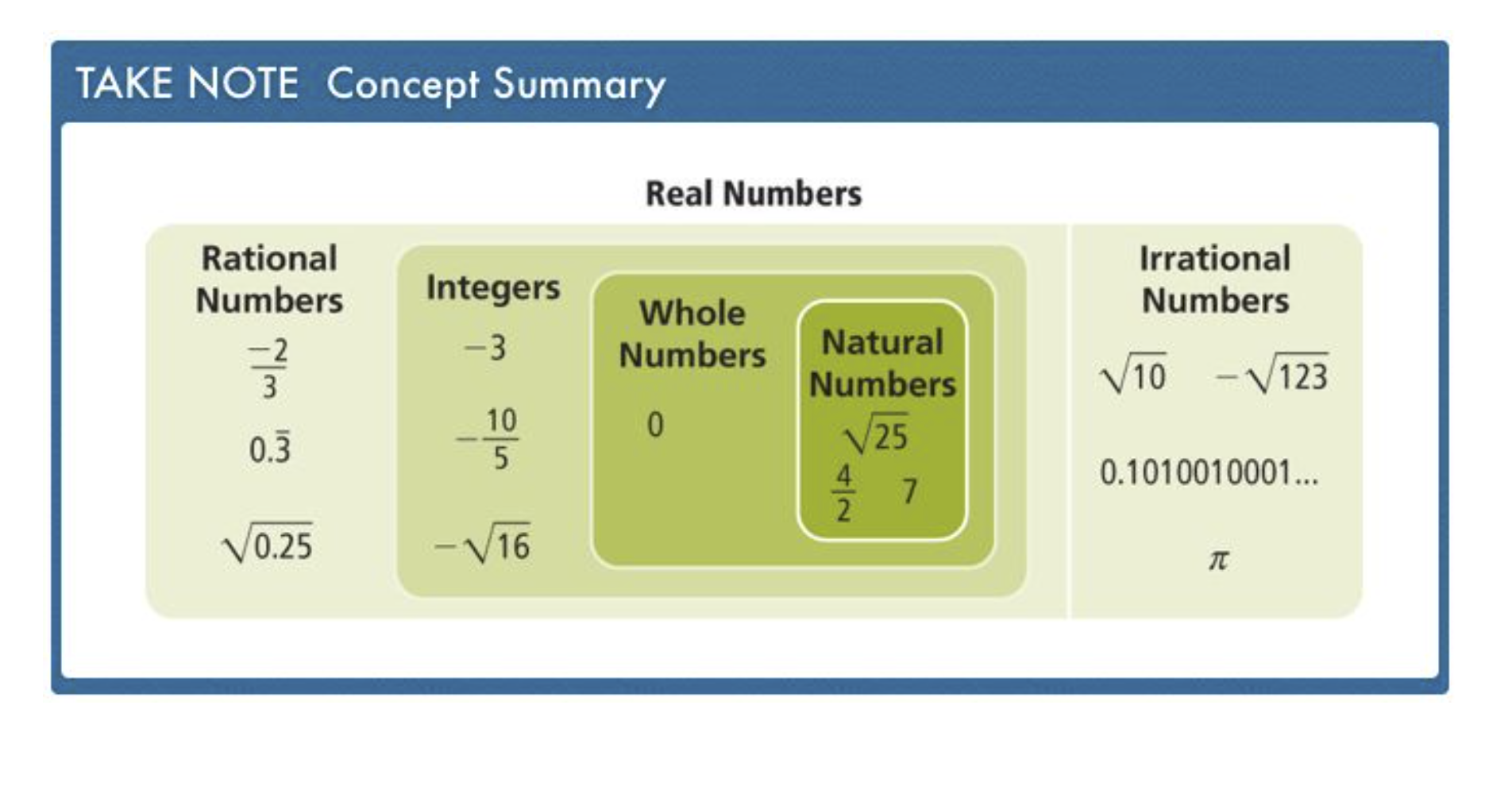
Take Note: Some sets of numbers are subsets of other number sets.
Categorize the number sets on the left based on whether or not they are subsets of the sets listed on the right.
Sets may belong in one category, in multiple categories, or in no categories.
The set of integers
The set of irrational numbers
The set of natural numbers
Subsets of the real numbers:
Subsets of the rational numbers:
Subsets of the whole numbers:

Take Note: What is a terminating decimal? Provide an example.
Take Note: What is a repeating decimal? Provide an example.
Take Note: How can you determine whether a number written in decimal form is a rational number or an irrational number?
Problem 3 Got It? To which subsets of the real numbers does the number belong?
Problem 3 Got It? To which subsets of the real numbers does the number belong?
Problem 3 Got It? To which subsets of the real numbers does the number belong?
Problem 3 Got It? To which subsets of the real numbers does the number belong?

Take Note: Define inequality.
Take Note: Use the math input tool to provide an example of an inequality that uses the symbol for less than or equal to.
Problem 4 Got It? Fill in the circle to complete the inequality.

Problem 4 Got It? Reasoning: In Problem 4, is there another inequality you can write that compares the two numbers? Explain.
Problem 5 Got It? Graph and label the following numbers on a number line.
Label units on the number line and be precise.
Problem 5 Got It? Order the numbers from least to greatest.
Take Note: Summarize the mathematical content of this lesson. What topics, ideas, and vocabulary were introduced?