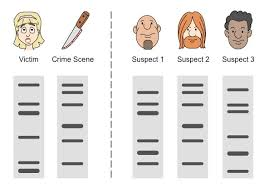
Which suspects DNA matches the DNA on the knife at the crime scene?
Which suspects DNA matches the DNA on the knife at the crime scene?
Because each DNA molecule is composed of two strands, DNA is known as a double helix.
Population genetics is the study of the variation in genes among a group of individuals.
To calculate the percentage of people who have a particular allele, population studies are conducted to collect data.
Since DNA is evidence that is capable of identifying a specific person, it is known as trace evidence.
When the amount of evidence left at a crime scene is very small, it is considered to be individual evidence.
Except for identical twins, no two people on earth have the same:
Biological evidence is used in forensics for identification purposes. Biological evidence includes:
The analysis of chromosomes, which was originally developed by geneticists, is known as:
Genetic information is stored in molecules of DNA making up structures called:
If you tease apart a human chromosome, you will see that it is made up of:
James Watson and Francis Crick received the 1953 Nobel Prize for their work on describing the structure of DNA--:
In the nucleus of most human body cells, there are:
DNA in chromosomes is called
One of two or more alternative forms of a gene is:
DNA sequences that have instructions for making a protein molecule that determines our inherited characteristics or traits such as blood type or enzyme production are:
Molecular scissors that cut DNA at specific base sequences are called ____________________________________________.
The method of separating the molecules within an electric field, based on their size, is called___________________________________.
A method used to rapidly make multiple copies of a specific segment of DNA is called ____________________________.
Tandem repeats of short DNA sequences (2-5 pairs) with varying numbers of repeats between individuals is called ________________________________.
What is the correct base pair rulings for the DNA strand TTTAACGAATA?
What is the correct base pair rulings for the DNA strand CCTTAATTCAGACCAT?
What is the correct base pair rulings for the RNA strand GGCATAAGATTACGA?
Electrophoresis uses _________ to move DNA.
A child inherits ___________ genes for each trait.
Which crimes when committed will law enforcement upload your DNA into the national DNA database?
One well contains a control, a solution containing DNA fragments of known lengths called a __________________ or Standard DNA
Which suspects DNA matches the DNA on the knife at the crime scene?
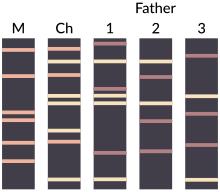
Which father is the child's father?
Each DNA strand is tightly coiled around _____________________ molecules and itself.
When a human egg and a sperm combine, nearly a ____________________ different gene combinations are possible.
A perpetrator may leave ______________________, such as saliva or blood, at a crime scene.
When performing the Strawberry DNA extraction lab, what did you need to break in order for the chemicals to react with the DNA?
DNA is separated within an ___________ gel
The DNA can be extracted from the cell __________________.
VNTR and STR data are analyzed for
Essay--Write the answer to one essay question in the space provided below.
FCA’s 1. Write in complete sentences and paragraph form.
2. Use Chapter 7 terminology to answer questions(example: DNA, alleles, chromosomes etc...).
3. Provide inferences, other thoughts, or personal experiences in your answer whenever possible.
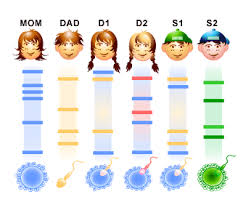
1. Using the DNA probes above, identify kids which could be from the parents and explain how you know they are their kids.
2. Using the DNA probes above, identify kids which are not both their kids or which neither of them are related to and explain how you know.
Extra Credit: In the case studies, who was the first person exonerated of their conviction because of DNA evidence?
Extra Credit: In the case studies, who was the victim when Ian Simms was the first convicted of murder where the victim's body was not found but DNA evidence was used?