Log in
Sign up for FREE
arrow_back
Library

Illustrative Math - Algebra 2 - Unit 2 - Lesson 5

star
star
star
star
star
Last updated about 1 year ago
6 questions
1
A.APR.3
1
A.APR.3
1
A.APR.3
1
A.APR.3
1
A.APR.3
1
A.APR.3
Question 1
1.

What is the value of 4(x-2)(x-3)+7(x-2)(x-5)-6(x-3)(x-5) when x=5?

Question 2
2.

Question 3
3.

The graph of a polynomial f(x)=(2x-3)(x-4)(x+3) has x-intercepts at 3 x values. What are they?

Question 4
4.

Draggable itemarrow_right_altCorresponding Item
arrow_right_alt
arrow_right_alt
arrow_right_alt
Question 5
5.

Han is multiplying 10x^{4} by 0.5x^{3} and gets 5x^{7}. He says that 0.5x^{3} is not a polynomial because 0.5 is not an integer. What is the error in Han’s thinking? Explain your reasoning.

Question 6
6.

This lesson is from Illustrative Mathematics. Algebra 2, Unit 2, Lesson 5. Internet. Available from https://curriculum.illustrativemathematics.org/HS/teachers/3/2/5/index.html ; accessed 27/July/2021.

IM Algebra 1, Geometry, Algebra 2 is © 2019 Illustrative Mathematics. Licensed under the Creative Commons Attribution 4.0 International License (CC BY 4.0).

The Illustrative Mathematics name and logo are not subject to the Creative Commons license and may not be used without the prior and express written consent of Illustrative Mathematics.

These materials include public domain images or openly licensed images that are copyrighted by their respective owners. Openly licensed images remain under the terms of their respective licenses. See the image attribution section for more information.
Which polynomial function has zeros when x=-2,\frac{3}{4},5?
f(x)=(x-2)(3x+4)(x+5)
f(x)=(x-2)(4x+3)(x+5)
f(x)=(x+2)(3x-4)(x+5)
f(x)=(x+2)(4x-3)(x-5)
Match each sequence with one of the recursive definitions. Note that only the part of the definition showing the relationship between the current term and the previous term is given so as not to give away the solutions. One of the sequences matches two recursive definitions.
b(n)=b(n-1)+0
7,3,-1,-5
a(n)=a(n-1)-4
1,-\frac{1}{2},\frac{1}{4},-\frac{1}{8}
c(n)=-\frac{1}{2}*c(n-1)
8,8,8,8
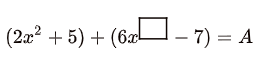
Here are two expressions whose sum is a new expression, A.
Select all the values that we can put in the box so that A is a polynomial.
0
0.5
-2
-0.5
1
-1
2