
1
Asemmisa {{asɛmmisaAhyɛnsode}}
1.
1
Asemmisa {{asɛmmisaAhyɛnsode}}
2.


List all the possible outcomes for spinning the spinner and rolling a fair number cube.
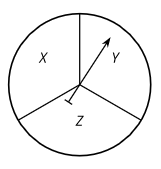
A student flips a fair coin and then spins this spinner.

How would you find the sample space?
Select all of the words for which the probability of selecting the letter A at random is

Here are 2 circles. The smaller circle has radius r, circumference c, and diameter d. The larger circle has radius R, circumference C, and diameter D.

The larger circle is a dilation of the smaller circle by a factor of k.
| Draggable item | arrow_right_alt | Ade a ɛne no hyia |
|---|---|---|
The ratios | arrow_right_alt | 2 |
The ratios | arrow_right_alt | |
The ratios | arrow_right_alt | k |
This lesson is from Illustrative Mathematics. Geometry, Unit 8, Lesson 4. Internet. Available from https://curriculum.illustrativemathematics.org/HS/teachers/2/8/4/index.html ; accessed 29/July/2021.
IM Algebra 1, Geometry, Algebra 2 is © 2019 Illustrative Mathematics. Licensed under the Creative Commons Attribution 4.0 International License (CC BY 4.0).
The Illustrative Mathematics name and logo are not subject to the Creative Commons license and may not be used without the prior and express written consent of Illustrative Mathematics.
These materials include public domain images or openly licensed images that are copyrighted by their respective owners. Openly licensed images remain under the terms of their respective licenses. See the image attribution section for more information.