
What is the melting point of the substance?
What is the melting point of the substance?
What is the melting point of the substance?
What is the boiling point of the substance?
What letter represents melting?
What letter represents a solid?
What letter represents a gas?
What letter represents boiling?
What letter represents a state that has a definite volume, but indefinite shape?
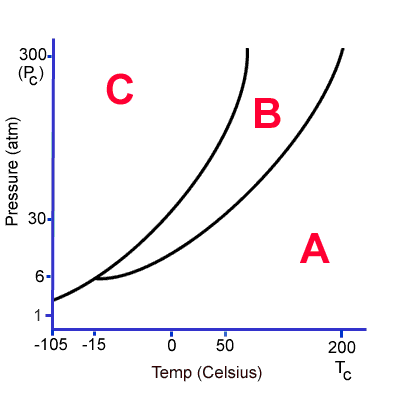
What state would this substance be in at a pressure of 30 atm and a temperature of -15 degrees Celsius?
If this substance was at a pressure of 30 atm, at what temperature would it boil?
This substance started at a temperature of -15 degrees Celsius and a pressure of 300 atm. The temperature was increased to 100 degrees Celsius. What phase change did this susbtance go through?
The point at which all three phases coexist at equilibrium is called....
As elevation increases, the atmospheric pressure ____________________, causing the boiling point of water to ________________.
The ability of a substance to be hammered and flattened without breaking is called...
The amount of matter something has is called....
The ability of a substance to be dissolved in something else is called....
The ability of a substance to be stretched into wires is called....
The ability of a substance to reflect light; "shininess"
The amount of matter something has per unit volume.
The ability of a substance to transfer heat to one another.
A block of ice melting into liquid water is an example of a...