The Center for Disease Control listed the causes of death in the United States during 2017:
Heart Disease 25.4%
Cancer 23.2%
Circulatory Diseases and stroke 5.6%
Chronic Respiratory Disease 5.3%
Accidents 5.1%
What percent of deaths were from causes not listed above?
Question 16
16.
Question 17
17.
Question 18
18.
Students in an Intro to Stats course were asked to describe their politics as 'Liberal', 'Moderate', or 'Conservative'. The results are below:
What percent of the class is male?
Round to one place past the decimal for the %.
Question 19
19.
Students in an Intro to Stats course were asked to describe their politics as 'Liberal', 'Moderate', or 'Conservative'. The results are below:
What percent of the class considers themselves to be 'conservative'?
Round to one place past the decimal for the %.
Question 20
20.
Students in an Intro to Stats course were asked to describe their politics as 'Liberal', 'Moderate', or 'Conservative'. The results are below:
What percent of the males in the class consider themselves to be 'conservative'?
Round to one place past the decimal for the %.
Question 21
21.
Students in an Intro to Stats course were asked to describe their politics as 'Liberal', 'Moderate', or 'Conservative'. The results are below:
What percent of all the students in the class are males who consider themselves to be 'conservative'?
Round to one place past the decimal for the %.
Question 22
22.
Students in an Intro to Stats course were asked to describe their politics as 'Liberal', 'Moderate', or 'Conservative'. The results are below:
What percent of the 'conservatives' are males?
Round to one place past the decimal for the %.
Question 23
23.
Students in an Intro to Stats course were asked to describe their politics as 'Liberal', 'Moderate', or 'Conservative'. The results are below:
What percent of the 'liberals' are females?
Round to one place past the decimal for the %.
Question 24
24.
Students in an Intro to Stats course were asked to describe their politics as 'Liberal', 'Moderate', or 'Conservative'. The results are below:
What percent of the females are 'liberals'?
Round to one place past the decimal for the %.
Question 25
25.
Use the table displayed below.
Circle the marginal distribution of sex.
I will grade your work myself.
Question 26
26.
Students in an Intro to Stats course were asked to describe their politics as 'Liberal', 'Moderate', or 'Conservative'. The results are below:
Give the marginal distribution for Sex.
Use the format: Female:space percent space Male: space percent
ex. Female: 22.2% Male: 22.4%
Round to one place past the decimal for the %.
I will try to double check answers to see if yours is correct, ask me if you have a question.
Question 27
27.
Students in an Intro to Stats course were asked to describe their politics as 'Liberal', 'Moderate', or 'Conservative'. The results are below:
Circle the marginal distribution of politics using the show your work section below.
I will grade myself as you are working.
Question 28
28.
Students in an Intro to Stats course were asked to describe their politics as 'Liberal', 'Moderate', or 'Conservative'. The results are below:
Give the marginal distribution for Politics.
Use the format: L:space percent space M: space percent space C: space percent
ex. L: 22.1% M: 22.4% C: 44.8%
Round to one place past the decimal for the %.
I will try to double check answers to see if yours is correct, ask me if you have a question.
Question 29
29.
Students in an Intro to Stats course were asked to describe their politics as 'Liberal', 'Moderate', or 'Conservative'. The results are below:
Circle the conditional distribution of Politicsfor the males.
I will grade your answer myself.
Question 30
30.
Students in an Intro to Stats course were asked to describe their politics as 'Liberal', 'Moderate', or 'Conservative'. The results are below:
Give the conditional distribution of Politicsfor the males.
Use the format: L:space percent space M: space percent space C: space percent
ex. L: 22.9% M: 22.5% C: 44.8%
Round to one place past the decimal for the %.
I will try to double check answers to see if yours is correct, ask me if you have a question.
Question 31
31.
Students in an Intro to Stats course were asked to describe their politics as 'Liberal', 'Moderate', or 'Conservative'. The results are below:
Circle the conditional distribution of Sexfor the Liberals.
I will check your answer as you work.
Question 32
32.
Students in an Intro to Stats course were asked to describe their politics as 'Liberal', 'Moderate', or 'Conservative'. The results are below:
Give the conditional distribution of Sexfor the Liberals.
Use the format: Female:space percent space Male: space percent
ex. Female: 24.6% Male: 33.2%
Round to one place past the decimal for the %.
I will try to double check answers to see if yours is correct, ask me if you have a question.
Question 33
33.
Question 34
34.
Question 35
35.
Marine biologists are concerned that pollution from a nearby factory has affected the health of local sea urchins.
Which of the following is most likely to be the population of interest?
All the sea urchins near the plant
All of the sea urchins in the entire ocean
4 sea urchins with abnormal coloration
20 sea urchins
Which of the following variables is most likely to be used as categorical?
Length of a garden hose
Recorded ranfall for a day
Weight of books on a shelf
Flower color
Which of the following variables is most likely to be used as quantitative?
Country of birth
Car manufacturer
Flash drive capacity
Zip code
A February 2014 Gallup Poll question asked, 'In politics, as of today, do you consider yourself a Republican, a Democrat or an Independant?'
The possible responses were : 'Democrat,' Republican', 'Independent', or 'Other'
What kind of variable is the response?
Quantitative
Categorical
The response is not a variable
Gallup conducted a series of telephone polls involving 20,392 American adults during 2011. Among the reported results were:
voters' gender, age, race, party affiliation, whether they were of Hispanic ethnicity, education level, region, # adults in the household, and phone statust (cell phone only, landline only, etc.)
Select all the variables that are categorical:
Gender
Race
Region
Party affiliation
Hispanic ethnicity yes or no
Education level
Number of adults in household
Age
Phone status (landline, cell, none, both)
Gallup conducted a series of telephone polls involving 20,392 American adults during 2011. Among the reported results were:
voters' gender, age, race, party affiliation, whether they were of Hispanic ethnicity, education level, region, # adults in the household, and phone statust (cell phone only, landline only, etc.)
Select all the variables that are quantitative:
Age
Gender
Phone status (landline, cell, none, both)
Race
Hispanic ethnicity yes or no
Region
Education level
Number of adults in household
Party affiliation
Gallup conducted a series of telephone polls involving 20,392 American adults during 2011. Among the reported results were:
voters' gender, age, race, party affiliation, whether they were of Hispanic ethnicity, education level, region, # adults in the household, and phone statust (cell phone only, landline only, etc.).
What would the sample be for this study?
Gallup pollsters
American voters
20,392 American adults
American adults during 2011
In 2012 Consumer Reports rated bottom-freezers. It listed 102 models, giving the brand, cost, size (small, medium, large), temperatuer performance, noise (poor, fair, etc), ease of use, energy efficiency, estimated annual energy cost, an overall rating and the exterior dimensions
What is the population for this study:
All freezer refrigerators
Consumer Reports
U.S. bottom freezer rerigerators
102 models of bottom freezer refrigerators
Business analysts hoping to provide information helpful to American grape growers compiled these data by surveying several vineyards:
Size (acres), number of years in existence, state, varieties of grapes grown, average case price, gross sales, and percent profit.
What is the population of interest for this study?
American vineyards
Grapes grown in America
American grape growers
Business analysts
The pie charts below show the percentages of users of Facebook and users of Twitter that fall into various age groups.
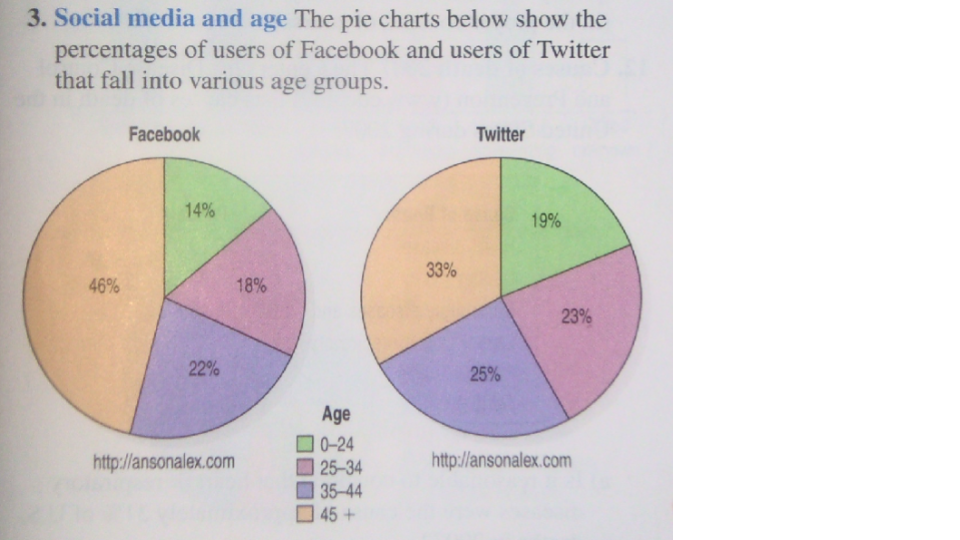
Which of the following statements below cannot be concluded about the pie charts?
There are about the same number of Facebook users as Twitter users.
Both Twitter and Facebook have more people in 45+ age group than any other age group.
The smallest age group for both Facebook and Twitter users is the 0-24 age group.
Facebook has a larger proportion of users in the 45+ age range than Twitter
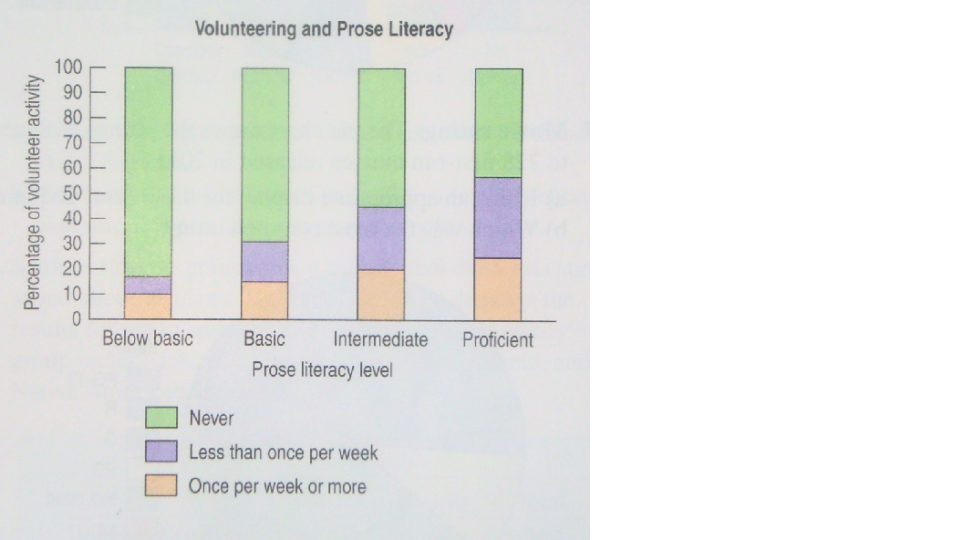
The segmented bar charts below depict the data from the NAAL conducted in 2003.
Which of the following is greatest? Hint: read carefully and think about what the bar charts display, and the y-axis label.
It is impossible to determine which is greatest without knowing the actual number of people at each literacy level.
The number of people who never volunteer and test Proficient on Prose Literacy
The number of people who volunteer once per week or more and test Below Basic on Prose Literacy.
The number of people who volunteer less than once per week and test Basic on Prose Literacy.
The segmented bar charts below depict the data from the NAAL conducted in 2003.
Based on the segmented bar graphs, does there appear to be an association between voluteerism and literacy level?
Yes, because the corresponding segments of the four bars have different heights.
Yes, because all four bars have the same height.
Yes, all four bars have the same number of segments.
No, because the corresponding segments of the four bars have different heights.
The segmented bar charts below depict the data from the NAAL conducted in 2003.
Based on the segmented bar graphs, which group is the most likely to not voluteer at all?
Basic
Below Basic
Proficient
Intermediate
The Center for Disease Control listed the causes of death in the United States during 2017:
Heart Disease 25.4%
Cancer 23.2%
Circulatory Diseases and stroke 5.6%
Chronic Respiratory Disease 5.3%
Accidents 5.1%
Would it be appropriate to display this data in a pie chart?
Yes, the data is listed as percents
Yes, pie charts show all the data
No, the data only includes 2017
No, the percents do not add up to 100%
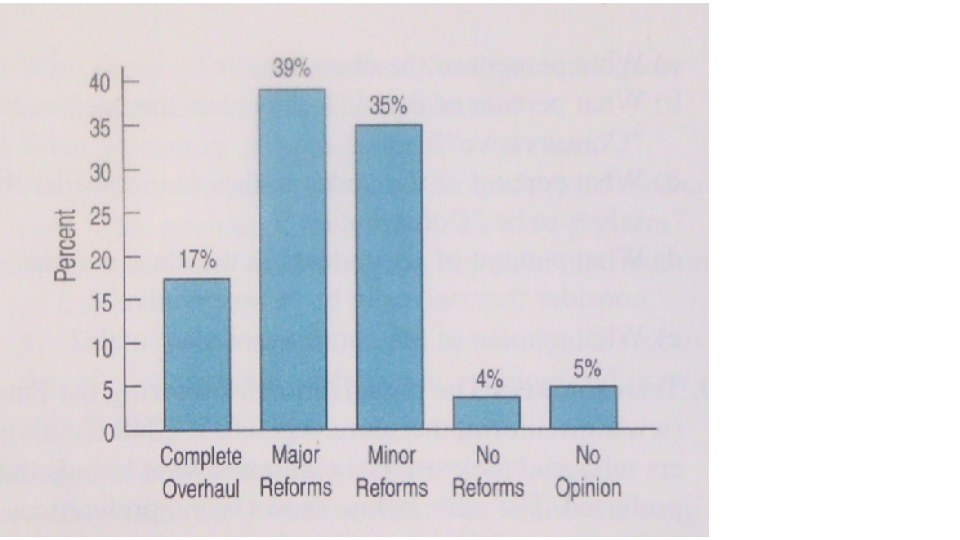
In the wake of some corporate financing scandals, the Gallup Organization asked 1,001 American adults what kind of changes, if any, were needed in the way major corporations were audited. Here's a display of the results.
Would it be appropriate to make a pie chart for these data?
No, the data should be in decimals
Yes, relative frequency bar charts and pie charts are similar
Yes, the data represents the whole group of data
No, the % do not add up to 100%
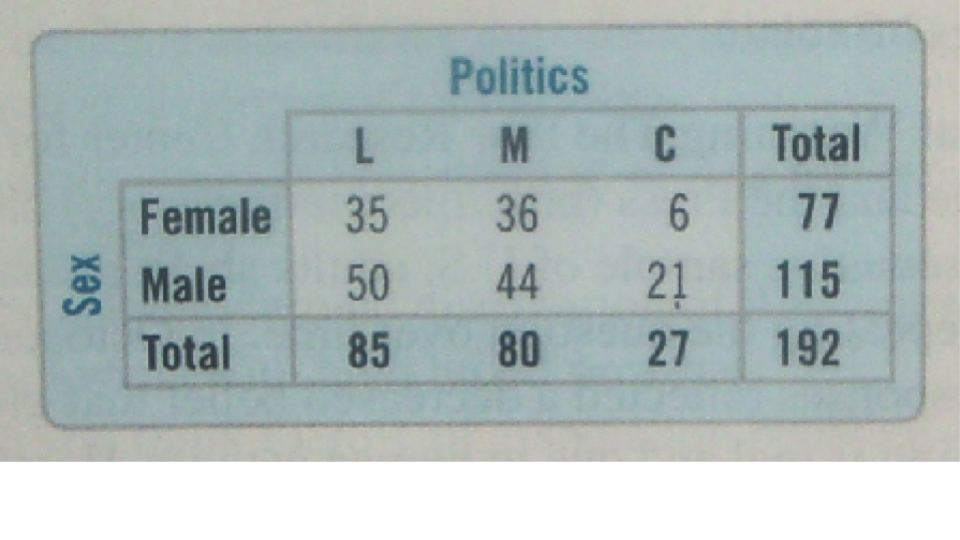
Students in an Intro to Stats course were asked to describe their politics as 'Liberal', 'Moderate', or 'Conservative'. The results are below:
What are the variables being compared in this table?
Liberal
Female
Conservative
Sex
Male
Moderate
Politics
Total
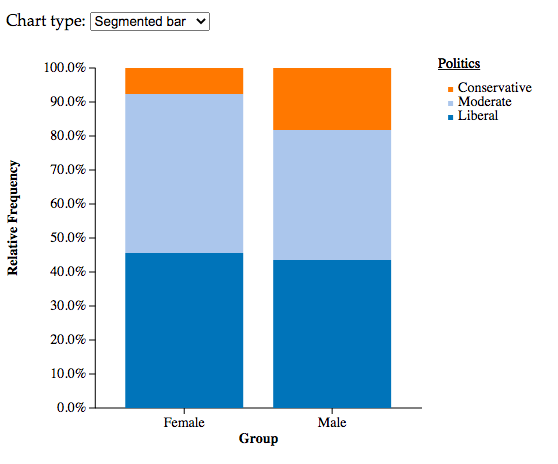
Students in an Intro to Stats course were asked to describe their politics as 'Liberal', 'Moderate', or 'Conservative'. The results are below:
Based on the segmented bar charts above, do you think Sex and Politics are associated?
No, the distributions are the same, both males and females are about 46% Liberal
Yes, the distributions are different, males have a higher percentage of Conservative views than female
Yes, the percentages are the same, both males and females are about 46% Liberal
No, the distributions are different, males have a higher percentage of Conservative views than female
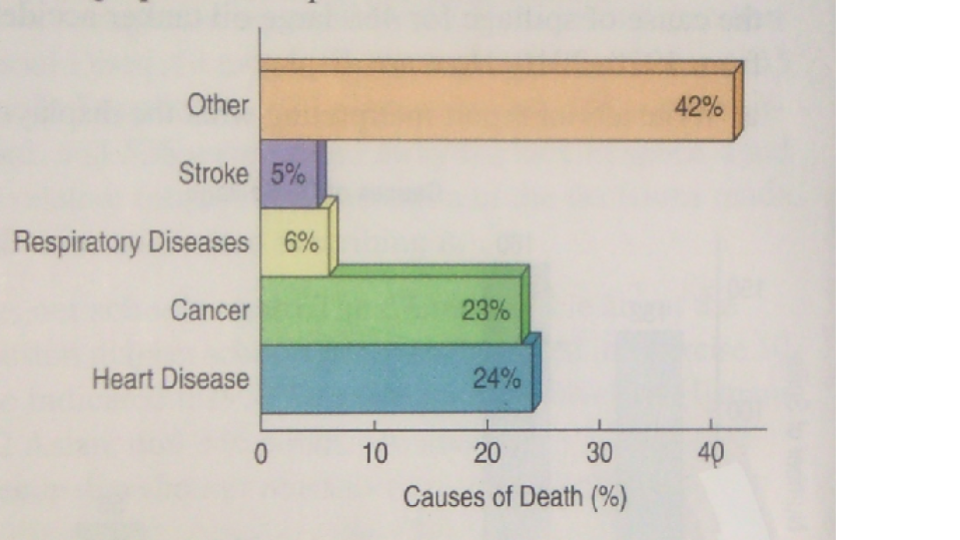
The bar chart below displays the cause(s) of death for a group of adults in January of 2012.
The 4 most common causes: heart disease, cancer, respiratory disease and stroke, accounted for nearly 60% of all deaths.
Do you see any problems with the graph?
No, the bars are 3-dimensional which is interesting.
Yes, the bars should have spaces between them.
No, the bars show the data in %.
Yes, the % do not add to 100%
What characteristics are important when creating a Relative Frequency Bar Chart, a Pie Chart or a Segmented Bar Chart? (there are 4)
The data needs to be categorical
The data should be on an interesting topic
The colors need to be bright and appealing.
The perents or decimals need to add to 100% or 1.0
The data should be quantitative
There needs to be a legend to identify the different categories