How Can I Protect Myself and Others from COVID-19?
star
star
star
star
star
Last updated about 5 years ago
45 questions
Note from the author:
This is a 6 lesson unit that was developed using the resource created by the Smithsonian Institute called COVID-19! How Can I Protect Myself and Others? - https://ssec.si.edu/sites/default/files/other/globalgoals/COVID19/COVID-19_HowCanIProtectMyselfandOthers.pdf. Students create an identiy map, learn about social distancing, wearing masks, hand washing, and contact tracing. They then create an action plan on what they are doing to do to keeo themselves and others safe from COVID-19.
How do I Protect Myself and Others from COVID-19?
Scroll through the instruction slides below for an overview for this unit. (These lessons were adapted from lessons written by the Smithsonian Science Education Center titled "COVID-19! How Can I Protect Myself and Others?" - Link)
Task 1: What is happening in the world right now?
You may have noticed that a lot is different than it was a few months ago. The adults around you may seem stressed or anxious. You may be feeling the same way, especially if you have watched the news, spent time on social media, or talked to friends.
This unit, "How Can I Protect Myself and Others from COVID-19?" will help you, and your community, understand the science of the virus that causes COVID-19 and other viruses like it. It will help you to figure out how this virus is impacting or affecting you or may impact you in the future. It will help you to understand the actions that you can take to keep yourself and your community safe.
In this project, you will discuss how people feel about the virus. You will investigate the science of this virus. You will explore public health measures, which are things that are happening in your community or may happen soon to keep COVID-19 from spreading. You will take action to support health in your community.
During this project, you will be asked to collect your thoughts, feelings, and research. There are a few different reasons to do this:
There is a lot happening in the world! One of the best ways to process how you are feeling is to write it down.
Scientists keep records! Throughout their research, scientists capture data about what they are studying so that it is all in one place.
You are experiencing history! It may not feel like it right now, but the world is experiencing a major historical event. History is preserved on a global and state level. But you are also a part of it. Someday future generations will want to know what it was like to be here now.
Take 30 seconds to think about this question: How has life changed recently and how do I feel about it?
1 point
1
Question 1
1.
1 point
1
Understand: How would I describe myself?
1 point
1
Question 3
3.
What have you included in your identity map? Please either draw your identiy map or upload a picture of one you have created.
1 point
1
Question 4
4.
How might your identity map change over time?
1 point
1
Turn your attention back to COVID-19. It’s time to make a map of what you know and what you would like to learn about COVID-19.
1 point
1
Question 6
6.
Write down what you know or think you know about COVID-19. Here are things that may help guide your thinking:
You don’t need to have all of the answers right now. If there are questions you have about COVID-19, write them down. Throughout the unit, you may be able to answer some of these questions. You may have more questions to add to your map. You can refer back to these questions at the end of each task.
Act: What are things we can do to feel safe?
COVID-19 is scary for everyone. But there are some things you can do to help you to feel safe:
Are there things that you do in your home that make you feel more safe?
Speak with others in your home about continuing these practices
Another strategy that you can practice any time you feel anxious, nervous, or scared is breathing. Try this:
If it is comfortable for you, start by closing your eyes.
Notice what you hear and what you smell in the space around you.
Place your hands on your stomach, just below your belly button. d. Inhale through your nose. Fill your belly with air so it presses against your hands.
Exhale out your mouth, pushing out all of the air that was in your belly.
Do this four more times or as many times as you need to feel more calm and secure.
Remember that no matter what is happening, you are not alone. Scientists, researchers, and healthcare workers all over the world are working on finding solutions to COVID-19. They are working to keep everyone safe. Before you go on to the next task, here are some COVID-19 basic facts to help you get started.
COVID-19 is a disease. It is caused by a virus called SARS-CoV-2. Scientists think this virus first spread from an animal to a person. Scientists now know that it can spread from one person to another person. Scientists are trying to find out more about if this virus can spread from people back to animals.
SARS-CoV-2 virus is part of a family of viruses called “coronaviruses.” They are called this because the pointy structures emerging from the viruses look like a crown or a “corona” when scientists look at them under a microscope.
COVID-19 is difficult to track or trace because it takes between 1 and 14 days for people to begin feeling sick, or “showing symptoms.”
A symptom is what people feel when they are sick. Symptoms of COVID-19 may include: fever, dry cough, tiredness, body aches, and shortness of breath or difficulty breathing. Some people may also lose their sense of smell or sense of taste. A stuffy nose or sore throat have been rare.
Some people who get COVID-19 become very ill and find it difficult to breathe. Older people and those with other medical conditions have more chance of becoming very ill, though this can happen to anyone. f. Some people who are carrying the virus in their bodies will never show any symptoms or look sick. But they can still pass the disease to others. This is called being “asymptomatic.”
This virus is affecting the health of people all over the world. It is also changing how people interact with each other, how they do business, their impact on Earth, and what they feel is right and wrong.
Look at the video below to learn more abut COVID-19.
TASK 2: How can keeping distance from others help?
1 point
1
Question 7
7.
You hve heard people talking in your home or community to keep more distance from each other than before? Why do you think this is happening?
Understand: Why is distance so important?
Think about the social perspectives of the problem in your community as you read the following quote from an expert.
“COVID is spread through respiratory droplets. These droplets travel from one person to another, including from our hands. Think of a typical day in your community. You greet multiple people with handshakes, hugs, and kisses. You buy things at the store using money that has passed from person to person. You are constantly interacting closely with people and things. These are all opportunities to spread COVID. Limiting these interactions and contacts is what reduces community transmission.” - Cassie Morgan, Kuunika Sustainability Coordinator, Cooper Smith, Malawi
To understand why distance is so important you must understand three other things about COVID-19: respiratory droplets, being asymptomatic, and contact?
Try this activity:
Blow a long slow breath into a dry cup or onto a mirror. Observe and feel the inside of the cup or mirror.
Do you notice that it feels wet? This is one example of respiratory droplets.
Read the following to learn more:
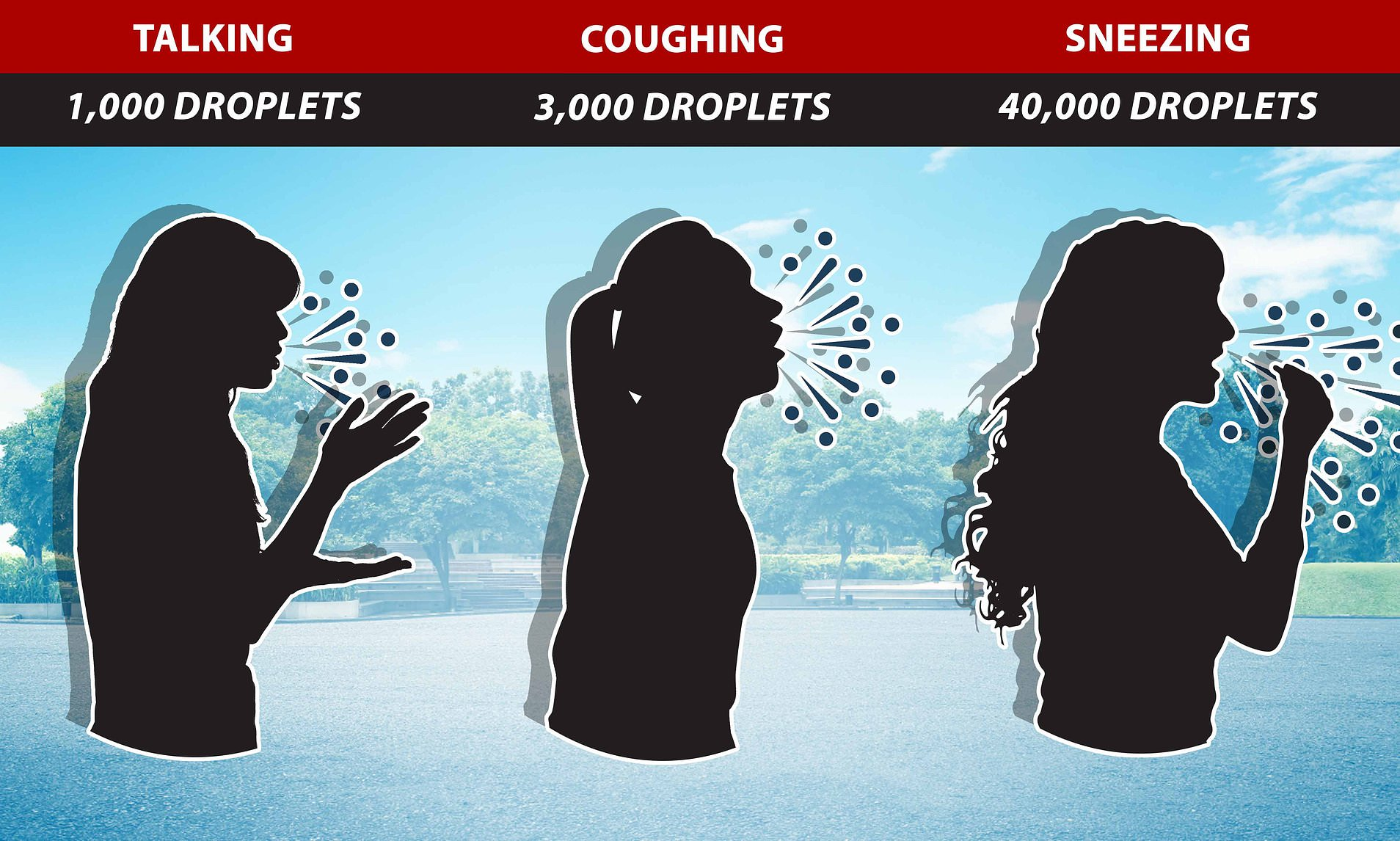
Respiratory droplets are very small drops of fluid that come from the lungs, nose, and mouth. When a person coughs, sneezes, or talks, the droplets can come out of the body. These droplets come out of the body through saliva and mucus. Respiratory drops mostly consist of water. All people, not just those who are ill, produce respiratory droplets.
Respiratory droplets can be of many different sizes. Sneezing and coughing can produce larger droplets. These droplets can spread COVID-19 if a person is infected with the virus. When healthy people come into contact with respiratory droplets from a person with COVID-19, the virus could be spread to them. Some people who are carrying the virus in their bodies will never show any symptoms or look sick. But they can still pass the disease to others. This is called being “asymptomatic.”
Being asymptomatic means you can still spread the virus to other people in the same ways as people who feel ill. This happens through the spread and contact with respiratory droplets.
There are different types of contact that can spread the respiratory droplets between people.
Direct Contact - Any person who is in close contact (within 2 meters) with someone who has respiratory symptoms (coughing). The risk is directly exposing your mouth, nose, or eyes to the respiratory droplets from the ill person. In these situations, you are more likely to breathe in the viruses when an ill person coughs, sneezes, or speaks.
Indirect Contact - Respiratory droplets containing the virus from a cough, sneeze, or talking may land on an object like your hand, a table, doorknob, or handrail. The COVID-19 virus could remain there for some time. Sometimes from a few hours to several days. Another person could then touch the object with their hand. If that person touches his or her face, mouth, nose or eyes, the virus gets into their body.
Understanding how respiratory droplets move is an important part of COVID-19 spread. Remember that the COVID-19 virus can be spread from person to person through these droplets.
1 point
1
Question 8
8.
Where do respiratory droplets come from?
1 point
1
Question 9
9.
Everyone produces respiratory droplets, not just people who are ill.
1 point
1
Question 10
10.
Respiratory droplets are all the same size.
1 point
1
Question 11
11.
What does asymptomatic mean?
1 point
1
Question 12
12.
There are different types of contact that can spread the respiratory droplets between people. What is the difference between direct contact and indirect contact?
Do an experiment by creating a model of respiratory droplets - This water model will help you observe how far droplets of water can move. These observations may help you think about how far you should stay from others when they cough, sneeze, and talk.
You will need these materials:
Bowl or cup with enough water to cup in your hand
cloth to clean up water on hands and surfaces
measuring device (ruler or use your foot)
objects or tape to mark off distances from the wall.
Procedure
Locate an open area with a wall inside or outside of your home. Make sure you have permission to get it a little wet, such as a bathroom or outside wall. Location requirements:
You need to be able to stand very close to the wall.
You need to also be able to stand at least 2 meters (4-6 steps) or more away from the wall without anything in your way.
Using your measuring device, mark off the following distances from the wall on the floor:
0.5 m, 1.0 m, 1.5 m, 2.0 m, or just count steps (1 step from wall, 2 steps, 3 steps, 4 steps)
Stand facing the wall at the 0.5 m or 1 step mark with a bowl of water.
You will now model respiratory droplets leaving your mouth and nose from a cough or sneeze by flicking water from your hand toward the wall. To do so:
Hold the bowl of water with one hand below your chin to prevent dripping.
Dip your other hand into the water to get all of your fingers wet.
Shape your hand into a fist. Quickly lift your fist out of the water over the bowl.
Quickly flick just your fingers 2-3 times toward the wall. Some of the water should fly off of your hand toward the wall. If it does not, practice and adjust until you find a method that works for you.
1 point
1
Question 13
13.
Look closely at the pattern of droplets on the wall and floor in front of you. Make a drawing and record your observations. In your drawing think about the following questions:
Are all the droplets the same size?
How high up the wall were the highest and lowest droplets?
How close together are the droplets?
Were there more droplets on the floor or wall?
Use your cloth to clean and dry the wall and floor. Repeat the experiment at 1.0 m (2 steps), 1.5 m (3 steps), and 2.0 m (4 steps) distances from the wall. Clean and dry the wall and floor between each trial.
1 point
1
Question 14
14.
Compare and contrast your observations at the different distances.
If water droplets still make it to the wall at the 2 m (4 step) distance then try this:
Continue moving farther away from the wall at 0.5 m (1 step) increments to see how far away you need to be until no droplets make it to the wall.
1 point
1
Question 15
15.
What is the farthest you could flick droplets to the wall?
1 point
1
Question 16
16.
Remember, the water is simulating potentially infected droplets that leave the body when you cough, sneeze, talk, or breathe.
1 point
1
Question 17
17.
Considering your observations ands the video, why is distance an important factor to think about when protecting yourself and others?
Act: What can you do or share about physical distancing?
Think about the economic, cultural and social perspectives of the problem as you read the following quotes from experts.
“Economics is the big picture of what groups of people do to survive. The need to survive the immediate threats of starvation, lack of shelter, security, water, and livelihood for an individual, family, or community is the most intense motivator of behavior. If you cannot buy enough food for 2 weeks, or can’t find 2 weeks of shelter with a 2 meter separation from other people, you will not be able to comply with social distancing or stay at home rules. Your need to eat or find water will have you out of the house working and interacting with others. If this is not understood and taken into consideration, then that pandemic response is not adequately thought out.” - Anne McDonough, MD, MPH, Public Health Emergency Officer, Smithsonian Occupational Health Services, USA
“During a pandemic, the recommendations guided by science may conflict with people’s cultural beliefs and values. For example, in some cultures, the value placed on group gatherings for worship or other special events is very great. Some people may perceive public health recommendations to engage in social distancing or to avoid physical contact difficult to accept. They may choose not to follow those distancing recommendations.” – Dr. Lisa Cooper, John Hopkins University, USA & Ghana
1 point
1
Task 3: How can covering our noses and mouths help?
Discover: Are the people in your home covering their noses and mouths?
Think about these questions by yourself first. Then ask the people in your home these questions:
1 point
1
Question 19
19.
Do you cover your nose and mouth when you sneeze or cough?
1 point
1
Question 20
20.
Do you think covering your nose and mouth could help protect you from the virus that causes COVID-19?
Read this social perspective from an expert about why physical distancing is so important:
“Social distancing is really important for COVID-19 because you can be transmitting (spreading) infection while still looking and feeling healthy...we don’t have those behavioral cues that we tend to rely on. ‘Oh, this person is sniffling or is sneezing or seems to have a high fever, so maybe I should keep my distance.’” - Shweta Bansal, PhD, Associate Professor of Biology, Georgetown University, USA
But what should you do if you can’t always keep physical distance?
1 point
1
Question 21
21.
How else can you avoid respiratory droplets?
In some countries, people are wearing masks or other cloth coverings over their nose and mouth. Masks are one way to try to prevent the movement of respiratory droplets. Some countries are letting people choose if they want to wear a mask. Other countries are telling people that they must wear a mask. You can ask the adults in your home to find out what your country says about wearing masks.
According to the WHO, another way to prevent the movement of respiratory droplets is by “...covering your mouth and nose with your bent elbow or tissue when you cough or sneeze. Then dispose of the used tissue immediately and wash your hands. Why? Droplets spread the virus."
Even if you feel healthy, you should always cover your nose and mouth in some way when you sneeze or cough. This is important because you may still have the virus that causes COVID-19, even if you don’t feel sick. That means that you could accidentally spread the virus to people or surfaces without realizing it.
Understand: How does covering your nose and mouth help?
In the last task, you modeled how far respiratory droplets can go. Now you’ll model how covering your nose and mouth can help protect you and others from droplets by doing another experiment
You will need these materials:
Bowl with a small amount of water
a cloth to clean up water on hands and surfaces
a cloth to hold in front of your face
Find an area where you can easily see where droplets of water land, such as the wall you used in Task 2, a wood, dirt, or tile floor, or on a piece of newspaper.
Dip your hand in the bowl of water. Model respiratory droplets from a cough or sneeze by flicking water from your hand.
Look at where the droplets landed. Make a drawing and record your observations.
Move to a new area without droplets so you can try again.
Ask someone in your home to hold another piece of cloth 3-5 centimeters in front of your hand. This cloth is a model for a mask, clean tissue, or bent elbow.
Dip your hand into the water again and model respiratory droplets by flicking the water from your hand.
Look at where the droplets landed. Make a drawing and record your observations.
1 point
1
Question 22
22.
What did you observe about where the droplest landed without the cloth barrier and with the cloth barrier?
1 point
1
Question 23
23.
How did the cloth change how the droplets traveled?
Act: What can you do or share about covering our noses and mouths?
1 point
1
Question 24
24.
Do you think covering your nose and mouth could help protect you from the virus that causes COVID-19?
1 point
1
Question 25
25.
Now that you understand more about covering your nose and mouth, make a drawing or poster that tells others about how to prevent spreading respiratory droplets.
1 point
1
Task 4: How can washing our hands help?
Discover: Are the people in your home washing their hands?
Think about these questions by yourself first.
When is it important to wash your hands?
What do you use to wash your hands?
How long do you wash your hands?
1 point
1
Question 27
27.
Do you think washing your hands can help protect you from the virus that causes COVID-19? Why or why not?
Remember that you learned that the virus that causes COVID-19 can be found on surfaces. If you touch a surface like a doorknob that has the virus on it, that virus may now be on your hand. If you accidentally touch your face, the virus may enter your body.
Read this perspective about washing your hands from an expert:
“We constantly touch our face, so it is easy to imagine how our hands become the virus's main way into our body through our nose, eyes, and mouth. Washing our hands with soap and water or hand sanitizer is a very powerful defense.” - Cassie Morgan, Kuunika Sustainability Coordinator, Cooper/Smith, Lilongwe, Malawi
Understand: Why do we need to wash our hands with soap?
To find out more about how soap and water help protect you against the virus that causes COVID-19, you are going to try a few different ways to wash your hands. Write down what you notice so you can share what you have learned.
You will need:
clean water
cooking oil, butter,or ghee
soap (bar or liquid)
Why does this activity use cooking oil? The virus that causes COVID-19 has a membrane, or outer layer that surrounds all of its parts. This membrane is fatty, like your cooking oil, butter, or ghee. This activity models how hand washing affects the fatty membrane of a virus.
🛑 Physical Safety: Only use cooking oil. Do not use oil for machinery. Do not eat any cooking oil once it has touched your skin.
1 point
1
Question 28
28.
Why are you going to use oil, butter, or ghee for this activity?
1 point
1
Question 29
29.
What worked best to wash away the oil?
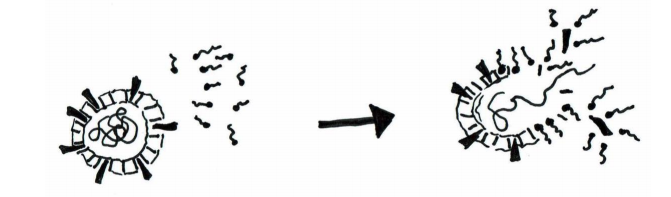
Remember that the virus that causes COVID-19 is surrounded by a fatty membrane. When you wash your hands with soap and water, very tiny pieces of soap go into the fatty membrane of the virus. As the soap goes into the membrane, the membrane eventually breaks open and the inner parts of the virus spill out. Once the virus is broken apart it can no longer infect you.
Look to the left side of the image below. You can see a round virus. You can see a long, twisted string of virus parts surrounded by a membrane and pointy pieces (this is the crown or “corona”). You can also see tiny pieces of soap on the right side of the virus.
Now look at the right side of the image below.
1 point
1
Question 30
30.
What do you think is happening in the picture above?
This shows what happens after the pieces of soap have gone into the fatty membrane of the virus. The membrane of the virus has opened up and the parts have spilled out. The soap surrounds the parts of the membrane and the spikes. The soap makes it easy to wash away pieces of the virus with water. These images show how soap can destroy the membrane of a coronavirus.
Washing your hands thoroughly allows you to wash every part and surface of your hands and destroy the viruses that might be on them. The WHO says that washing your hands should take between 40 and 60 seconds.
Act: What can you do or share about washing your hands?
1 point
1
Question 31
31.
Think back to your answer to this question:
Do you think washing your hands can help keep you safe from COVID-19?
Would you change your answer now? Why or why not?
1 point
1
Question 32
32.
Now that you understand more about how using soap or hand sanitizer can destroy viruses, choose a way to communicate what you have learned by making a drawing of how soap works to kill a virus.
1 point
1
Task 5: How is COVID-19 impacting families and communities?
Understand: How are we protecting people in our community from COVID19?
1 point
1
Question 34
34.
How many people do you think you have been in contact with, directly or indirectly, in the past week?
1 point
1
Question 35
35.
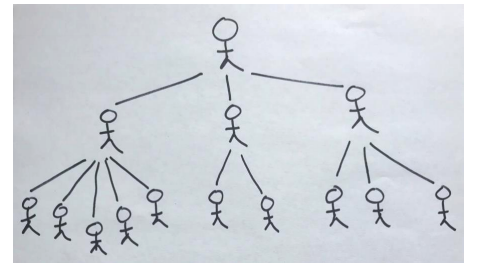
You are going to create a contact tree. You are at the top of your contact tree. Your “primary contacts” are the middle row, and your “secondary contacts” are the bottom row.
Make a list of everyone in your home. Add anyone else you have met or talked to in person in the past week. It does not matter where you met them or how old they are. Count them all. These people are your “primary contacts.” Add them to your contact tree.
Ask everyone in your home to make a list of the people that they have been in contact with. You can now add these people to the bottom row of your contact tree. They will go under the person that you both had contact with. These people are your “secondary contacts.”
1 point
1
Question 36
36.
Review your tree. Does everyone have the same number of contacts? Do some people have more contacts than others?
One common tool that scientists use to help with making predictions are computer simulations.
If we were to run a computer simulation to help us predict how the coronavirus will spread based on our actions, what would we want that computer simulation to represent?
1 point
1
Question 37
37.
Considering our questions and based on what you know about how viruses and other germs spread, what would you include in a computer simulation of the coronavirus/COVID-19 and its spread in our communities?
In the simulations below of the corona virus, different colors represent
a healthy person (blue)
a sick person (orange)
a recovered person (pink)
The first simulation represents a case where there is no social distancing attempted.
1 point
1
Question 38
38.
In what ways is the simulation useful and realistic.
1 point
1
Question 39
39.
How could we change this simulation to represent social distancing?
Run the simulation below that shows moderate social distancing (3 out of every 4 individuals in the population participates in social distancing).
1 point
1
Question 40
40.
Why does this representation make sense based on what we know about social distancing and how the virus gets transmitted? What changes when we add moderate social distancing to the simulation?
Run the simulation below with extreme social distancing (7 out of every 8 individuals in the population participates).
Run the simulation again. Why is it that even though there are random differences from one run of the simulation to the next, the results between this simulation and the previous one can help us predict what will happen as more individuals take social distancing seriously?
1 point
1
Question 41
41.
What does this tell you about actions that you should take?
1 point
1
Thinking about your own contract tree and the simulations aboive. Are the people with lots of contacts in your tree doing things that are ethically or economically necessary to support your household or community such as going to work, going to the market, attending a religious ceremony, or caring for older people?
Contact tracing for COVID-19 is important because:
Other than keeping distance, covering mouths and noses, and washing hands, humans do not have any tools yet to protect us from COVID-19. (S. Bansal, personal communication, April 23, 2020).
This is a new virus, and humans do not yet have a vaccine for it. (S. Bansal, personal communication, April 23, 2020).
Current data indicate the number of people becoming very ill or dying from COVID-19 appears to be higher than with other viruses. Scientists do not yet have enough data to know exactly what these numbers are (S. Bansal), personal communication, April 23, 2020).
People can pass this virus to others even when they are looking and feeling healthy.
Contact tracing can identify people who are potentially infected and isolate them before they spread the virus further.
Act: How can you plan for COVID-19 in your home?
1 point
1
Question 43
43.
Review your ideas on what you will do if someone gets sick. How can we help and support someone who becomes ill even though we have to keep distance from them?
Task 6: What actions can I take right now?
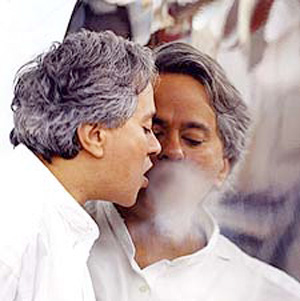
Think about the tasks that you have done on Physical Distancing, Hand Washing, Covering Your Nose and Mouth, and contact tracing. These tasks helped you learn how to slow the spread of COVID-19.
1 point
1
Question 44
44.
Think about all the strategies that may have helped you, your family, and your community manage COVID-19. Write them down in a list. Circle the ones you think worked the best.
1 point
1
Question 45
45.
Criteria for your Action Plan:
Design an action plan with 2 or 3 actions that you can take that you will feel will work best for you and your family to stay safe from COVID-19.
Use evidence from what you have learned and done in this unit to support your plan.