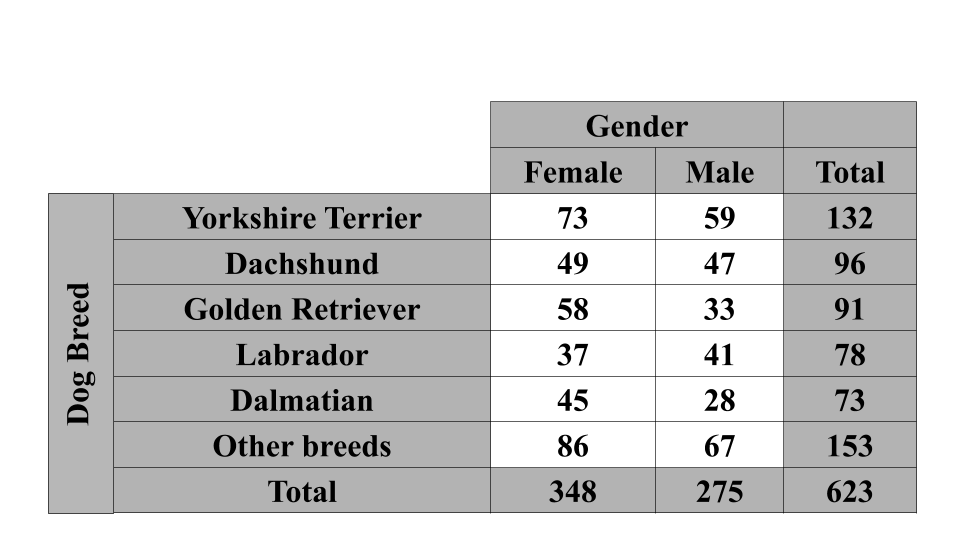
To determine if people’s preference in dogs had changed in the recent years, organizers of a local dog show asked people who attended the show to indicate which breed was their favorite.
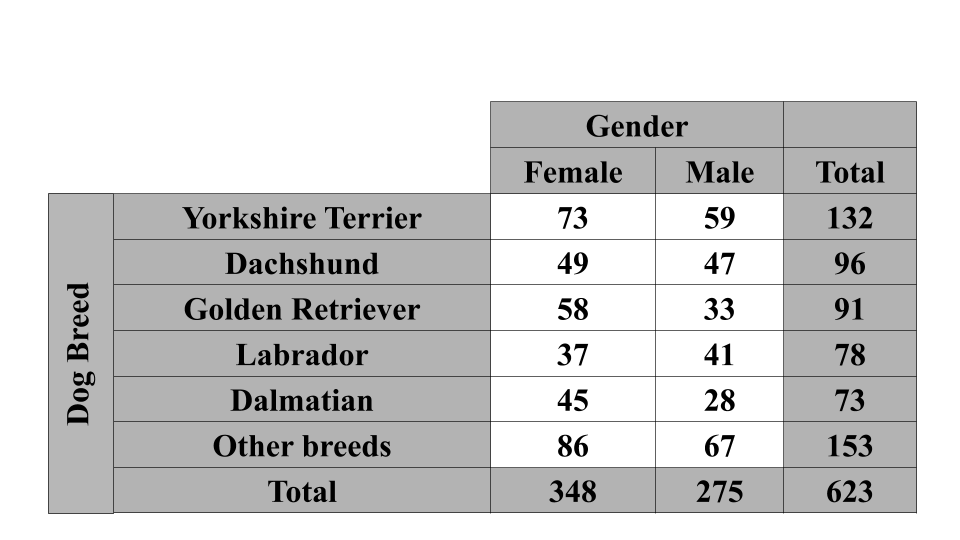
This information was compiled by dog breed and gender of the 623 people who responded. The table summarizes the responses.
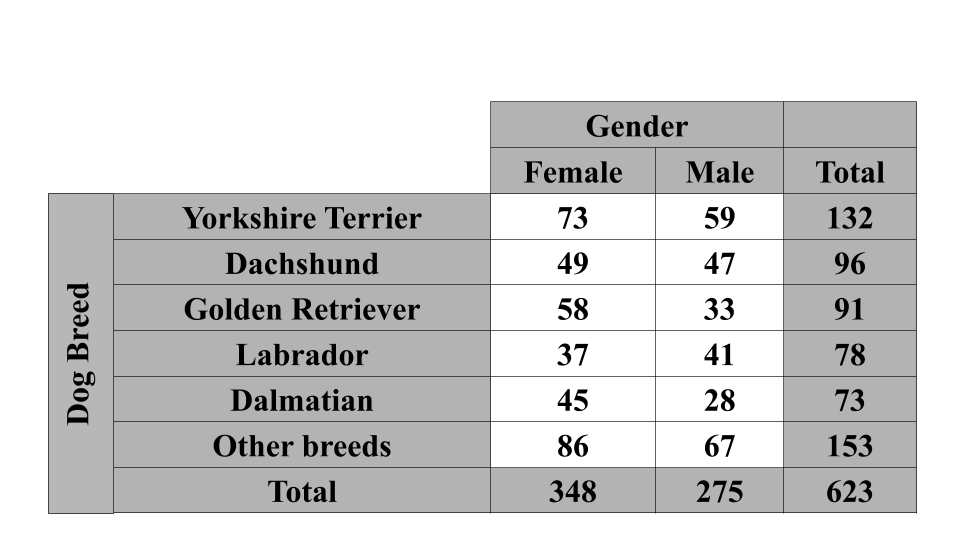
What is the population for this study?
Select the correct answer.
Question 4
4.
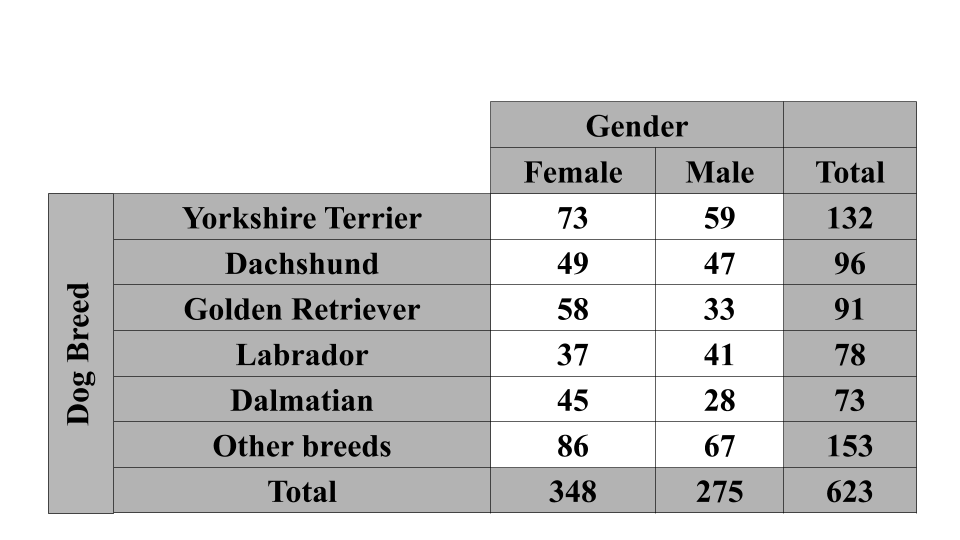
To determine if people’s preference in dogs had changed in the recent years, organizers of a local dog show asked people who attended the show to indicate which breed was their favorite.
This information was compiled by dog breed and gender of the 623 people who responded. The table summarizes the responses.
What is the sample for this study?
Select the correct answer.
Question 5
5.
Question 6
6.
To determine if people’s preference in dogs had changed in the recent years, organizers of a local dog show asked people who attended the show to indicate which breed was their favorite.
This information was compiled by dog breed and gender of the 623 people who responded. The table summarizes the responses.
What percent of all the people who responded were males who favor Labradors?
Round your percent to one place past the decimal.
Ex. 32.5%
Question 7
7.
To determine if people’s preference in dogs had changed in the recent years, organizers of a local dog show asked people who attended the show to indicate which breed was their favorite.
This information was compiled by dog breed and gender of the 623 people who responded. The table summarizes the responses.
What percent of the males favor Labradors?
Round your percent to one place past the decimal.
Ex. 32.5%
Question 8
8.
To determine if people’s preference in dogs had changed in the recent years, organizers of a local dog show asked people who attended the show to indicate which breed was their favorite.
This information was compiled by dog breed and gender of the 623 people who responded. The table summarizes the responses.
What percent of the people who chose Labradors were males?
Round your percent to one place past the decimal.
Ex. 32.5%
Question 9
9.
To determine if people’s preference in dogs had changed in the recent years, organizers of a local dog show asked people who attended the show to indicate which breed was their favorite.
This information was compiled by dog breed and gender of the 623 people who responded. The table summarizes the responses.
Circle the marginal distribution of breeds on the table
Question 10
10.
To determine if people’s preference in dogs had changed in the recent years, organizers of a local dog show asked people who attended the show to indicate which breed was their favorite.
This information was compiled by dog breed and gender of the 623 people who responded. The table summarizes the responses.
Circle the marginal distribution of gender on the table
Question 11
11.
To determine if people’s preference in dogs had changed in the recent years, organizers of a local dog show asked people who attended the show to indicate which breed was their favorite.
This information was compiled by dog breed and gender of the 623 people who responded. The table summarizes the responses.
Calculate the marginal distribution of gender using information in the table.
Use the format: Female:space percent space Male: space percent
Round percents to one place past the decimal.
Ex. Female: 21.3% Male: 25.6%
Question 12
12.
To determine if people’s preference in dogs had changed in the recent years, organizers of a local dog show asked people who attended the show to indicate which breed was their favorite.
This information was compiled by dog breed and gender of the 623 people who responded. The table summarizes the responses.
Circle the Conditional Distribution of dog breedfor females using the table below.
Question 13
13.
To determine if people’s preference in dogs had changed in the recent years, organizers of a local dog show asked people who attended the show to indicate which breed was their favorite.
This information was compiled by dog breed and gender of the 623 people who responded. The table summarizes the responses.
Circle the Conditional Distribution of genderfor golden retrievers using the table below.
Question 14
14.
To determine if people’s preference in dogs had changed in the recent years, organizers of a local dog show asked people who attended the show to indicate which breed was their favorite.
This information was compiled by dog breed and gender of the 623 people who responded. The table summarizes the responses.
Calculate the Conditional Distribution of genderfor golden retrievers using the table above.
Use the format: Female:space percent space Male: space percent
Ex. Female: 24.5% Male: 12.4%
Round percents to one place past the decimal
Question 15
15.
Question 16
16.
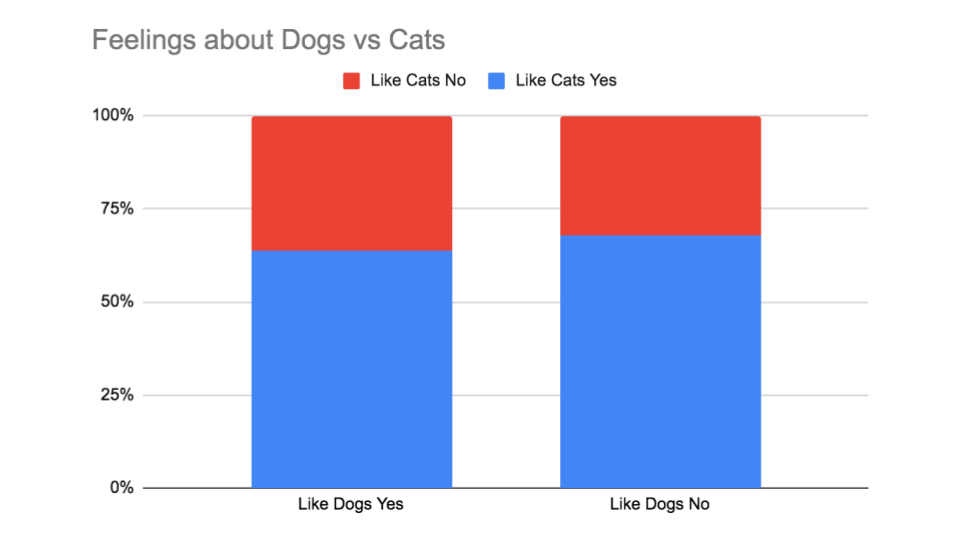
Using the side by side segmented bar charts above, are the two variables associated or independent?
Select one answer.
Question 17
17.
Using the side by side segmented bar charts above, if the two variables associated, what is a possible association?
Select one answer.
Question 18
18.
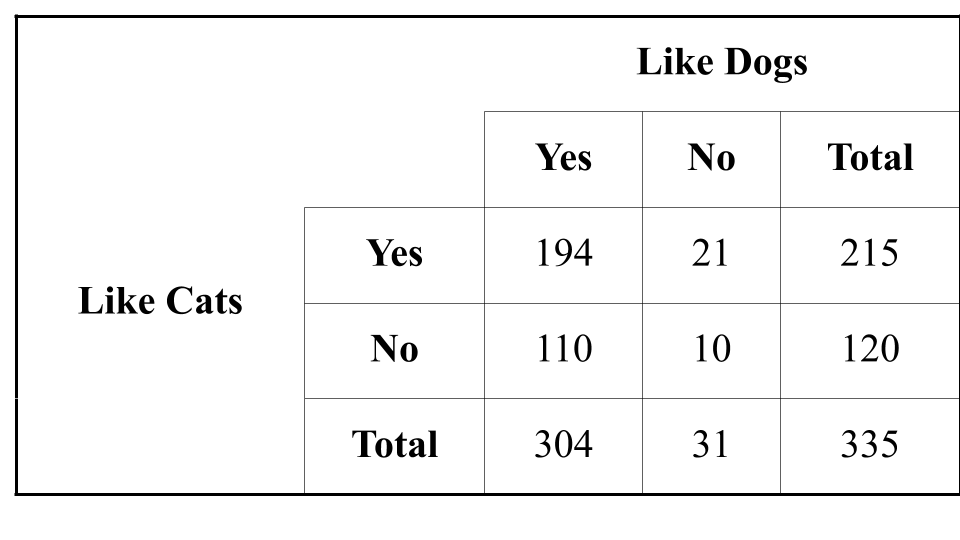
In a study on animal preferences, two of the questions adults were asked were:
1. Do you like dogs?
2. Do you like cats?
The data is summarized in the table below:
How many adults were part of the sample for this study?
Question 19
19.
Question 20
20.
AHHS administrators collect data on students attending the school. Which of the following variables are quantitative?
Select all that are quantitative.
Class group in school: freshman, sophomore, junior, senior (not the numerical grade of 9th, 10th, etc)
Whether the student is taking an AP or PAP course
Years in the school district
Electives the student has chosen
Number of extra curricular activities
Score on ACT or SAT
GPA
The SPCA collects the following data about the dogs they house.
Which are categorical?
Select all that are categorical
Is the dog able to be trrusted with children
Amount of food eaten
Health status: poor, moderate, good
Weight
Was the dog found abandoned?
Type of special diet
Is the dog adoptable?
Height at the shoulder
Organizers of a local dog show
623 people who responded to the survey
6 dog breed classes
People who attended a local dog show
623 people who responded to the survey
People who attended a local dog show
6 dog breed classes
Organizers of a local dog show
To determine if people’s preference in dogs had changed in the recent years, organizers of a local dog show asked people who attended the show to indicate which breed was their favorite.
This information was compiled by dog breed and gender of the 623 people who responded. The table summarizes the responses.
What are the variables being compared in this study?
Select both variables.
Male
Organizers of a local dog show
Dog breed
6 dog breed categories
Gender
623 people who responded to the survey
Female
Using the side by side segmented bar charts above, what are the 2 variables that are being compared (not the categories)?
Select both variables.
Super strength
Male
Gender
Freeze time
Invisibility
Female
Fly
Favorite Super Power
Independent because the segmented bar charts show similar data distributions
Both males and females are equally likely to have freeze time as a favorite super power
Males are more likely to have flying as a super power than females
Females less likely to have telepathy as a super power than males
Females are more likely to have super strength as a super power than males
In a study on animal preferences, two of the questions adults were asked were:
1. Do you like dogs?
2. Do you like cats?
The data is summarized in the table below:
What graphical displays would be helfpul when trying to determine if the variables of 'feelings about cats' and 'feelings about dogs' are associated or independent?
Choose all that apply:
Two circle graphs
A
segmented bar chart displaying feelings about dogs
A bar chart displaying the frequency of people in each cell of the table.
A circle graph displaying feelings about cats
Double Bar chart
Side by side segmented bar charts
In a study on animal preferences, two of the questions adults were asked were:
1. Do you like dogs?
2. Do you like cats?
The data is summarized in the table below:
The side by side bar charts below compare peoples feelings about dogs and cats. Based on the data distributions, are people's feelings about dogs and their feelings about cats associated or independent?
Hint: does a person's feelings about dogs make them more or less likely to like or dislike cats?
Base your answer on the bar charts (similarity vs different), and if they are associated, give a possible association. If they are independent what does this mean?