The Nitrogen Cycle
Nitrogen is everywhere! In fact nitrogen gas, N2, makes up about 78% of Earth's atmosphere by volume, far surpassing O2, we often think of as "air". The major reservoir of nitrogen is the atmosphere.
But having nitrogen around and being able to make use of it are two different things. Your body, and the bodies of other plants and animals, have no good way to convert N2, into a usable form. We animals—and our plant compatriots—just don't have the right enzymes to capture, or fix, atmospheric nitrogen.
Still, your DNA and proteins contain quite a bit of nitrogen. Where does that nitrogen come from? In the natural world, it comes from bacteria!
Bacteria play a key role in the nitrogen cycle.
Nitrogen enters the living world by way of bacteria and other single-celled prokaryotes, which convert atmospheric nitrogen — N2—into biologically usable forms in a process called nitrogen fixation. Some species of nitrogen-fixing bacteria are free-living in soil or water, while others are beneficial symbionts that live inside of plants. Lightning also has the ability to convert N2 to usable forms.
Nitrogen-fixing microorganisms capture atmospheric nitrogen by converting it to ammonia—NH3—which can be taken up by plants and used to make organic molecules. The nitrogen-containing molecules are passed to animals when the plants are eaten. They may be incorporated into the animal's body or broken down and excreted as waste, such as the urea found in urine.
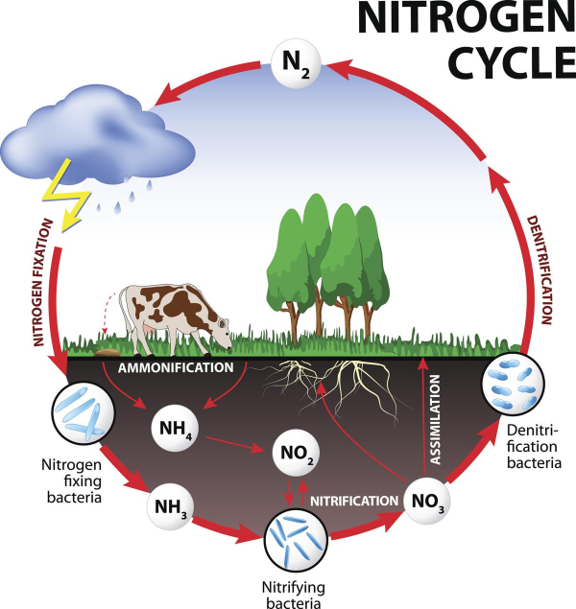
Prokaryotes play several roles in the nitrogen cycle. Nitrogen-fixing bacteria in the soil and within the root nodules of some plants convert nitrogen gas in the atmosphere to ammonia. Nitrifying bacteria convert ammonia to nitrites or nitrates. Ammonia, nitrites, and nitrates are all fixed nitrogen and can be absorbed by plants. Denitrifying bacteria convert nitrates back to nitrogen gas.
Nitrogen doesn't remain forever in the bodies of living organisms. Instead, it's converted from organic nitrogen back into N2, gas by bacteria. This process often involves several steps in terrestrial—land—ecosystems. Nitrogenous compounds from dead organisms or wastes are converted into ammonia—NH3—by bacteria, and the ammonia is converted into nitrites and nitrates. In the end, the nitrates are made into N2, gas by denitrifying prokaryotes.
Nitrogen cycling in marine ecosystems
So far, we’ve focused on the natural nitrogen cycle as it occurs in terrestrial ecosystems. However, generally similar steps occur in the marine nitrogen cycle. There, the ammonification, nitrification, and denitrification processes are performed by marine bacteria and archaea.
The illustration shows the nitrogen cycle. Nitrogen gas from the atmosphere is fixed into organic nitrogen by nitrogen-fixing bacteria. This organic nitrogen enters terrestrial food webs. It leaves the food webs as nitrogenous wastes in the soil. Ammonification of this nitrogenous waste by bacteria and fungi in the soil converts the organic nitrogen to ammonium ion—NH4 plus. Ammonium is converted to nitrites—NO2 minus—then to nitrate—NO3minus—by nitrifying bacteria. Denitrifying bacteria convert the nitrate back into nitrogen gas, which reenters the atmosphere. Nitrogen from runoff and fertilizers enters the ocean, where it enters marine food webs. Some organic nitrogen falls to the ocean floor as sediment. Other organic nitrogen in the ocean is converted to nitrite and nitrate ions, which is then converted to nitrogen gas in a process analogous to the one that occurs on land.
Nitrogen as a limiting nutrient
In natural ecosystems, many processes, such as primary production and decomposition, are limited by the available supply of nitrogen. In other words, nitrogen is often the limiting nutrient, the nutrient that's in shortest supply and thus limits the growth of organisms or populations.
How do we know if a nutrient is limiting? Often, this is tested as follows:
When a nutrient is limiting, adding more of it will increase growth—e.g., it will cause plants to grow taller than if nothing were added.
If a non-limiting nutrient is instead added, it won't have an effect—e. g., plants will grow to the same height whether the nutrient is present or absent.
For example, if we added nitrogen to half the bean plants in a garden and found that they grew taller than untreated plants, that would suggest nitrogen was limiting. If, instead, we didn't see a difference in growth in our experiment, that would suggest that some other nutrient than nitrogen must be limiting.
Nitrogen and phosphorous are the two most common limiting nutrients in both natural ecosystems and agriculture. That's why, if you look at a bag of fertilizer, you will see it contains a lot of nitrogen and phosphorous.
Define each step of the nitrogen cycle. Use the "T" tool to type into the box.
What percent of the air is nitrogen?
What is assimilation?
What happens to the nitrogen found in the remains of dead organisms?
What is the major reservior of nitrogen?
How does nitrogen get to the soil?
Fixation could occur by: (more than one answer)
Process by which ammonium is changed into nitrates by bacteria.
Process when the plants absorb nitrates from the soil into their roots.
Process when extra nitrogen in the soil is put back out into the air.
Ammonification is part of the decaying process. When a plant or animal dies, decomposers like fungi and ________turn the nitrogen back in ammonium so it can reenter the nitrogen cycle.
Denitrification is performed by
How do herbivores obtain (get) the nitrogen they need?