Log in
Sign up for FREE
arrow_back
Library

Case Study 2: Lactose Tolerance

star
star
star
star
star
Last updated almost 5 years ago
20 questions
1
1
1
1
1
1
1
1
1
1
1
1
1
1
1
1
1
1

1
1
Question 1
1.

Question 2
2.

If you selected lactose intolerant (feel sick after dairy) above, tell me here how you normally feel after eating dairy. If you selected lactose tolerant (feel fine after dairy) above, tell me here your favorite dairy filled food (certain type of ice cream or cheese, or yogurt, or chocolate milkshake etc).

Case Study- Jake, Joe and Lactose tolerance
Jake goes over to his friend Joe’s house. He arrives and Joe has a whole ice cream sundae spread out ready to go for a snack. “Ut Oh” Jake thinks…. this is not going to be good- he knows what happens after he eats dairy…he feels sickly and the smelly gas will come shortly to follow. Jake doesn’t want to tell his friend Joe he is lactose intolerant after how good this sundae spread looks and with all the work he can tell his friend put into it. He decides to suck it up and eat the ice cream. (and hopes for good air circulation in Joe's house!)
Question 3
3.

Based on the case study and the background information, which of the following genes do you think Jake has in his DNA--> mutated MCM6 gene or normal MCM6 gene. Pull a direct quote from the background (linked in blue) as evidence for your answer. Be sure to explain your answer.

Question 4
4.

Question 5
5.

Provide evidence to defend your claim above. (perform transcription of both forms of the MCM6 gene, for evidence)

Question 6
6.

Question 7
7.

Question 8
8.

Provide evidence to defend your claim above (perform translation for evidence).

Question 9
9.

Question 10
10.

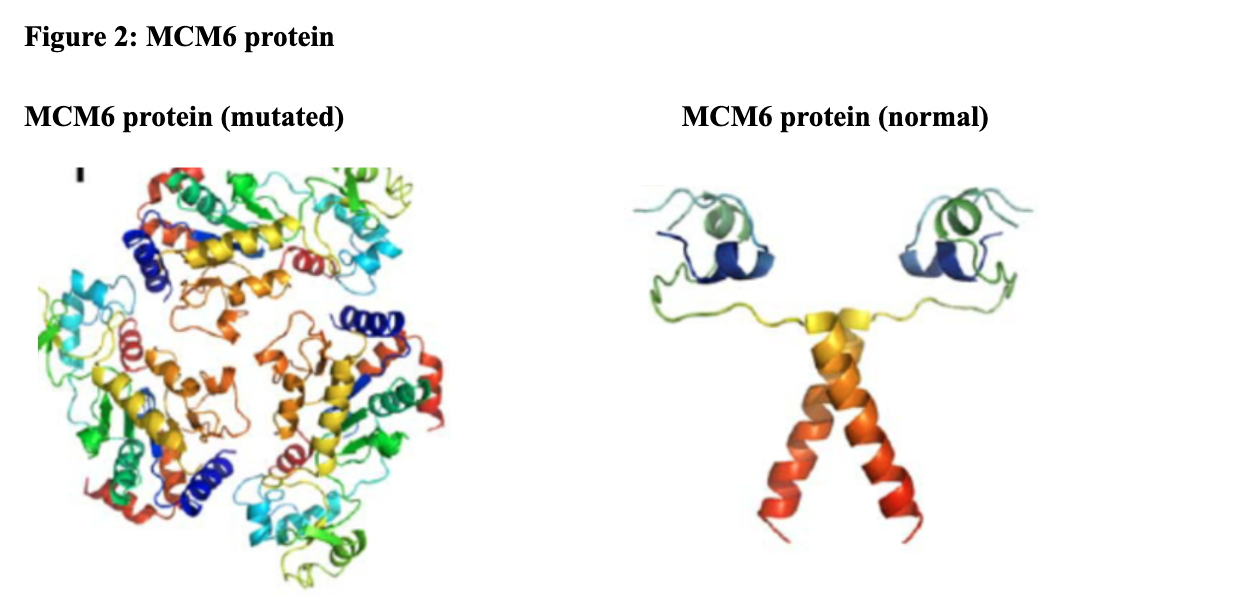
Make a claim to answer the following question… Will the shape of the MCM6 protein differ for someone who has a mutated MCM6 gene and someone who has a normal MCM6 gene? (remember a claim is a statement that does not use the words "yes" or "no" but simply states an answer to the question in one COMPLETE sentence).

Question 11
11.

Provide evidence to defend your claim above. (see figure 2 for evidence)- remember evidence is not an explanation it is data or observations with no personal touch.

Question 12
12.

Question 13
13.

Make a claim to answer the following question… Will the function of the MCM6 protein differ for someone who has a mutated MCM6 protein and someone who has a normal MCM6 protein?

Question 14
14.

Question 15
15.

Question 16
16.

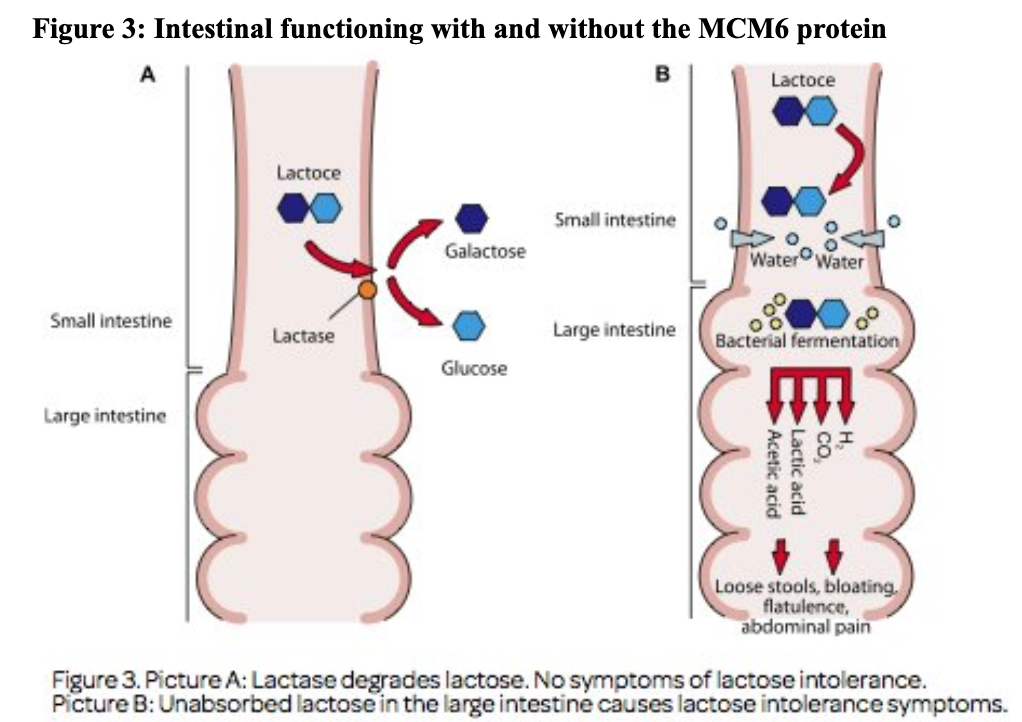
Make a claim to answer the following question… Will the function of the cells of the small intestine differ for someone who has a mutated MCM6 protein and someone who has a normal MCM6 protein?

Question 17
17.

Question 18
18.

Provide reasoning to tie your evidence to your claim. (restate your claim and discuss your evidence in full sentences!)

Question 19
19.

Make a claim to answer the following question… Will the feeling after eating dairy differ for someone who has a mutated MCM6 protein and someone who has a normal MCM6 protein?

Question 20
20.

Are you lactose intolerant (feel sick after dairy) or lactose tolerant (feel fine after dairy)?
I am lactose intolerant
I am lactose tolerant
Make a claim to answer the following question… Will the mRNA transcript for the MCM6 gene differ for someone who has a mutated MCM6 gene and someone who has a normal MCM6 gene?
The mRNA transcript for the MCM6 gene will not differ for someone who has a mutated MCM6 gene and someone who has a normal MCM6 gene.
The mRNA transcript for the MCM6 gene will differ for someone who has a mutated MCM6 gene and someone who has a normal MCM6 gene.
Provide reasoning to tie your evidence to your claim. (select the best answer below)
In transcription DNA polymerase makes a copy of a gene called mRNA using base pairing rules. If one person has the mutated gene with the sequence TAG-TTT-TTT-ATT they will have an mRNA strand that reads AUC-AAA-AAA-UAA which is different from a person with the normal gene sequence TAG-TCT-TTT-ATT, whose cells would make an mRNA transcript of AUC-AGA-AAA-UAA. Clearly, the second codon in each mRNA strand differs as a result of differing genes.
In transcription RNA polymerase makes a copy of a gene called mRNA using base pairing rules. If one person has the mutated gene with the sequence TAG-TTT-TTT-ATT they will have an mRNA strand that reads AUC-AAA-AAA-UAA which is different from a person with the normal gene sequence TAG-TCT-TTT-ATT, whose cells would make an mRNA transcript of AUC-AGA-AAA-UAA. Clearly, the second codon in each mRNA strand differs as a result of differing genes.
In transcription RNA polymerase makes a copy of a gene called mRNA using base pairing rules. If one person has the mutated gene with the sequence TAG-TTT-TTT-ATT they will have an mRNA strand that reads UAC-UUU-UUU-AUU which is different from a person with the normal gene sequence TAG-TCT-TTT-ATT, whose cells would make an mRNA transcript of AUC-AGA-AAA-UAA. Clearly, the entire mRNA sequence is different as a result of a single nucleotide difference in the gene.
In transcription RNA polymerase makes a copy of a gene called mRNA using base pairing rules. If one person has the mutated gene with the sequence TAG-TTT-TTT-ATT they will have an mRNA strand that reads AUC-AAA-AAA-UAA which is the same as a person with the normal gene sequence TAG-TCT-TTT-ATT, whose cells would make an mRNA transcript of AUC-AGA-AAA-UAA. Clearly, despite the differing of genes, the mRNA transcripts in each person would be the same.
Make a claim to answer the following question… Will the amino acid sequence for the MCM6 protein differ for someone who has a mutated MCM6 gene and someone who has a normal MCM6 gene?
The amino acid sequence for the MCM6 protein will differ for someone who has a mutated MCM6 gene and someone who has a normal MCM6 gene.
The amino acid sequence for the MCM6 protein will not differ for someone who has a mutated MCM6 gene and someone who has a normal MCM6 gene.
Provide reasoning to tie your evidence in number 8 to your claim in number 7.
The amino acid sequence for the MCM6 protein will not differ for someone who has a mutated MCM6 gene and someone who has a normal MCM6 gene. In translation, tRNA anticodons carrying amino acids are called to the ribosome by mRNA anticodons. If a person has a mutated gene they will have an mRNA strand that reads AUC-AAA-AAA-UAA which will call over tRNA anticodons that bring the following amino acids in the following order: Ile-Lys-Lys-Stop. This is the same as a person with the normal gene sequence who will have an mRNA strand that reads AUC-AGA-AAA-UAA and will call over tRNA anticodons that bring the following amino acids in the following order: Ile-Arg-Lys-Stop.
The amino acid sequence for the MCM6 protein will differ for someone who has a mutated MCM6 gene and someone who has a normal MCM6 gene. In translation, tRNA anticodons carrying amino acids are called to the ribosome by mRNA codons. If a person has a mutated gene they will have an mRNA strand that reads AUC-AAA-AAA-UAA which will call over tRNA anticodons that bring the following amino acids in the following order: Ile-Lys-Lys-Stop. This is different from a person with the normal gene sequence who will have an mRNA strand that reads AUC-AGA-AAA-UAA and will call over tRNA anticodons that bring the following amino acids in the following order: Ile-Arg-Lys-Stop.
The amino acid sequence for the MCM6 protein will differ for someone who has a mutated MCM6 gene and someone who has a normal MCM6 gene. In transcription, mRNA anticodons carrying amino acids are called to the ribosome by tRNA anticodons. If a person has a mutated gene they will have an mRNA strand that reads AUC-AAA-AAA-UAA which will call over tRNA anticodons that bring the following amino acids in the following order: Stop- Phe-Phe- Ile. This is different from a person with the normal gene sequence who will have an mRNA strand that reads AUC-AGA-AAA-UAA and will call over tRNA anticodons that bring the following amino acids in the following order: Stop- Ser- Phe- Ile.
Provide reasoning to tie your evidence to your claim.
The shape of the MCM6 protein will differ for someone who has a mutated MCM6 gene and someone who has a normal MCM6 gene. As shown in figure 2, the mutated MCM6 protein has a circular shape while the normal MCM6 gene has a scissor like shape. This is a result of the differing amino acid sequences coded for by each gene. The order of amino acids determines the shape into which the protein will fold.
The shape of the MCM6 protein will not differ for someone who has a mutated MCM6 gene and someone who has a normal MCM6 gene. As shown in figure 2, the mutated MCM6 protein has a circular shape while the normal MCM6 gene also has a circular shape. Despite the differences in DNA nucleotide sequence, the proteins fold the same.
The shape of the MCM6 protein will differ for someone who has a mutated MCM6 gene and someone who has a normal MCM6 gene. As shown in figure 2, the mutated MCM6 protein has a circular shape while the normal MCM6 gene has a scissor like shape.
Provide evidence to defend your claim above. (see the background information (paragraph 2) for evidence)
- the normal MCM6 protein will turn off the lactase gene - the mutated MCM6 protein will not turn off the lactase gene -lactase breaks down lactose so it is more easily digested
- the mutated MCM6 protein will break down lactose so it is more easily digested - the normal MCM6 protein will not break down lactose so it is more difficult to digest.
- both the normal MCM6 protein and the mutated MCM6 protein will turn off the lactase gene
Provide reasoning to tie your evidence to your claim.
The function of the MCM6 protein will differ for someone who has a mutated MCM6 gene and someone who has a normal MCM6 gene. As described in the background information, a normal MCM6 gene will turn off the lactase gene after a child turns a certain age. A mutated MCM6 gene on the other hand will not be able to turn of the lactase gene and it will remain on.
The function of the MCM6 protein will not differ for someone who has a mutated MCM6 gene and someone who has a normal MCM6 gene. As described in the background information, a normal MCM6 protein will turn off the lactase gene after a child turns a certain age, a mutated MCM6 protein will do the same.
Provide evidence to defend your claim above. (Select all relevant pieces of evidence)
- in someone with a normal MCM6 protein, the cells of the small intestine cannot break lactose into glucose and galactose and it continues through the intestines.
-Normal MCM6 proteins have a scissor shape, mutated MCM6 proteins have a circular shape.
-The amino acid sequence for a mutated MCM6 protein is Ile-Arg-Lys-Stop.
- The gene sequence for a normal MCM6 protein is TAG-TCT-TTT-ATT
- in someone with a mutated MCM6 protein, the cells of the small intestine break lactose into glucose and galactose and it is absorbed into the body cells.
Provide evidence to defend your claim above. (Select all that are applicable)
The amino acid sequence for a mutated MCM6 protein is Ile-Arg-Lys-Stop.
The gene sequence for a normal MCM6 protein is TAG-TCT-TTT-ATT
A person who has the mutated MCM6 protein feels normal after drinking lactose.
Normal MCM6 proteins have a scissor shape, mutated MCM6 proteins have a circular shape.
A person who has the normal MCM6 protein feels nautious, gassy, bloated, short of breath and crampy when they drink lactose.