Log in
Sign up for FREE
arrow_back
Library

Unit 3 Exam Review

star
star
star
star
star
Last updated almost 5 years ago
47 questions
1
1
1
1
1
1
1
1
1
1
1
1
1
1
1
1
1
1
1
1
1
1
1
1
1
1
2
2
1
2
1
1
1
1
1
1
Question 1
1.

Question 2
2.

Question 3
3.

Question 4
4.

Question 5
5.

Question 6
6.

Question 7
7.

Question 8
8.

Question 9
9.

Question 10
10.

Question 11
11.

Question 12
12.

Question 13
13.

1
1
1
1
1
Question 19
19.

Question 20
20.

Question 21
21.

Question 22
22.

1
1
1
1
1
1
Question 29
29.

Question 30
30.

Question 31
31.

Question 32
32.

Question 33
33.

Question 34
34.

Question 35
35.

Question 36
36.

Question 37
37.

Question 38
38.

Question 39
39.

Question 40
40.

Question 41
41.

Question 42
42.

Question 43
43.

Question 44
44.

Question 45
45.

Question 46
46.

Question 47
47.

Please explain EVERYTHING happening in the image in as much DETAIL as possible!

You have been planking for one minute now, you feel a burning sensation in your core because...
Your muscles don't have enough calcium
Lactic acid is building up
You are eating too little protein
More ATP than normal is being made
Concentric contraction is...
When the muscle lengthens under contraction.
When the muscle shortens under contraction.
When the muslc remains the same length while contracting.
Which of the following describes eccentric contractions? (select all that apply Hint: you should select 3 answers)
When the muslc remains the same length while contracting.
When the muscle shortens under contraction.
When the muscle lengthens under contraction.
Isometric
The muscle acts as a break, while another muscle pulls
Isotonic
You fell in cheer practice and broke your left arm 2 months ago. Today your cast comes off and your bicep is small?!
atrophy
hypertrophy
You just finished summer league training for football. You go to put your jeans on and they don't fit....why?
The number of muscle fibers increased in your leg muscles.
The number of actin and myosin strands in your leg muscles increased
The endomysium of your leg muscles began to thicken
More mitochondria are now in your leg muscles
Which of the following is an example of Isometric contraction?
Calf raises
Breathing
Swimming
Plank
Involuntary contractions of muscles can lead to
Hypertrophy
Spasms and Cramps
Muscle Fatigue
Atrophy
Which of the following is a eccentric movement of the bicep?
Raising a water bottle from the table to your mouth
Holding a water bottle straight out in front of you
Lowering a water bottle from your face to the table.
You just finished summer league training for soccer. Your leg muscles are larger then ever because they experienced..
Atrophy
Hypertrophy
Fascia tapers off at the ends of skeletal muscles to form ___ which connects the skeletal muscle to a bone.
Endomysium
Tendon
Ligament
Perimysium
The many tubes that fill a muscle fiber, and themselves are made up of long strands of protein filaments
Nuclei
Sarcolemma
Actin
Sarcoplasmic Reticulum
Sarcomere
Sarcoplasm
Z- Line
Myosin
Myofibril
T-Tubules
These make the striations as you can see in the image shown. They are made up of actin.
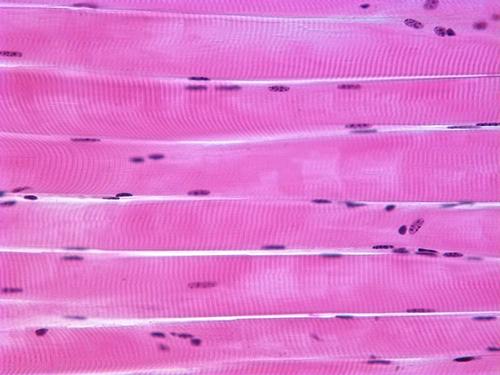
T-Tubules
Myofibril
Sarcoplasmic Reticulum
Nuclei
Myosin
Z- Line
Sarcolemma
Sarcoplasm
Actin
Contracting units of a muscle made up of actin and myosin, that extend from Z-line to Z-line.
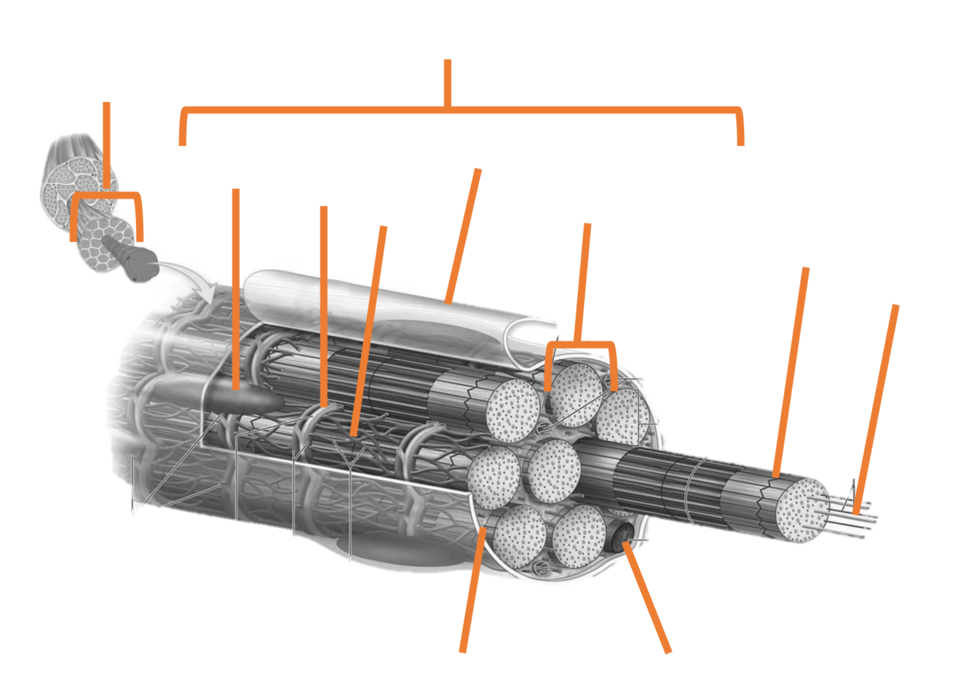
Myofibril
Actin
Myosin
Z- Line
Sarcomere
T-Tubules
Sarcoplasmic Reticulum
Sarcoplasm
Sarcolemma
Nuclei
Question 14
14.
Question 15
15.
Question 16
16.
Question 17
17.
Question 18
18.
The layers of connective tissue in a skeletal muscle, in order of innermost to outermost are:
Endomysium, Perimysium, Epimysium
Epimysium, Endomysium, Perimysium
Endomysium, Epimysium, Perimysium
Perimysium, Epimysium, Endomysium
Epimysium, Perimysium, Endomysium
Perimysium, Endomysium, Epimysium
The perimysium surrounds
muscle fibers
fascicles
the entire muscle
The endomysium surrounds
muscle fibers
the entire muscle
fascicles
The epimysium surrounds
fascicles
the entire muscle
muscle fibers
Question 23
23.

Question 24
24.
Question 25
25.
Question 26
26.
Question 27
27.
Question 28
28.
Letter _____ would be found in a muscle like your latissimus dorsi, a large muscle on your back which makes imprecise movements. This is a large motor unit.
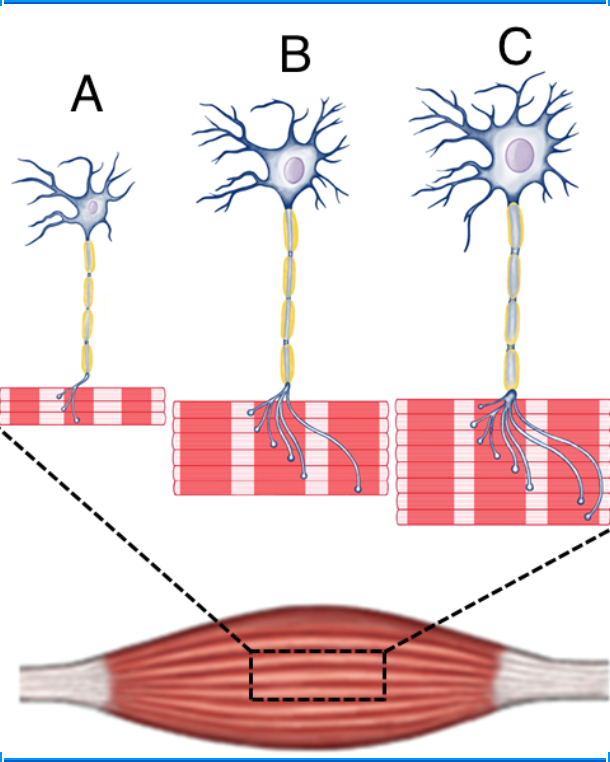
B
A
C
Which of the following correctly describes the events that happen directly after acetylcholine binds the motor end plate?
The synaptic vesicles release ACh out of the axon terminal and into the synaptic cleft.
Sodium and potassium move through the sarcolemma.
The myosin binds to the actin pulling the Z-lines closer together
The action potential travels through the T-tubles triggering the sarcoplasmic reticulum to release calcium.
Which of the following statements is true? Use the image to help you!
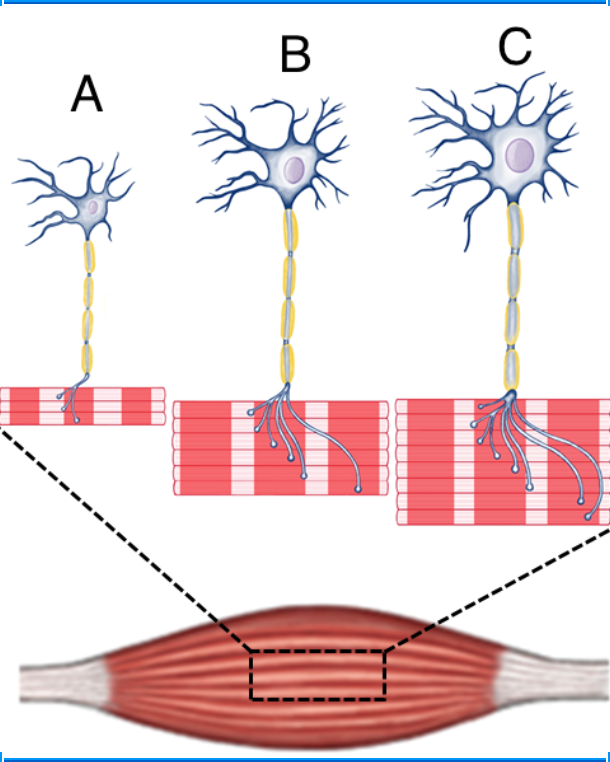
Each muscle fiber has MANY motor end plates.
A muscle fiber can attach to MANY motor neurons.
A motor neuron can attach to MANY muscle fibers.
A motor neuron can only attach to ONE muscle fiber.
A motor neuron is labeled by number....
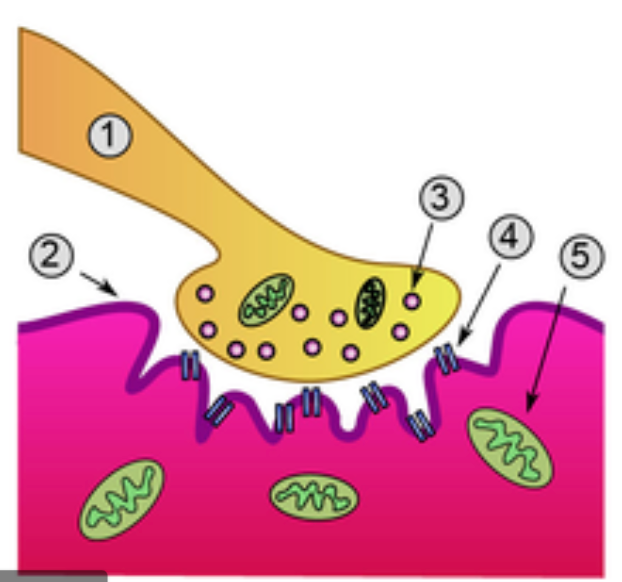
1
2
3
4
5
Acetylcholine is released by number ________.
1
2
3
4
5
The synaptic cleft is the gap between the axon terminal and the motor end plate of the sarcolemma. The motor end plate is labeled by number
1
2
3
4
5
Acetylcholine receptors are labeled by number....
1
2
3
4
5
In the myofibril cross section shown below, letter C labels __________ .
H zone
Z-line
myofibril
myosin
sarcoplasm
a sarcomere
actin
When doing a bicep curl, as you pull the weight in your hand up toward your shoulders, the Tricep acts as....
The antagonist
The prime mover
The synergist
Put the following steps in order:
Actin binding sites are free
Tropomyosin shifts
Calcium binds to troponin
A cross bridge is formed
Troponin changes shape
Once a cross bridge is formed, a powerstroke takes place in which _____________________and ______________.
myosin pulls actin, ATP binds
actin pulls myosin, ADP and P fly off
myosin pulls actin, ADP and P fly off
myosin pulls actin, ATP breaks
actin pulls myosin, ATP breaks
actin pulls myosin, ATP binds
"A few hours after a person or animal dies, the joints of the body stiffen and become locked in place. This stiffening is called rigor mortis. It's only a temporary condition. Depending on body temperature and other conditions, rigor mortis lasts approximately 72 hours. The phenomenon is caused by the skeletal muscles partially contracting. The muscles are unable to relax, so the joints become fixed in place."

After a person is dead, their cells no longer produce the energy form needed to break a cross bridge, so the actin and myosin stay contracted producing tone. Which of the following is unable to happen in a person once dead, to break the cross bridge, causing this condition?
ATP binds to myosin
ADP and P fly off actin
ADP and P fly off myosin
ATP binds to actin
ATP breaks down into ADP and P
Calcium released from the _________ binds to __________.
T-tubules, B
Sarcolemma, D
Sarcolemma, A
Sarcoplasmic Reticulum, D
Sarcoplasmic Reticulum, C
Sarcolemma, B
T-tubules, D
Sarcoplasmic Reticulum, A
Sarcoplasmic Reticulum, B
Sarcolemma, C
T-tubules, C
T-tubules, A
In the myofibril cross section shown below, letter A labels _________ .
Z-line
sarcoplasm
H zone
myofibril
myosin
actin
a sarcomere
In the myofibril cross section shown below, letter B labels _________ .
a sarcomere
actin
myofibril
myosin
H zone
sarcoplasm
Z-line
In the myofibril cross section shown below, letter E labels _________ .
a sarcomere
actin
myofibril
Z-line
myosin
sarcoplasm
H zone
In the myofibril cross section shown below, letter D labels _________ .
actin
H zone
sarcoplasm
a sarcomere
myosin
myofibril
Z-line
Which of the following occurs during muscle relaxation?
Calcium is pumped into the sarcoplasmic reticulum
T-tubules stimulate the sarcoplasmic reticulum
Acetylcholine crosses the synaptic cleft
Actin binding sites are freed.
Myofibril
Fascicle
Muscle fiber
Actin
Myosin
Sarcoplasm
Sarcomere
Sarcoplasmic Reticulum
Z-line
Sarcolemma
Nuclei
T-Tubules
Blood Vessels
Myosin
Sarcoplasmic Reticulum
Sarcoplasm
Actin
Z-line
Muscle fiber
Myofibril
Blood Vessels
Sarcolemma
Fascicle
Sarcomere
T-Tubules
Nuclei
Sarcomere
Sarcoplasm
Actin
Myosin
Myofibril
Z-line
Sarcoplasmic Reticulum
Fascicle
Blood Vessels
Nuclei
Muscle fiber
Sarcolemma
T-Tubules
Myosin
Sarcolemma
Sarcoplasmic Reticulum
Sarcomere
Sarcoplasm
Actin
Fascicle
Nuclei
Muscle fiber
Z-line
Myofibril
Blood Vessels
T-Tubules
Sarcoplasm
Sarcolemma
Myofibril
Actin
Z-line
Muscle fiber
Fascicle
Sarcomere
Blood Vessels
Nuclei
Sarcoplasmic Reticulum
T-Tubules
Myosin
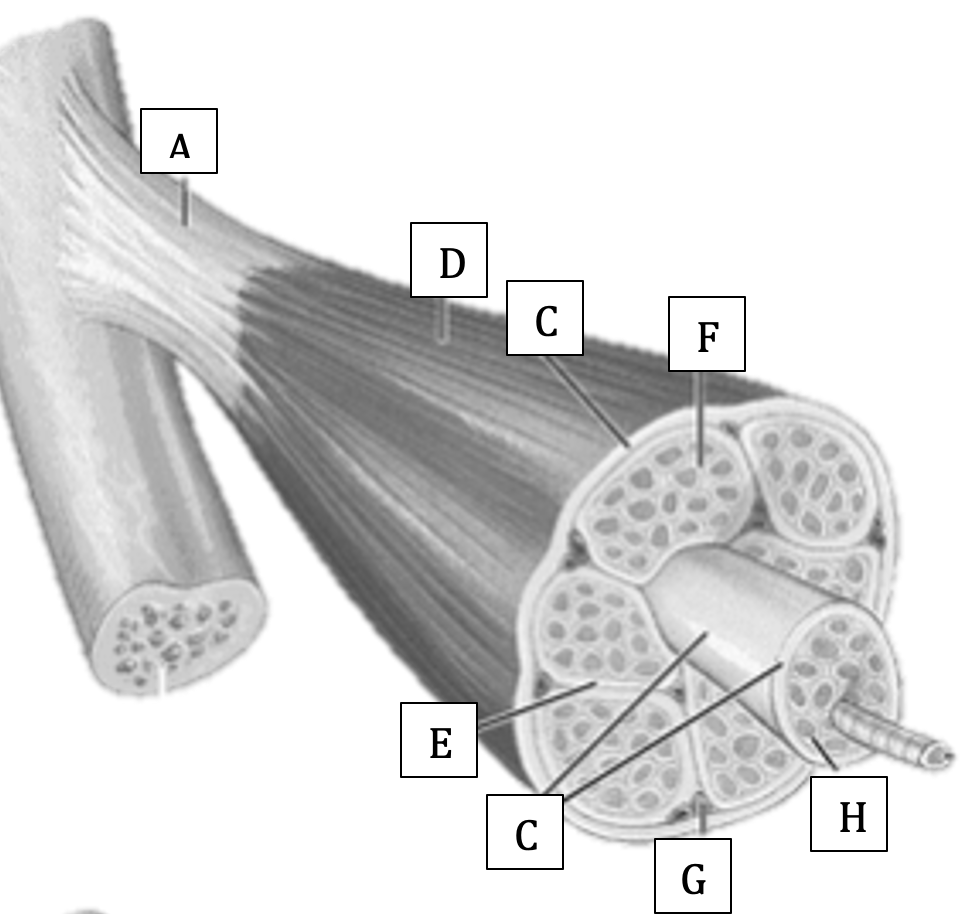
Hint: bundle of muscle fibers
Fascicle
Perimysium
Blood Vessels
Fascia
Muscle Fiber
Endomysium
Epimysium
Tendon
Perimysium
Epimysium
Tendon
Fascicles
Fascia
Blood Vessels
Muscle Fiber
Endomysium
Tendon
Fascicles
Perimysium
Fascia
Blood Vessels
Epimysium
Muscle Fiber
Endomysium
Muscle Fiber
Perimysium
Epimysium
Endomysium
Fascia
Blood Vessels
Tendon
Fascicles
Epimysium
Muscle Fiber
Endomysium
Fascicles
Fascia
Tendon
Perimysium
Blood Vessels
Fascicles
Perimysium
Endomysium
Tendon
Fascia
Muscle Fiber
Blood Vessels
Epimysium