Ms. Little's Global History I Pre-Assessment

Last updated over 5 years ago
7 questions
Hi Scholars,

It is Ms. Little. Today, you will take a pre-assessment. I will use your test results to place you into small groups that you will stay in until quint 1 is complete. Remember if you need technical support, you can email me at: askhari.little@capitalprepharlem.org or text me at 917.310.4142. Please do not use anything but your own brains and the resources I have provided for you below. This is a strictly independent assignment. If at all possible, please complete this assignment in one sitting so that you are focused. Remember to check over your work with the criteria for sucess writing rubric that I have provided to you below. Please do your absolute best, as I believe in your greatness! 🤩 We will complete this assignment in class on Friday, September 11, 2020 at 8AM. It is due in its entirety no later than Saturday, September 12 at 7AM.

Before getting started, I'd suggest eating a healthy snack and doing the meditation practice below to get rid of any jitters if you'd like.
1

Part 1: 1 Paragraph
Question: Should we study history? Why or why not? Answer in paragraph form. (1 paragraph = 5 to 7 sentences)

2

PART 2: Short Response
Directions: Read the text to answer the question below.

Document 1
In 1492, a sailor named Christopher Columbus sailed west from Europe hoping to find a direct route to Asia. The voyage was funded by Isabella and Ferdinand, the King and Queen of Spain. They hoped to gain power and wealth if Columbus was successful. Instead of finding a route to Asia, Columbus landed on islands in the Caribbean. The following is an excerpt of a letter Columbus wrote to Lord Raphael Sanchez, Isabella and Ferdinand’s royal Treasurer who was responsible for managing Spain’s money.

-----------------------------------------------------------------------------------------

Knowing that it will afford you pleasure to learn that I have brought my undertaking to a successful termination [end], I have decided upon writing you this letter to acquaint [inform] you with all the events which have occurred in my voyage, and the discoveries which have resulted from it.
Thirty-three days after my departure from Cadiz I reached the Indian sea, where I discovered many islands, thickly peopled, of which I took possession without resistance in the name of our most illustrious Monarch [King Ferdinand]...

…. On my arrival at that sea, I had taken some Indians by force from the first island that I came to, in order that they might learn our language, and communicate to us what they knew respecting the country; which plan succeeded excellently, and was a great advantage to us, for in a short time, either by gestures and signs, or by words, we were enabled to understand each other. These men are still travelling with me, and although they have been with us now a long time, they continue to entertain the idea that I have descended from heaven; and on our arrival at any new place they published this, crying out immediately with a loud voice to the other Indians, “Come, come and look upon beings of a celestial [godly] race”: upon which both women and men, children and adults, young men and old, when they got rid of the fear they at first entertained, would come out in throngs, crowding the roads to see us, some bringing food, others drink, with astonishing affection and kindness. ….

I promise, that with a little assistance afforded me by our most invincible sovereigns [King Ferdinand and Queen Isabella],  I will procure [get] them as much gold as they need, as great a quantity of spices, of cotton... and as many men for the service of the navy as their Majesties may require. I promise also rhubarb and other sorts of drugs….

Letter from Christopher Columbus to Raphael Sanchez, March 14, 1493 from Select letters of Christopher Columbus: with other original documents, relating to his four voyages to the New World, translated and edited by Richard Henry. Major, 1847 found on archive.org

Question: Using document 1, explain how audience affects the way Christopher Columbus writes about his voyage. Answer in short response format (R.A.C.E. method) and provide evidence from the text.

…
2

PART 3: Enduring Issues Response

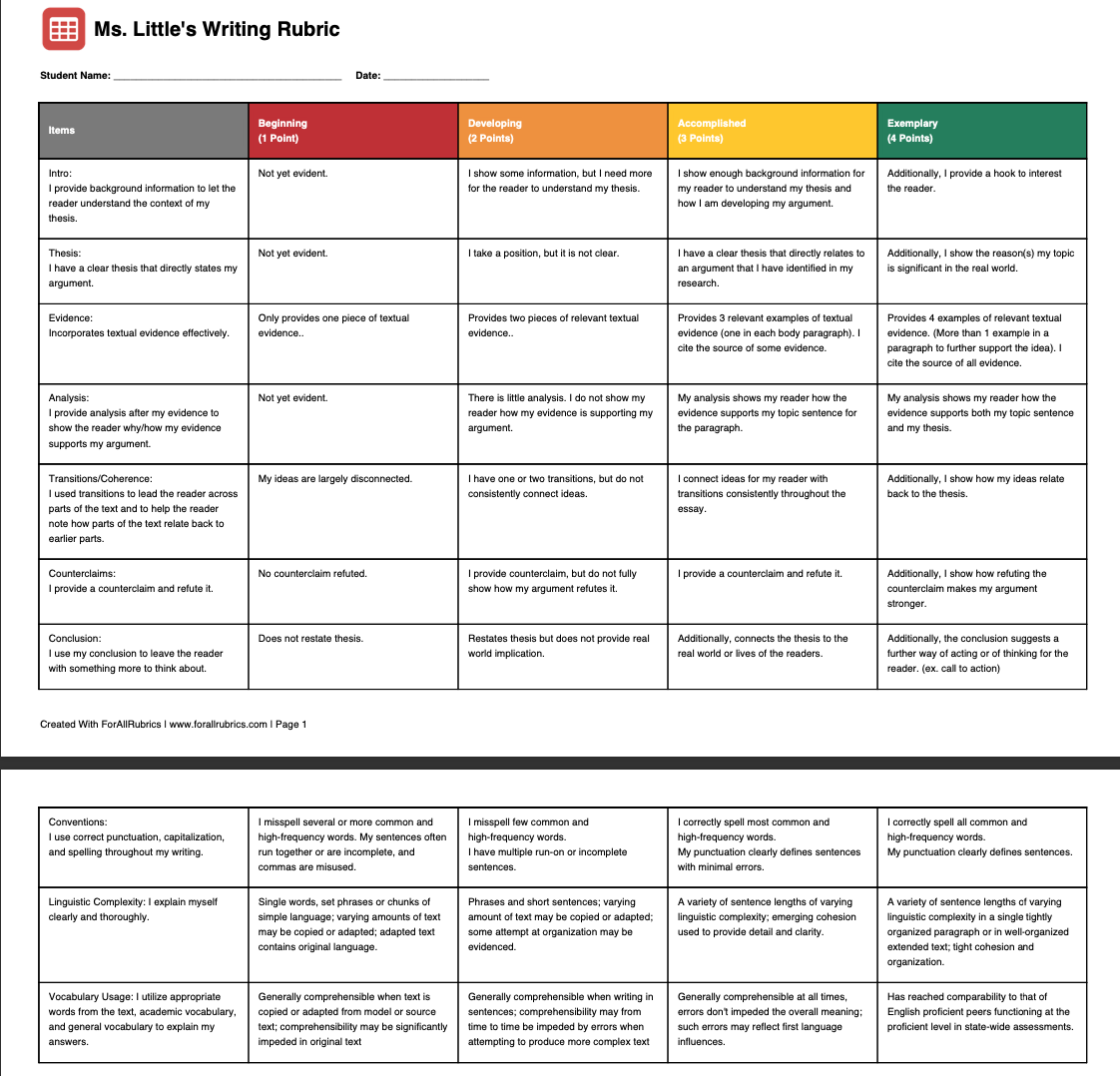
Based on these documents (3 Documents total), what is a challenge or problem that ALL of those societies have faced across time? (At least 2 paragraphs/10-14 sentences)

Document 1 - Black Death
The Black Death, also known as the Black Plague, was a devastating disease that started in China and spread to large portions of Asia, the Middle East, and Europe in the 14th century (1300s). In Europe, it killed between â…“ and â…” of the population, depending on the region. In total around the world, at least 75 million people were killed by the disease in the mid 1300s.

Origins and Spread of the Black Death in Asia
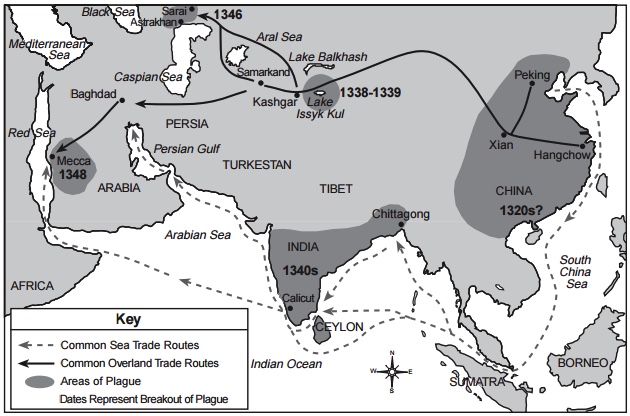
Source: Melissa Snell, “Origins and Spread of the Black Death in Asia,” Medieval History, About.com (adapted) from the NYS Global History and Geography Regents Exam, June, 2014.
--------------------------------------------------------------------------------------------------------------------------------------------------------------
Document 2 - Diseases Christopher Columbus Brought
In 1492, Christopher Columbus sailed west across the Atlantic Ocean and landed in the West Indies. As a result of his journey, Europeans from countries like Portugal, England, Spain, and France wanted to take over the Americas which was controlled by Native Americans. Contact between Europeans and Native Americans increased, sometimes through trade and sometimes through conflict.  When Europeans came to the Americas they brought diseases with them that the people living in the Americas had never encountered. Smallpox was the most deadly of those diseases and contributed to the information presented in the graph below.
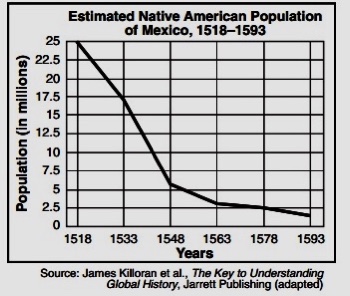
Source: James Killoran et al, The Key to Understanding Global History, Jarrett Publishing (adapted)  from the NYS Global History and Geography Regents Exam, June 2003.
--------------------------------------------------------------------------------------------------------------------------------------------------------------
Document 3 - SARS Outbreak
In 2003, an outbreak of severe acute respiratory syndrome (SARS) that started in southeastern China spread around the world infecting 8000 people in 26 countries. SARS was most likely transmitted from a live animal sold at a market in southeast China to humans in November, 2002 and spread amongst the population in that region.  On February 21, 2003 a doctor from that part of China spent one night in a hotel in Hong Kong, where he transmitted the disease to sixteen other guests. Those guests took planes to other places which led to outbreaks in Hong Kong, Toronto, Singapore and Vietnam. Withing weeks SARS had infected people in North America, Europe, South Africa, Australia, and most of Central , East, and Southeast Asia.
Arrows in the map below show the paths followed by the virus in the transmission of the infection from Hong Kong to the other countries. The thickness of the arrows represents the probability associated to a given path.Two different colors are used: black for paths that transmit the virus directly from the seed – Hong Kong – to the first level of infected countries; gray for paths that start from the first level of infected countries.
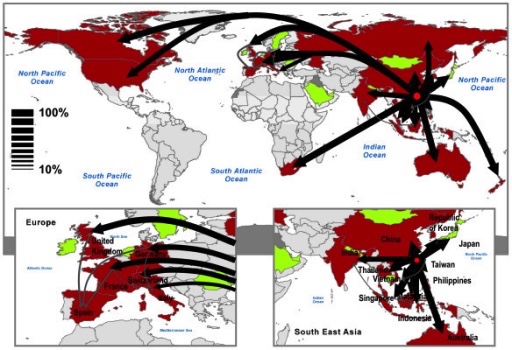
Source: US National Library of Medicine, National Institutes of Health, “Global Transport Networks and Infectious Disease Spread.” 2011. Open access license.

Question:
Based on documents 1-3 (1: Black Death, 2: Diseases Christopher Columbus Brought, and 3: SARS Outbreak), what is at least one challenge or problem that all 3 of those societies have faced across time? Write using at least 2 paragraphs/10-14 sentences and reference evidence from all 3 documents.
…
Woo-Hoo! You've made it to the end of the pre-assessment. ✅🔰🔋
Take a 3 minute rest, and then take a moment to answer these following reflection questions in 1-3 sentences.
0

To complete, press "show your work", then choose scribble or shapes to circle your answer.

0

What was easy about this pre-assessment? Why?

0

What was hard about this pre-assessment? Why?

0

What did you do when you are confused about what you are reading or how to write the response?